Understanding solar cell band diagram

3 replies · 3K views · last reply
Hamidreza
Messages
1
Reaction score
0
Hi everyone, I have been studying the physics of solar cells for a long time. The only thing that I can not completely understand is the physical operation of solar cell based on band diagram.
Can anyone briefly explain the movements of carriers from one electrode to the another based on band diagram?
Layer diagram of a two-junction tandem solar cell: top InGaP cell 1.86-1.9eV, GaAs tunnel diode, bottom GaAs cell 1.42-1.43eV, GaAs substrate, with anode contact at top and cathode contact at bottom, showing layer thicknesses and doping levels.

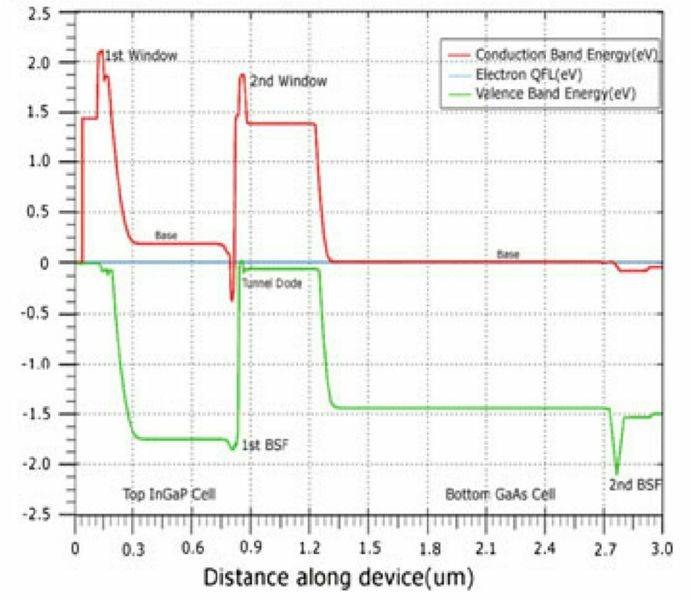
Band diagram of a two-junction InGaP/GaAs solar cell plotting conduction band energy, electron quasi-Fermi level and valence band energy in eV against distance along the device in micrometres, with labelled top InGaP cell, tunnel diode, bottom GaAs cell, windows, base and BSF regions.
 
Attachments
  • Layer diagram of a two-junction tandem solar cell: top InGaP cell 1.86-1.9eV, GaAs tunnel diode, bottom GaAs cell 1.42-1.43eV, GaAs substrate, with anode contact at top and cathode contact at bottom, showing layer thicknesses and doping levels.
    IMG_20180311_202159_438.jpg
    46.5 KB · Views: 1,504
  • Band diagram of a two-junction InGaP/GaAs solar cell plotting conduction band energy, electron quasi-Fermi level and valence band energy in eV against distance along the device in micrometres, with labelled top InGaP cell, tunnel diode, bottom GaAs cell, windows, base and BSF regions.
    IMG_20180311_202157_156.jpg
    46.3 KB · Views: 1,646
Hamidreza said:
Hi everyone, I have been studying the physics of solar cells for a long time. The only thing that I can not completely understand is the physical operation of solar cell based on band diagram.
Can anyone briefly explain the movements of carriers from one electrode to the another based on band diagram?
View attachment 221819
View attachment 221820
The 'cell' you have included with your post is not a single cell, but is in fact a multi-junction solar cell. The InGaP cell up to the tunnel diode acts as one photovoltaic cell, and the GaAs cell after the tunnel diode acts as a second cell.