Question's Diagram: Am I Right?

  • Thread starter Thread starter MatinSAR
  • Start date Start date
  • Tags Tags
    Diagram
Join the discussion
Ask a follow-up here, or get your own question answered by working scientists, mathematicians and engineers — people, not an autocomplete.
Real named experts · corrections over time · the nuance an AI answer skips
3 replies · 1K views
MatinSAR
Messages
673
Reaction score
207
Homework Statement
We condense some ideal gas from a volume of 30 liters and a pressure of 1 atmosphere to a volume of 10 liters and a pressure of 2 atmospheres. What is the volume of the gas when its temperature is maximum?
Relevant Equations
pV=nRT
Hello. This is question's diagram.
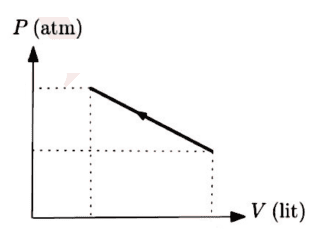
1674331087276.png

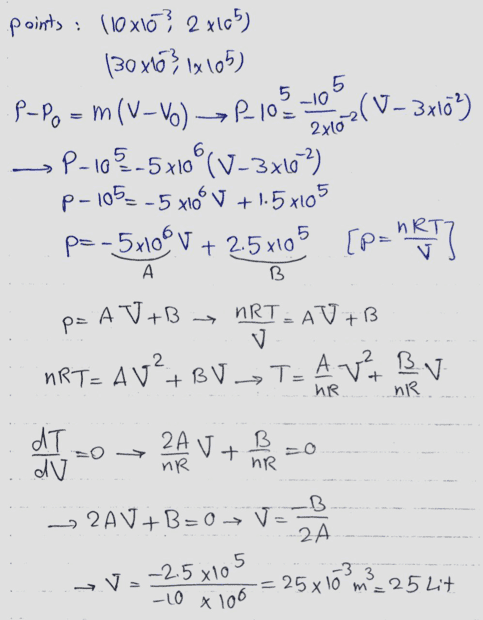
Can someone tell me if I am wrong ?

1674332589798.png
 
on Phys.org
MatinSAR said:
Homework Statement:: We condense some ideal gas
Presumably you mean 'compress'. 'Condense' means something different!

In addition to what @haruspex already said...

It's not necessary to use SI units here. You can work in 'atm' and 'lit' (though 'lit' is not a common abbreviation for litres) and you will get the same answer. It's less messy.

For example, the gradient of the line can immediately be written as ##\frac {-1}{20}## (corresponding to units of atm/lit).

Try it – and check you understand why it works here.
 
Reply
  • Like
Likes   Reactions: MatinSAR
haruspex said:
Looks ok, except that you did not check that it is a maximum. Could be a local minimum, in which case either the starting or finishing temperature would be the max.
I will use derivative test to prove it.
Thanks a lot for your help.
Steve4Physics said:
Presumably you mean 'compress'. 'Condense' means something different!
Sorry! I haven't spoken English for a long time and I didn't remember the correct word so I used google translate ...
Steve4Physics said:
It's not necessary to use SI units here. You can work in 'atm' and 'lit' (though 'lit' is not a common abbreviation for litres) and you will get the same answer. It's less messy.
Yes, thanks, I use SI units when I'm not sure if it's correct to use non-SI units.
Steve4Physics said:
For example, the gradient of the line can immediately be written as −120 (corresponding to units of atm/lit).

Try it – and check you understand why it works here.
Thanks a lot for your help ...
I will try this and I hope I will get similar result.
 
Reply
  • Like
Likes   Reactions: Steve4Physics