Understanding the Physics of a Cylinder Rolling Down a Slope

Click For Summary
SUMMARY

This discussion focuses on the physics of a cylinder rolling down a slope, specifically addressing the forces acting on the cylinder and the calculations for linear and angular acceleration. Key concepts include the free-body diagram, the role of gravitational forces, and the friction force represented by the coefficient of friction (μ). Participants express confusion regarding the correct application of these forces and the implications for the cylinder's motion, particularly concerning the no-slip condition and the relationship between linear and angular acceleration.

PREREQUISITES
  • Understanding of free-body diagrams in physics
  • Knowledge of Newton's laws of motion
  • Familiarity with rotational dynamics and angular acceleration
  • Concept of static friction and its role in motion
NEXT STEPS
  • Study the derivation of equations for linear and angular acceleration of rolling objects
  • Learn about the no-slip condition and its implications in rotational motion
  • Explore the relationship between frictional force and normal force in rolling motion
  • Investigate the effects of different slopes on the motion of rolling cylinders
USEFUL FOR

Students of physics, educators teaching mechanics, and anyone interested in understanding the dynamics of rolling objects and their motion on inclined planes.

TauMuon
Messages
1
Reaction score
0
I would appreciate some help on this question involving a cylinder rolling down a slope; I'm far from comfortable with the physics involved.

Question here:
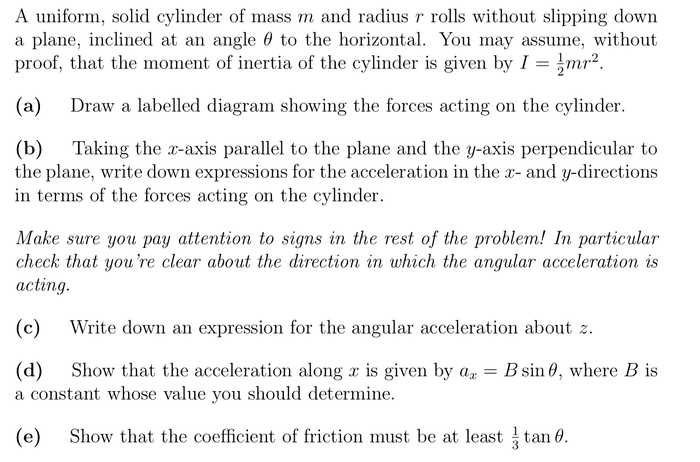
LjmIRSr.png


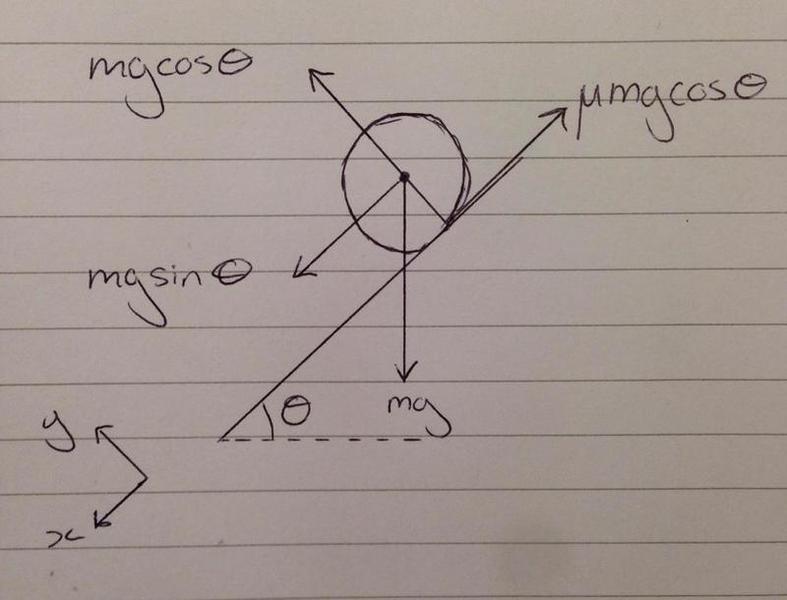
This is my free-body diagram of the forces acting on the cylinder:
tUNGtjV.jpg


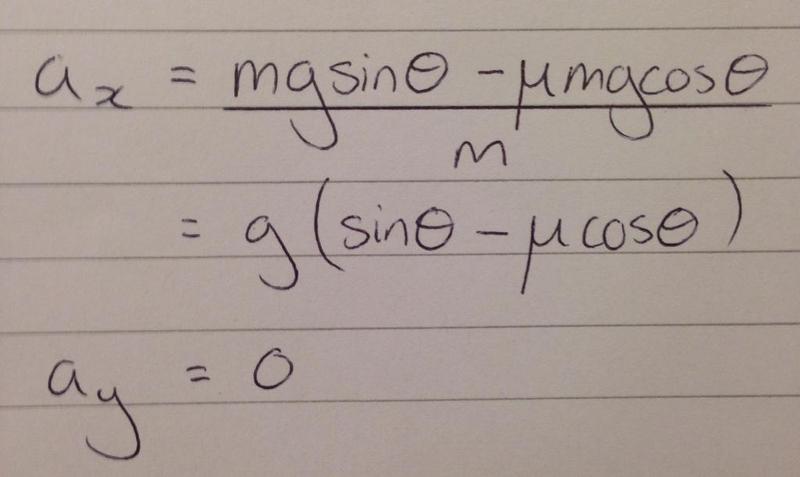
Expressions for the acceleration in the x- and y-directions in terms of the forces acting on the cylinder:
ihHqL6q.jpg


Now I think the above is okay. The following is where I get a bit lost...

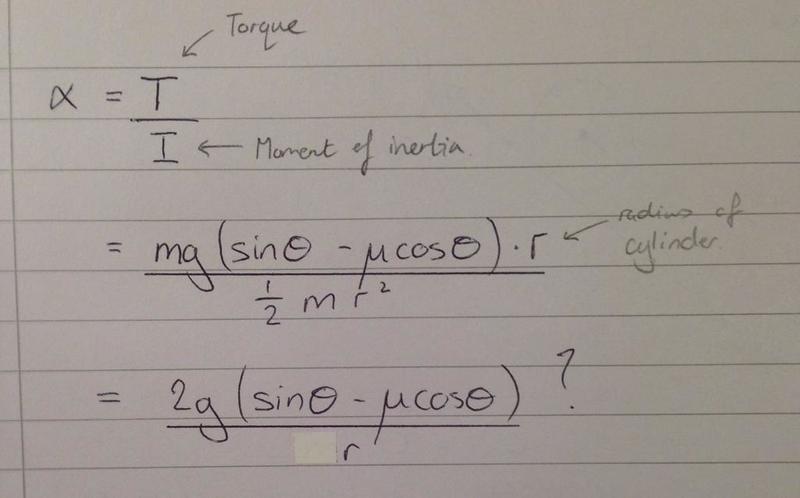
Expression for the angular acceleration:
rVkSqDe.jpg


Acceleration along x (didn't it already ask for this..?) :
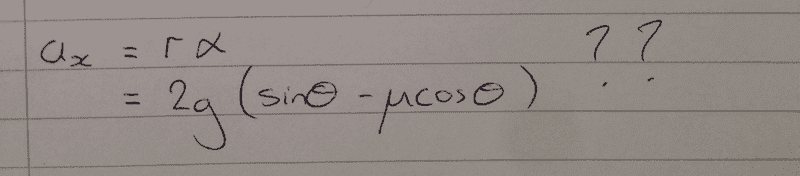
Et8k6F9.png


I really have no clue if the above is even remotely correct. I'm very fuzzy on the physics at the moment, so if someone could take the time to explain it to me I would be immensely grateful.

Thanks!
 
Physics news on Phys.org
RE diagram: it's a bit strange that ##m\vec g\cos\theta## is pointing upwards. After all, the vectors ##m \vec g\cos\theta## and ##m \vec g\sin\theta## should add up to ##m\vec g##

An unexplained ( :) ) ##\mu## pops up in the diagram.

If I take the diagram seriously, the cylinder should take off from the ramp in the vertical y-direction: forces don't add up to 0 (see first comment re diagram)

so much for a) and b).

c) there's ##\mu## again. For the friction force we usually write ##|\vec F_{fric, max}| = \mu |\vec F_N|## where ##\vec F_N## is the normal force. Hence my "confusion": the friction force let's the thing rotate, but perhaps the maximum friction force is more than is needed to satisfy the no-slip condition... So you want to wonder about this non-slipping and what it means for ##\alpha## and thereby for the friction force..
 

Similar threads

Replies
39
Views
4K
  • · Replies 6 ·
Replies
6
Views
2K
  • · Replies 7 ·
Replies
7
Views
4K
Replies
13
Views
2K
  • · Replies 9 ·
Replies
9
Views
2K
  • · Replies 97 ·
4
Replies
97
Views
6K
Replies
8
Views
6K
  • · Replies 2 ·
Replies
2
Views
2K
  • · Replies 7 ·
Replies
7
Views
2K
Replies
2
Views
1K