Understanding the Role of D1, C1, and Lm in a Boost-Flyback Converter

  • Thread starter Thread starter anhnha
  • Start date Start date
  • Tags Tags
    Converter
Click For Summary

Discussion Overview

The discussion revolves around the roles of components D1, C1, and Lm in a Boost-Flyback converter. Participants seek to clarify the function of these elements in the context of energy storage and transfer within the converter circuit.

Discussion Character

  • Technical explanation
  • Conceptual clarification
  • Debate/contested

Main Points Raised

  • One participant expresses confusion regarding the roles of D1 and C1, specifically how they relate to the energy stored in the transformer leakage inductance Ld.
  • Another participant explains that Lm represents the non-ideal leakage inductance of the transformer and that it stores energy similarly to Ld, which needs to be managed as the magnetic field collapses.
  • A different viewpoint suggests that leakage inductance may also include the inductance of the wiring or traces connecting the components, which could complicate the circuit if not designed properly.
  • One participant questions the interpretation of Ld and Lm, seeking clarification on whether they are physical inductors or conceptual representations of the transformer’s characteristics.
  • Another participant asserts that Lm is internal to the transformer while Ld is a real inductor, referencing an external source for further context.

Areas of Agreement / Disagreement

Participants do not reach a consensus on the definitions and implications of Ld and Lm, with multiple competing views presented regarding their physicality and roles in the circuit.

Contextual Notes

There are unresolved assumptions regarding the definitions of leakage inductance and the implications of circuit layout on performance. The discussion also highlights the potential complexity introduced by non-ideal components.

anhnha
Messages
179
Reaction score
1
I am reading about Boost-Flyback converter and this is a bit confusing.
Could you explain the role of D1 and C1 here?
The lecture says that "D1 and C1deliver to the output the energy stored in the transformer leakage inductance Ld." I can't understand what is meant here.
And could you explain why there is Lm there?
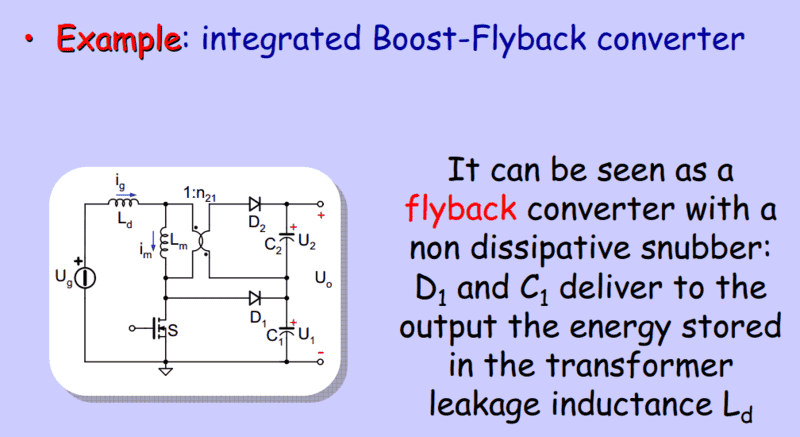
attachment.php?attachmentid=69500&stc=1&d=1399443252.png
 

Attachments

  • Boost-Fyback converter.PNG
    Boost-Fyback converter.PNG
    31.8 KB · Views: 804
Engineering news on Phys.org
Lm is the (non-ideal) leakage inductance of the transformer. You need to understand that first.
http://en.wikipedia.org/wiki/Leakage_inductance

The leakage inductance stores energy the same as Ld does, and that energy needs to go somewhere as the field collapses. It doesn't go through the transformer because that's what Lm is representing, the inductance of the transformer as seen from the primary.
 
I don't know your source for that circuit so take this as speculation.

I'd wager leakage inductance includes not only transformer leakage as pointed out by mBGuy, but inductance of the loop (of wires or pc traces) connecting transistor S to the power supply and transformer as well.
That inductance can be quite troublesome if the layout is not very good as in the first switcher i ever built.
That's clever, capturing its stored energy with D1-C1 and adding it to output. The dissipative snubbers in my amateur project got quite hot.
 
this isn't my field of expertise
so just wanting to learn...

mebigguy ... You are saying that Ld and Lm are not physical inductors but are the "product" of the primary of the 1:n transformer ?
At least I think that's what you are saying ?

Dave
 
I am saying Lm is inside the transformer. I think Ld is a real inductor.
http://www.ijrte.org/attachments/File/v2i6/F0948012614.pdf uses a series inductor for boost.
 
Last edited by a moderator:

Similar threads

  • · Replies 21 ·
Replies
21
Views
9K
  • · Replies 5 ·
Replies
5
Views
2K
Replies
18
Views
3K
  • · Replies 3 ·
Replies
3
Views
4K
Replies
6
Views
5K
  • · Replies 1 ·
Replies
1
Views
2K
  • · Replies 2 ·
Replies
2
Views
3K
  • · Replies 9 ·
Replies
9
Views
2K
  • · Replies 1 ·
Replies
1
Views
1K
  • · Replies 8 ·
Replies
8
Views
3K