Usage of Taylor's formula on stress analysis

Click For Summary
SUMMARY

The discussion focuses on the application of Taylor's formula in stress analysis, specifically in deriving the stress-equilibrium equation. Participants clarify that a truncated Taylor series expansion is utilized to express the forces acting on a cube in a stress field, with functions denoted as F1, F2, F3, F4, F5, and F6. The mathematical relations involve evaluating the stress tensor's variation with spatial position, leading to a differential force balance on the cube. This method is essential for understanding how forces exerted by surrounding materials influence stress distributions.

PREREQUISITES
  • Understanding of Taylor series expansion
  • Familiarity with stress tensors in continuum mechanics
  • Knowledge of differential calculus
  • Basic principles of force balance in solid mechanics
NEXT STEPS
  • Study the derivation of the stress-equilibrium equation using Taylor series
  • Learn about the application of truncated Taylor series in fluid mechanics
  • Explore the mathematical foundations of stress tensor analysis
  • Investigate differential force balance techniques in solid mechanics
USEFUL FOR

Mechanical engineers, materials scientists, and students studying continuum mechanics who seek to deepen their understanding of stress analysis and the application of Taylor's formula in engineering problems.

fisher garry
Messages
63
Reaction score
1
Moderator Note: Thread moved from forum Atomic, Solid State, Comp. Physic, so no homework template shown.
Uten navn.png


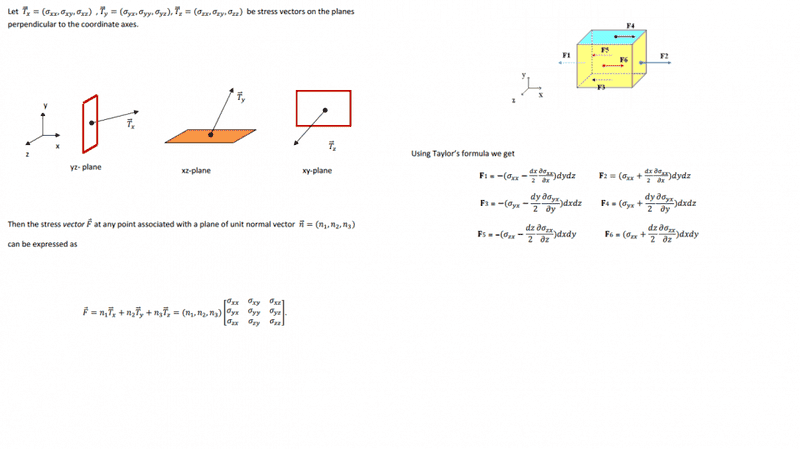
What function do they use Taylor's formula on? And can you show how they derive it? I know how one derives Taylor formula. Thanks! The text i taken from this page:http://ingforum.haninge.kth.se/armin/fluid/exer/deriv_navier_stokes.pdf
 
Last edited by a moderator:
Physics news on Phys.org
It isn't clear what you are asking. What exactly do you mean by Taylor's formula? Are you talking about the use of a Taylor series in stress to derive the stress-equilibrium equation?
 
Chestermiller said:
It isn't clear what you are asking. What exactly do you mean by Taylor's formula? Are you talking about the use of a Taylor series in stress to derive the stress-equilibrium equation?
They use Taylors formula on the functions ##F_1##, ##F_2##, ##F_3##, ##F_4##, ##F_5## and ##F_6##. Where do they get the formulas from and show how the Taylors formulas are used on the functions. I only wonder about the mathematical relations not about any understanding of stress-equiibriums.
 
Last edited:
fisher garry said:
They use Taylors formula on the functions ##F_1##, ##F_2##, ##F_3##, ##F_4##, ##F_5## and ##F_6##. Where do they get the formulas from and show how the Taylors formulas are used on the functions. I only wonder about the mathematical relations not about any understanding of stress-equiibriums.
They are making use of a truncated Taylor series expansion as follows:$$f\left(x+\frac{\Delta x}{2}\right)=f(x)+f'(x)\frac{\Delta x}{2}$$
$$f\left(x-\frac{\Delta x}{2}\right)=f(x)-f'(x)\frac{\Delta x}{2}$$

Assuming that the stress tensor varies with spatial position, they are finding the components of the forces exerted by the surrounding material on the 2 faces of the little cube that are perpendicular to the x axis. These two faces are located at ##x+\Delta x/2## and at ##x-\Delta x/2##, while the center of the cube is at x. So F1 is the normal component of force acting on the face at ##x-\Delta x/2##, and F2 is the normal component of force acting on the face at ##x+\Delta x/2##. They are doing all this so that they can do a differential force balance on the cube.
 

Similar threads

  • · Replies 9 ·
Replies
9
Views
2K
  • · Replies 1 ·
Replies
1
Views
2K
Replies
3
Views
3K
  • · Replies 18 ·
Replies
18
Views
2K
  • · Replies 4 ·
Replies
4
Views
3K
  • · Replies 3 ·
Replies
3
Views
19K
  • · Replies 1 ·
Replies
1
Views
2K
  • · Replies 8 ·
Replies
8
Views
3K
  • · Replies 4 ·
Replies
4
Views
5K
Replies
1
Views
2K