Using MOSFET in Saturation (as a switch)

Click For Summary
SUMMARY

This discussion focuses on the operation of MOSFETs as switches, specifically addressing the confusion surrounding the saturation and linear regions. The user observes that the MOSFET remains off until a gate voltage of approximately 2.5V, with the LED brightness stabilizing at around 4V. The conversation clarifies that for efficient switching, the MOSFET should operate in the linear (or triode) region, where the drain-source voltage (V(DS)) is low, allowing for maximum current flow. The distinction between the terminology used for BJTs and MOSFETs is also highlighted, emphasizing the need for clear understanding of these concepts.

PREREQUISITES
  • MOSFET operation principles
  • Understanding of gate-source voltage (V(GS)) and threshold voltage (V(TH))
  • Basic circuit analysis techniques, including load-line analysis
  • Familiarity with voltage divider circuits and their implications
NEXT STEPS
  • Study MOSFET characteristic curves and their implications for switching applications
  • Learn about load-line analysis for MOSFET circuits
  • Explore the differences between BJT and MOSFET operation regions
  • Investigate design strategies for optimizing MOSFET performance in switching applications
USEFUL FOR

Electronics enthusiasts, circuit designers, and engineers looking to deepen their understanding of MOSFET operation, particularly in switching applications.

saad87
Messages
83
Reaction score
0
I'm trying to learn about MOSFETs in order to use them as a switch. (note: this is not a homework/school question). On my breadboard, I have the following circuit hooked up:
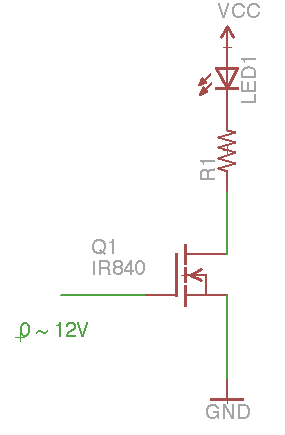
JQmsg.png


I vary the gate voltage using a potentiometer. Here is what confuses me: according to wikipedia, the MOSFET is in saturation when V(GS) > V(TH) and V(DS) > V(GS) - V(TH).

If I slowly increase the gate voltage starting from 0, the MOSFET remains off. The LED starts conducting a small amount of current when the gate voltage is around 2.5V or so. The brightness stops increasing when the gate voltage reaches around 4V. There is no change in the brightness of the LED when the gate voltage is greater then 4V.

I also monitor the Drain to Source voltage while I'm increasing the gate voltage. The drain to source voltage drops from 12V to close to 0V when the gate voltage is 5V or so. This is easy to understand: since R1 and R(DS) form a voltage divider and R1 is much larger than R(DS), most of the voltage is dropped on R1. In my measurements, around 10V is being dropped on R1 and the rest on the red LED (2V).

However, since V(DS) is now approximately 0, the condition V(DS) > V(GS) - V(TH) is not satisfied, is the MOSFET not in saturation? If so, what type of circuit do I need to make the MOSFET go into saturation?
 
Engineering news on Phys.org
Try drawing a load-line analysis. You will see that when Vgs-Vt is small (i.e. you are slightly above threshold), then the MOSFET is in saturation. In this case, most of the voltage is being dropped across the MOSFET. As you increase Vgs, the device will leave saturation and move down into the linear region, where most of the voltage is being dropped across the resistor, as you said.
 
Ah, so one moves from right to left in the graph! Am I correct in my understanding that, when used as a switch, the MOSFET should then reach the "linear" region as soon as possible?

This use of the word saturation is very confusing for me!
 
saad87 said:
However, since V(DS) is now approximately 0, the condition V(DS) > V(GS) - V(TH) is not satisfied, is the MOSFET not in saturation? If so, what type of circuit do I need to make the MOSFET go into saturation?

Hi Saad. I think your confusion arises from an unfortunate discrepancy in the way the regions of operation for a BJT and Mosfet are usually defined.

Both terminologies agree with what the "cut off" region is, however the terminology for the other two regions are pretty much swapped around.

- The "constant current" region is usually called the "active" or "linear" region for a BJT but is called the "saturation" region for the mosfet.

- The region where Vds/Vce in too low to sustain constant current operation is usually referred to as the "saturation" region in the BJT but is usually called either the "linear" or "triode" region in a mosfet.
 
Last edited:
saad87 said:
Ah, so one moves from right to left in the graph! Am I correct in my understanding that, when used as a switch, the MOSFET should then reach the "linear" region as soon as possible?

This use of the word saturation is very confusing for me!
This is a good sign that you are understanding the device operation in my opinion. The differing use of the term "saturation" is inherently confusing, at least to the beginner.
 
u2C07.png


This is the load line that I plotted. I measured the drain current (vertical axis) and the Drain to Source voltage (horizontal axis). I varied the Gate-Source voltage via potentiometer.

Now, I'm not going to confuse myself with saturation or linear/triode. I'm going to ask: in order for the MOSFET to work efficiently as a switch, the operating point should be towards the left-side on the load line.

Am I correct regarding this?

If one imposes the MOSFET characteristic curves on this graph, one could see that the operating point would be in the so-called triode region.

Do I get it? :(
 
Last edited:
I'm going to ask: in order for the MOSFET to work efficiently as a switch, the operating point should be towards the left-side on the load line.

Am I correct regarding this?

If one imposes the MOSFET characteristic curves on this graph, one could see that the operating point would be in the so-called triode region.

Yes that is correct.
 

Similar threads

  • · Replies 42 ·
2
Replies
42
Views
5K
Replies
39
Views
6K
  • · Replies 5 ·
Replies
5
Views
2K
Replies
0
Views
2K
  • · Replies 1 ·
Replies
1
Views
18K
  • · Replies 14 ·
Replies
14
Views
4K
  • · Replies 4 ·
Replies
4
Views
4K
  • · Replies 1 ·
Replies
1
Views
12K
  • · Replies 1 ·
Replies
1
Views
3K
  • · Replies 2 ·
Replies
2
Views
4K