Using Multiple integrals to compute expected value

Click For Summary

Homework Help Overview

The discussion revolves around the computation of expected values using multiple integrals, particularly in the context of random variables and their joint probability density functions (pdfs). Participants are examining the derivation of specific terms in an example and exploring the implications of independence and dependence between random variables.

Discussion Character

  • Exploratory, Conceptual clarification, Assumption checking, Mixed

Approaches and Questions Raised

  • Participants are questioning the complexity introduced by joint pdfs and suggesting simpler approaches by considering random variables separately. There are discussions about the independence of random variables and how this affects computations. Some participants are seeking clarification on specific terms and derivations presented in the example.

Discussion Status

The discussion is active, with participants providing insights and questioning assumptions about independence and the implications of certain mathematical statements. There is a mix of attempts to clarify misunderstandings and explore deeper implications of the concepts involved.

Contextual Notes

Some participants express confusion regarding the definitions and limits of variables involved, as well as the relevance of the random variables to practical scenarios, such as manufacturing processes. There are references to necessary reading materials and programming exercises to verify results, indicating a focus on practical application and understanding.
WMDhamnekar
MHB
Messages
378
Reaction score
30
Homework Statement
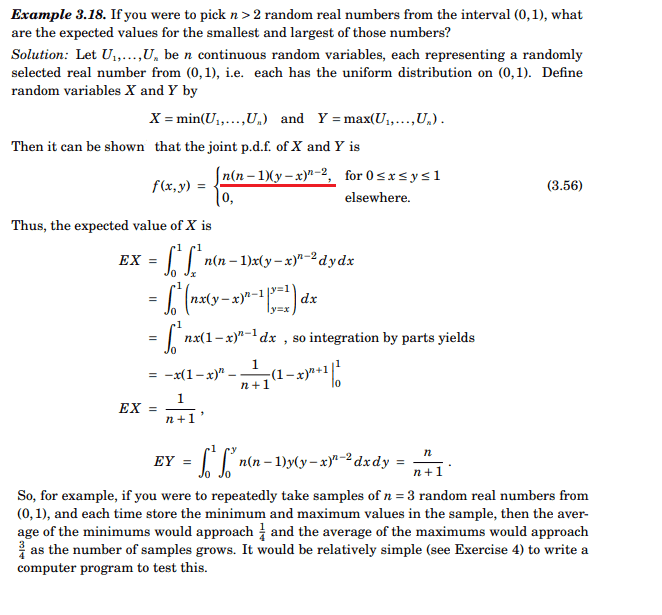
If you were to pick n > 2 random real numbers from the interval (0,1), what are the expected values for the smallest and largest of those numbers?
Relevant Equations
None
I want to know how did author derive the red underlined term in the following Example?

Probability,Expectedvalue.png
 
  • Like
Likes   Reactions: Delta2
Physics news on Phys.org
First, I'm not sure why the author invokes the complexity of a joint pdf. Try working on ##X## and ##Y## separately. It is much simpler.

The basic idea is that if ##X = x## and ##Y = y##, then all ##n## variables must be in the range ##y-x##.
 
  • Informative
Likes   Reactions: Delta2
Since the two RVs are independent, the computation should be straighforward. Otherwise, it can't be known without additional information. Edit. Please see my post #5 below. They are dependent.
 
Last edited:
WWGD said:
Since the two RVs are independent, the computation should be straighforward. Otherwise, it can't be known without additional information.
X and Y are certainly not independent.
 
My bad, I misread. Clearly Max> Min, so once y is selected, need X>Y.
 
WWGD said:
How so? How does knowing one change or affect the other . More formally:
Isn't ##P(M=Max| m=Min) \neq P(M=max)##?
No. For example, ##\lim_{x\to 0} E(Y|X=x) = (n-1)/n \neq n/(n+1) = E(Y)##. It should also be clear from the form of ##f(x,y)## that ##f(x,y) \neq f_X(x) f_Y(y)##.

However, all you need to know is that the ##U_i## are independent and uniformly distributed in (0,1).
 
  • Like
Likes   Reactions: PeroK
Orodruin said:
No. For example, ##\lim_{x\to 0} E(Y|X=x) = (n-1)/n \neq n/(n+1) = E(Y)##. It should also be clear from the form of ##f(x,y)## that ##f(x,y) \neq f_X(x) f_Y(y)##.

However, all you need to know is that the ##U_i## are independent and uniformly distributed in (0,1).
Yes, I rewrote and corrected in #5.
 
Orodruin said:
No. For example, ##\lim_{x\to 0} E(Y|X=x) = (n-1)/n \neq n/(n+1) = E(Y)##. It should also be clear from the form of ##f(x,y)## that ##f(x,y) \neq f_X(x) f_Y(y)##.

However, all you need to know is that the ##U_i## are independent and uniformly distributed in (0,1).
Following reading material is necessary to answer my questions. After reading the following material, you may answer my following questions and therby clear my doubts:
1) What is the meaning of 1 ?

2) How did author make 2 = ## n (n-1) (y-x)^{n-2}##

3) How to prove 3 ?
Order Statistics:
1655702900965.png

Kth Order Statistics:
1655702947844.png

1655703006370.png

1655703026208.png
 
1) Which part of (1) are you having trouble with? ##(-\infty,x]## and ##(x,\infty)## are intervals on the real line.

2) By inserting the distribution function for the random variables. For a stochastic variable uniformly distributed on (0,1) ##f(x) = 1## on that interval and consequently ##F(x) = x##.

3) Think about what that statement means in terms of the variables.
 
  • #10
Orodruin said:
1) Which part of (1) are you having trouble with? ##(-\infty,x]## and ##(x,\infty)## are intervals on the real line.

2) By inserting the distribution function for the random variables. For a stochastic variable uniformly distributed on (0,1) ##f(x) = 1## on that interval and consequently ##F(x) = x##.

3) Think about what that statement means in terms of the variables.
What is x? Why are its lower and upper limits ##-\infty## and ## + \infty## respectively?

Does x(any real number) relate to the size of n parts manufactured in the single run of assembly line?
 
Last edited:
  • #11
WMDhamnekar said:
What is x? Why are its lower and upper limits −∞ and +∞ respectively?
x is any real number.

The rest of your post is unclear to me in termms of what you are actually asking. Please keep your questions contained without branching out in all kinds of directions. This will help focus on particular misunderstandings and issues.
 
  • #12
WMDhamnekar said:
What is x? Why are its lower and upper limits ##-\infty## and ## + \infty## respectively?

Does x(any real number) relate to the size of n parts manufactured in the single run of assembly line?
x is the length of a manufactured part.
 
  • Informative
Likes   Reactions: WMDhamnekar
  • #13
How to write a computer program in any language (octave, Java, C,C++) that verifies the results in this example for the case n =3 and n=4 by taking a large number of samples?
 
  • #14
WMDhamnekar said:
How to write a computer program in any language (octave, Java, C,C++) that verifies the results in this example for the case n =3 and n=4 by taking a large number of samples?
What do you mean by "how to write a computer program"? If you know a programming language like Python it's just a standard programming exercise.
 
  • #15
WMDhamnekar said:
How to write a computer program in any language (octave, Java, C,C++) that verifies the results in this example for the case n =3 and n=4 by taking a large number of samples?
Just generate several random triplets from within (0,1) and order them from smaller to larger. Find their mean, and plot them ( All Minima, All medium, All Maxima) test against the respective distributions of each of the Order Statistics. Note this is not a proof of any sort, but a way of testing a model.
 
  • Informative
Likes   Reactions: WMDhamnekar
  • #16
WMDhamnekar said:
How to write a computer program in any language (octave, Java, C,C++) that verifies the results in this example for the case n =3 and n=4 by taking a large number of samples?
For more details, context, I suggest John Mandel's " The Statistical Analysis of Experimental Data". Not a textbook , but a pretty interesting read. Mandel worked for the National Bureau of Standards, way back in the 50's-70's. Specially if you're interested in the area and/or will be using it for your major. Some applications: You study floods, to estimate the Max and Min volume of floods in a given area , in order to have a reasonable margin of error (and not to overdo it when building dams). IIRC, you can also use them as tests of fit for a given distribution: The distribution of Order Statistics associated to specific distributions are pretty different from each other, so that you can test whether a sample ##(X_1, X_2,...,X_n)## comes from a given distribution.
 
  • Informative
Likes   Reactions: WMDhamnekar
  • #17
"pick n > 2 random real numbers from the interval (0,1)"

Just to point out that the author has forgotten to specify that the picks are not only independent but, specifically, using a uniform distribution on the interval. "Random", by itself, tells you nothing; a deterministic selection is just a special case of random.
 

Similar threads

Replies
24
Views
3K
  • · Replies 6 ·
Replies
6
Views
2K
  • · Replies 5 ·
Replies
5
Views
2K
  • · Replies 9 ·
Replies
9
Views
2K
Replies
4
Views
2K
  • · Replies 2 ·
Replies
2
Views
1K
  • · Replies 3 ·
Replies
3
Views
1K
  • · Replies 4 ·
Replies
4
Views
2K
  • · Replies 2 ·
Replies
2
Views
2K
  • · Replies 4 ·
Replies
4
Views
2K