Using the Fourier transform to interpret oscilloscope data

Click For Summary

Discussion Overview

The discussion revolves around the interpretation of oscilloscope data using the Fourier transform, specifically addressing how the frequency domain representation relates to the peak-to-peak voltage of a waveform composed of multiple waves. The scope includes technical explanations and conceptual clarifications regarding Fourier transforms and their application in analyzing waveform data.

Discussion Character

  • Technical explanation
  • Conceptual clarification
  • Debate/contested

Main Points Raised

  • One participant questions whether the value of the largest column in the Fourier transform represents the peak-to-peak voltage of the original waveform.
  • Another participant argues that the peak value of the time domain signal depends on the relative phases of the frequency components, suggesting that the frequency domain display shows actual amplitude values in volts.
  • A participant expresses confusion about the term "normalize" and seeks clarification on its meaning in the context of Fourier transforms.
  • Clarification is provided that "normalize" refers to scaling the maximum frequency domain value to the maximum time domain value for convenience.

Areas of Agreement / Disagreement

Participants do not reach a consensus on the interpretation of the Fourier transform results, with some asserting that the largest column value does not directly represent peak-to-peak voltage due to phase considerations, while others seek further clarification on the topic.

Contextual Notes

There are limitations regarding the assumptions made about the relationship between time domain and frequency domain representations, as well as the potential for confusion surrounding normalization and scaling in the context of Fourier transforms.

rwooduk
Messages
757
Reaction score
59
We have a waveform that is composed of several waves, maybe something like this:
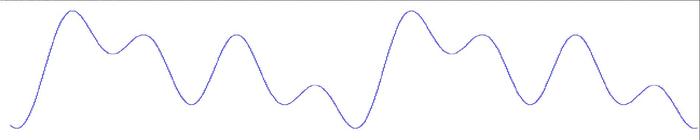
original.jpg


If we Fourier transform the graph we get something like this:

zhGVrnz.jpg


My question is, does the value of the largest column represent the peak to peak voltage of the waveform pictured above?
 
Engineering news on Phys.org
rwooduk said:
We have a waveform that is composed of several waves, maybe something like this:
If we Fourier transform the graph we get something like this:
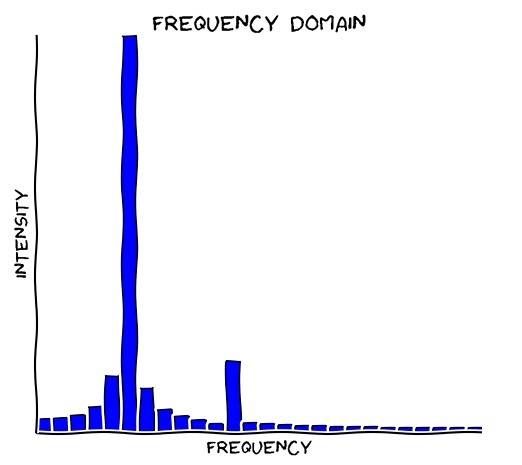
My question is, does the value of the largest column represent the peak to peak voltage of the waveform pictured above?

That's too simple. The peak value of the whole time domain signal will depend on the relative phases of the frequency components. That frequency domain display will be the actual values of the amplitudes of the components in volts. The DFT gives you an actual value and would not 'normalise' the scale unless you ask it to.
 
  • Like
Likes   Reactions: rwooduk
Many thanks for the reply! So although my OP was in simple terms (apologies I'm fairly new to this) it is correct?

I have 200+ snapshots (1ms) of data from our oscilloscope and I'm trying to use MATLAB using the Fourier transform to determine the pressure amplitude for each waveform. Similar to what is shown here:

https://uk.mathworks.com/help/examples/matlab/FFTOfNoisySignalExample_01.png

https://uk.mathworks.com/help/examples/matlab/FFTOfNoisySignalExample_02.png

https://uk.mathworks.com/help/matlab/ref/fft.html

I'm a little confused what you mean by "normalise", if you could give a few more comments it would be appreciated.
 
Last edited by a moderator:
rwooduk said:
I'm a little confused what you mean by "normalise",
I just meant scaled to bring the displayed maximum frequency domain value to, perhaps, the maximum time domain value. (For convenience, when the input range is inconveniently small, for instance.)
If you Google around the Fourier Transform (finding a link that suits you) the constants outside the transform do not depend on the maximum amplitude of the time function.
 
  • Like
Likes   Reactions: rwooduk
I see, that's great many thanks for the suggestions and your help!
 

Similar threads

  • · Replies 6 ·
Replies
6
Views
5K
Replies
1
Views
2K
Replies
6
Views
5K
  • · Replies 63 ·
3
Replies
63
Views
8K
  • · Replies 5 ·
Replies
5
Views
3K
  • · Replies 7 ·
Replies
7
Views
1K
  • · Replies 7 ·
Replies
7
Views
4K
  • · Replies 3 ·
Replies
3
Views
2K
  • · Replies 31 ·
2
Replies
31
Views
12K
  • · Replies 14 ·
Replies
14
Views
2K