Using two electromagnets to study self-inductance

Click For Summary

Discussion Overview

The discussion centers on the concept of self-inductance and mutual inductance as illustrated by a setup involving two electromagnets. Participants explore how the configuration of these electromagnets and their connection might influence self-inductance and mutual inductance, considering both theoretical implications and practical applications.

Discussion Character

  • Exploratory
  • Technical explanation
  • Debate/contested

Main Points Raised

  • One participant describes a figure used in their study materials to explain self-inductance with two electromagnets and questions whether the connection affects self-inductance.
  • Another participant asserts that the connection will affect mutual inductance but not self-inductance, which is determined by self-flux only.
  • There is a query about the choice of using two electromagnets instead of a single solenoid, with no clear reasoning provided by the original author.
  • Some participants suggest that the base material (potentially iron) may influence mutual inductance by reducing reluctance, while self-inductance remains unaffected.
  • Concerns are raised about the cancellation of fluxes in the intermediate area and whether this affects self-flux, with differing opinions on the implications for self-inductance.
  • A later reply discusses effective inductance as a combination of self and mutual inductance, emphasizing the role of winding directions in determining the overall inductance behavior.
  • One participant proposes viewing the setup as a single coil on a U-shaped core, suggesting that this configuration could enhance self-inductance compared to a straight core.

Areas of Agreement / Disagreement

Participants generally disagree on the implications of the electromagnet configuration for self-inductance, with some asserting it remains unchanged while others suggest it could be affected under certain conditions. The discussion includes multiple competing views on how mutual inductance is influenced by the arrangement of the coils.

Contextual Notes

Participants express uncertainty regarding the assumptions about the base material and its effects on inductance. The discussion also highlights the complexity of inductance interactions without reaching a consensus on specific outcomes.

Asmaa Mohammad
Messages
182
Reaction score
7
Hi,
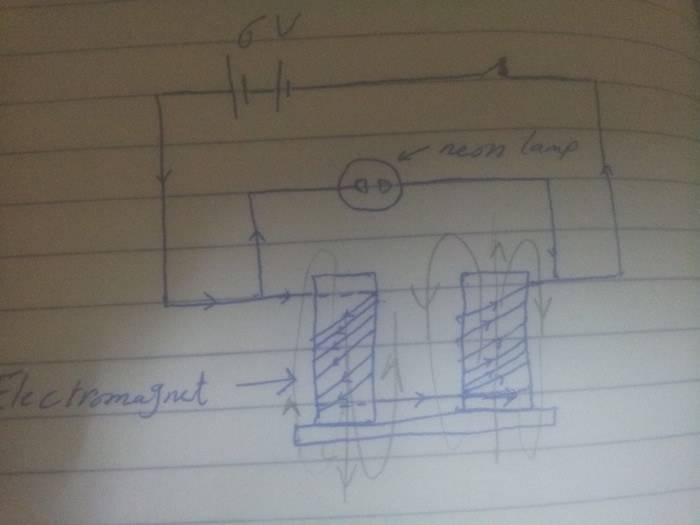
I study physics and I know what the concept self-inductance means, and in one of my study books, a figure like this was used to explain the self inductance in a coil
Ggh1F.jpg
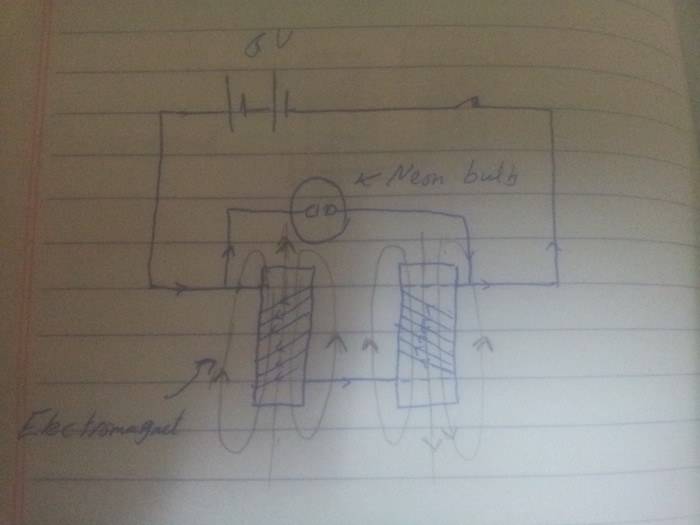
As shown in the figure, two electromagnets are connected together and the current is passing through them and would produce a magnetic field as shown, I drew it by myself, it wasn't drawn in the original figure. And at first, an induced emf and induced current will be produced, and the induced magnetic field will be in the opposite direction to the original magnetic field. What has attracted my attention is the way the electromagnets connected by, they are connected in a way so that the field between them can be in opposite directions, and I wonder whether it would be the same if we connected them like this:
KKDsc.jpg
will this connection affect self-inductance? Or will it make any difference in anything?
 
Last edited:
Physics news on Phys.org
Asmaa muhammad said:
will this connection affect self-inductance? Or will it make any difference in anything?
It will affect the mutual inductance between the two coils. Self inductance is affected by self-flux only.
 
  • Like
Likes   Reactions: davenn
Asmaa muhammad said:
a figure like this was used to explain the self inductance in a coil
Does the book's author indicate why he chose to use a pair of electromagnets instead of a single solenoid with a core, to illustrate self-inductance?

That horizontal base the magnets seem to be mounted on...are you told what it is made of?
 
Actually it didn't say why he used a pair of electromagnets, and the base, which I forgot to draw in the second figure, seems to be made of iron, but that is just my assumption, and I am not sure of it, and the author didn't say anything about it too.
 
Asmaa muhammad said:
Actually it didn't say why he used a pair of electromagnets, and the base, which I forgot to draw in the second figure, seems to be made of iron, but that is just my assumption, and I am not sure of it, and the author didn't say anything about it too.
Well, to explain self inductance, only one coil is sufficient.
Mutual inductance will depend on the directions of the coils. If the fluxes from the two coils tend cancel each other, mutual flux will be very small and hence, mutual inductance will be smaller than the MI when the fluxes add up.
 
  • Like
Likes   Reactions: Asmaa Mohammad
Asmaa muhammad said:
KKDsc.jpg
will this connection affect self-inductance? Or will it make any difference in anything?
I reply to my own post beacuase I can't edit it, and in this figure I forgot to draw the base of the two electromagnet existed in the other figure, and I think it has an importance somehow, but I don't know what is it, and the book's author didn't say any thing about it. So, do anyone know why it is here? and how could their connection affect both self and mutual inductance?
 
cnh1995 said:
Well, to explain self inductance, only one coil is sufficient.
Mutual inductance will depend on the directions of the coils. If the fluxes from the two coils tend cancel each other, mutual flux will be very small and hence, mutual inductance will be smaller than the MI when the fluxes add up.
Ok, but what about the self-inductance, would their connection by another way affect it?
 
Asmaa muhammad said:
Ok, but what about the self-inductance, would their connection by another way affect it?
No.
cnh1995 said:
It will affect the mutual inductance between the two coils. Self inductance is affected by self-flux only.
 
Asmaa muhammad said:
I reply to my own post beacuase I can't edit it, and in this figure I forgot to draw the base of the two electromagnet existed in the other figure, and I think it has an importance somehow, but I don't know what is it, and the book's author didn't say any thing about it. So, do anyone know why it is here? and how could their connection affect both self and mutual inductance?
If the base is made of a ferromagnetic material (like iron), it will reduce the reluctance of the path for the mutual flux. That will change the coupling co-efficient of the coils.
Self inductance will not be affected by the base plate.
 
  • #10
cnh1995 said:
No.
OK, but the two fluxes seem to cancel each others in the intermediate area, so the self-flux would be affected by this, wouldn't it?
 
  • #11
Asmaa muhammad said:
OK, but the two fluxes seem to cancel each others in the intermediate area, so the self-flux would be affected by this, wouldn't it?
cnh1995 said:
Well, to explain self inductance, only one coil is sufficient.
Mutual inductance **flux** will depend on the directions of the coils. If the fluxes from the two coils tend cancel each other, mutual flux will be very small and hence, mutual **effective** inductance will be smaller than the effective inductance when the fluxes add up.

I should have said "effective inductance" instead of mutual inductance.

Well, effective inductance of the system is a combination of self inductance and mutual inductance. Self inductance has a fixed value determined by its physical parameters and no of turns. Mutual inductance is also fixed, determined by the coupling co-efficient (and geometry). Winding directions decide whether self and mutual inductances add to each other or mutual inductance is subtracted from the self inductance.
Look up "series aiding" and "series opposing" inductance.
 
  • Like
Likes   Reactions: Asmaa Mohammad
  • #12
Asmaa muhammad said:
Actually it didn't say why he used a pair of electromagnets, and the base, which I forgot to draw in the second figure, seems to be made of iron, but that is just my assumption, and I am not sure of it, and the author didn't say anything about it too.
I was looking at this not as two coils having mutual inductance (though that is equally valid), but as a single coil wound onto a U-shape core. This shape allows the solenoid's field to pass through a high-permeability material for more of its path to give it a higher self-inductance than for the same number of turns wound on a similar cylindrical but straight core. This being a demonstration of self-inductance, consideration may be on efficiently obtaining a reasonable self-inductance. A donut-shape core would be even better, but it's not a shape that lends itself to DIY experimenters and it can be pain to wind with thousands of turns; further, without an air gap the magnetism can't be gauged with a scrap of steel like it can be for a horse-shoe shape.

(As with a horse-shoe magnet, this U-shape concentrates the field into a narrow air gap should we wish to use it as a strong magnet.)
 

Similar threads

  • · Replies 6 ·
Replies
6
Views
2K
  • · Replies 14 ·
Replies
14
Views
4K
  • · Replies 6 ·
Replies
6
Views
2K
  • · Replies 11 ·
Replies
11
Views
3K
  • · Replies 16 ·
Replies
16
Views
5K
  • · Replies 6 ·
Replies
6
Views
2K
  • · Replies 21 ·
Replies
21
Views
2K
  • · Replies 2 ·
Replies
2
Views
3K
  • · Replies 60 ·
3
Replies
60
Views
7K
  • · Replies 23 ·
Replies
23
Views
2K