CoolFool
- 4
- 0
This is a problem from Foundations of Analog and Digital Electronic Circuits by Agarwal & Lang, I'm going through it by myself, I'm not in a course, so I'm depending on you friendly forum people for help! I really like this book but it has a lot of errors, perhaps this is another error.
1. Homework Statement
Sketch the i-v characteristics for the network. Label intercepts and slopes.
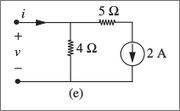
The solution PDF for this textbook says that the answer is
i = (v/4) + (v/5 + 2)
i = (9/20)v + 2
So the slope is 9/20 and the i-intercept is 2 Amps.
My answer is i = v/4 + 2, which I got from connecting a current source to the terminal and solving the circuit for i. So the slope is 1/4, the i-intercept is 2 Amps.
I tried simulating the circuit on partsim.com with a DC sweep and I think it confirmed my answer, but I don't really know my way around circuit simulators yet so maybe I messed up.
I understand that the solution PDF got its answer by plugging Ohm's law into i = i1 + i2, where i1 is current through the 4 Ohm resistor and i2 is current through the 5 Ohm resistor.
But didn't it get i2 wrong? Shouldn't i2 = 2 Amps, because the current through the 5 Ohm resistor goes directly into the ideal current source which is set at 2 Amps?
So in my view, the 5 Ohm resistor could be any resistance, it doesn't matter, because there will always be 2 Amps going through it. Am I correct? (Obviously for real life elements this wouldn't hold up but I'm talking ideal elements here). I still am not totally comfortable with the intuition behind ideal current sources so confirming/denying this would really help me out.
Thanks!
1. Homework Statement
Sketch the i-v characteristics for the network. Label intercepts and slopes.
Homework Equations
The solution PDF for this textbook says that the answer is
i = (v/4) + (v/5 + 2)
i = (9/20)v + 2
So the slope is 9/20 and the i-intercept is 2 Amps.
The Attempt at a Solution
My answer is i = v/4 + 2, which I got from connecting a current source to the terminal and solving the circuit for i. So the slope is 1/4, the i-intercept is 2 Amps.
I tried simulating the circuit on partsim.com with a DC sweep and I think it confirmed my answer, but I don't really know my way around circuit simulators yet so maybe I messed up.
I understand that the solution PDF got its answer by plugging Ohm's law into i = i1 + i2, where i1 is current through the 4 Ohm resistor and i2 is current through the 5 Ohm resistor.
But didn't it get i2 wrong? Shouldn't i2 = 2 Amps, because the current through the 5 Ohm resistor goes directly into the ideal current source which is set at 2 Amps?
So in my view, the 5 Ohm resistor could be any resistance, it doesn't matter, because there will always be 2 Amps going through it. Am I correct? (Obviously for real life elements this wouldn't hold up but I'm talking ideal elements here). I still am not totally comfortable with the intuition behind ideal current sources so confirming/denying this would really help me out.
Thanks!
