Discussion Overview
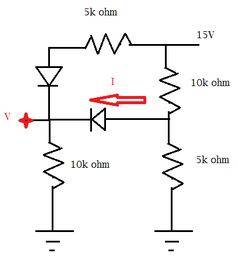
The discussion revolves around analyzing a circuit containing two diodes to determine the voltage (V) and current (I) through various components. Participants explore methods for approaching the problem, including assumptions about the state of the diodes and the implications of a forward voltage drop of 0.7 volts.
Discussion Character
- Exploratory
- Technical explanation
- Homework-related
- Mathematical reasoning
Main Points Raised
- One participant expresses uncertainty about how to approach the circuit analysis problem and requests step-by-step assistance.
- Several participants suggest starting with assumptions about the diodes being either on or off, leading to four possible circuit combinations to analyze.
- It is noted that if a diode is assumed to be non-conducting but is found to be forward-biased, the initial assumption must be reconsidered.
- Participants discuss the implications of the 0.7 volts forward voltage drop on the analysis and whether this affects the approach.
- One participant questions how to account for voltage drops when treating diodes as short circuits or open circuits.
- Another participant mentions that using experience and intuition can sometimes simplify the analysis of whether diodes are conducting.
- One participant describes a specific analysis where they assumed both diodes were conducting, leading to a conclusion about the state of one diode based on voltage measurements.
- There is a suggestion that in some cases, using a circuit simulator might be easier than solving the equations manually.
Areas of Agreement / Disagreement
Participants generally agree on the approach of analyzing the circuit by considering the states of the diodes, but there are differing opinions on the necessity of making multiple assumptions and the complexity of the analysis. The discussion remains unresolved regarding the best method for handling the diode states and voltage drops.
Contextual Notes
Some participants highlight the challenge of determining diode states when voltages are close to the forward voltage drop, indicating that assumptions may not always lead to clear conclusions.