Velocity, traveling distance and friction force on a sliding object

Click For Summary
The discussion centers on the sliding dynamics of two metal strips, A and B, which are initially pushed to the same velocity but differ in their orientation during sliding. Object A slides straight, while object B rotates to an angle of 45 degrees as it slides. The key point is that friction plays a crucial role in determining how quickly each object stops, with the frictional forces needing to be compared to answer which object travels a shorter distance. The conversation highlights that the angle of rotation affects the friction experienced by object B, potentially leading to a different stopping distance compared to object A. Ultimately, understanding the frictional forces is essential for solving the problem accurately.
Javad
Messages
35
Reaction score
2
Homework Statement
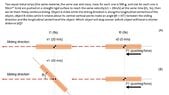
Two equal metal strips (the same material, the same size and mass, mass for each one is 500 g, and size for each one is 50cm* 5cm) are pushed on a straight rigid surface to reach the same velocity (v1 = 20m/s) at the same time (t1, 5s), then we let them freely continue sliding. Object A slides while the sliding direction is along the longitudinal centerline of the object, object B slides while it rotates about its central-vertical axis to make an angle (ϴ = 45°) between the sliding direction and the longitudinal centerline of the object. Which object will stop sooner (which object will travel a shorter distance (d))?
Relevant Equations
F=ma
Kinetic energy = 1/2mv²
Power = Fv
d = vt + 1/2at²
d = 1/2 (v + v˳)t
Fᵪ=F.cosθ
friction question 4.jpg
 
Physics news on Phys.org
Well, work out your relevant equations for ##d## and there is your answer !

##\ ##
 
Javad said:
Homework Statement:: Two equal metal strips (the same material, the same size and mass, mass for each one is 500 g, and size for each one is 50cm* 5cm) are pushed on a straight rigid surface to reach the same velocity (v1 = 20m/s) at the same time (t1, 5s), then we let them freely continue sliding. Object A slides while the sliding direction is along the longitudinal centerline of the object, object B slides while it rotates about its central-vertical axis to make an angle (ϴ = 45°) between the sliding direction and the longitudinal centerline of the object. Which object will stop sooner (which object will travel a shorter distance (d))?
Relevant Equations:: F=ma
Kinetic energy = 1/2mv²
Power = Fv
d = vt + 1/2at²
d = 1/2 (v + v˳)t
Fᵪ=F.cosθ

View attachment 296671
Assuming object B is initially not rotating and is accelerated by F1 acting through its centre, there is nothing to make object B rotate.

So what you are describing is physically impossible unless there is/are other force(s) you haven't mentioned.
 
  • Like
Likes Lnewqban
BvU said:
Well, work out your relevant equations for ##d## and there is your answer !

##\ ##
so " d " for both would be equal, what is the effect of angle (ϴ = 45°) on d ?
 
Steve4Physics said:
Assuming object B is initially not rotating and is accelerated by F1 acting through its centre, there is nothing to make object B rotate.

So what you are describing is physically impossible unless there is/are other force(s) you haven't mentioned.
how about if the object rotates accidentally during sliding?
 
Javad said:
how about if the object rotates accidentally during sliding?
Then there must have been some 'accidental' additional forces -- or more precisely, two accidental net torques - one torque to start the rotation and another to stop it.
 
Steve4Physics said:
Then there must have been some 'accidental' additional forces -- or more precisely, two accidental net torques - one torque to start the rotation and another to stop it.
however the velocity of two objects at t1 is the same, what will happen next, is d equal for both objects?
 
Note that "object B slides while it rotates about its central-vertical axis to make an angle (ϴ = 45°)."
To me, that angle is gradually increasing until reaching 45 degress just before stopping.
Perhaps one side is "feeling" more friction than the opposite one?
 
Javad said:
is d equal for both objects?

There is no ##\theta## in your equations for ##d##, so: yes !

I would like to read your thoughts on this, so could you say something about your views ? (telepathy not being one of my strengths :frown: )

##\ ##
 
  • #11
BvU said:
There is no ##\theta## in your equations for ##d##, so: yes !

I would like to read your thoughts on this, so could you say something about your views ? (telepathy not being one of my strengths :frown: )

##\ ##
Lnewqban said:
Note that "object B slides while it rotates about its central-vertical axis to make an angle (ϴ = 45°)."
To me, that angle is gradually increasing until reaching 45 degress just before stopping.
Perhaps one side is "feeling" more friction than the opposite one?
They are two separated objects, A and B, not two sides of one object. Object B reaches 45 degrees at t1 and then freely slides to stop, what is the effect of 45 degrees angle on duration and length of sliding?
 

Attachments

  • friction question5.jpg
    friction question5.jpg
    42 KB · Views: 140
  • #12
If overall friction would be greater for case B than A, the metal piece simply would change its direction of travel to the path of less friction.
That is what makes the front wheels of a car roll in the steering direction rather than continuing moving forward (which only happens in very low friction conditions, like when asphalt is covered with ice).

https://i.makeagif.com/media/5-11-2015/mJxAPt.gif

Refering to your other thread:
https://www.physicsforums.com/threa...ing-at-different-angles.1011952/#post-6596517
That is also the reason for both skies to point against each other in a symmetrical way for reducing speed.
If both pointed in the same angled direction, a turn rather than a braking efect would follow.

In real life, there is less resistance to movement from the snow to parallel skies than to the V-shape arrangement used for slowing down because the energy is not wasted in fighting each other about what direction to turn to.
 
Last edited:
  • #13
Javad said:
They are two separated objects, A and B, not two sides of one object. Object B reaches 45 degrees at t1 and then freely slides to stop, what is the effect of 45 degrees angle on duration and length of sliding?
That's not your thoughts, that's a snapshot of some book.
Is it all supposed to be frictionless ? I suppose not ('which will stop sooner') ...
Is there some context of static and dynamic friction here ? With one being greater than the other ?

##\ ##
 
  • #14
BvU said:
That's not your thoughts, that's a snapshot of some book.
Is it all supposed to be frictionless ? I suppose not ('which will stop sooner') ...
Is there some context of static and dynamic friction here ? With one being greater than the other ?

##\ ##
It's not a snapshot of a book, it is my original question.
 
  • #15
So no friction ?
 
  • #16
BvU said:
So no friction ?
For sure there is friction.
 
  • #17
Interesting. Good it's explicitly mentioned now. Does it appear in your relevant equations ?

##\ ##
 
  • #18
BvU said:
Interesting. Good it's explicitly mentioned now. Does it appear in your relevant equations ?

##\ ##
No
 
  • #19
@Javad, as an aside to the main discussion, note that the Post #11 attachment appears to say:

- object B rotates while it slides to a stop, which means angle θ is continuously changing (till rotation stops);

- angle θ = 45º, which is a fixed value.

Both can’t be true!
 
  • #20
Steve4Physics said:
@Javad, as an aside to the main discussion, note that the Post #11 attachment appears to say:

- object B rotates while it slides to a stop, which means angle θ is continuously changing (till rotation stops);

- angle θ = 45º, which is a fixed value.

Both can’t be true!
No, actually object B rotates to reach angle θ = 45º at t1 and then continues sliding to stop (between t1 to full stop time angle θ = 45º is a fixed value.
 
  • #21
Javad said:
For sure there is friction.
That is the whole point. It is friction (and only friction) which brings each object to a stop. The time to stop (and the distance covered) depend on friction.

Unless you compare the frictional forces on A and B, you can't answer the question.

Can you tell us how you can calculate the frictional force on A and the frictional force on B?
 
  • #22
Steve4Physics said:
That is the whole point. It is friction (and only friction) which brings each object to a stop. The time to stop (and the distance covered) depend on friction.

Unless you compare the frictional forces on A and B, you can't answer the question.

Can you tell us how you can calculate the frictional force on A and the frictional force on B?
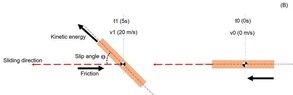
Actually, I think the calculation of friction is not a matter (we can calculate it by measuring all parameters t, v, d, …), I think I need to focus on the kinetic energy, I think due to the initial applied force along the longitudinal centerline of the object (during t0-t1), and due to mass of the object, it tends to continue sliding along the longitudinal centerline (based on the kinetic energy), but it slides with an angle between the sliding direction and the longitudinal centerline (slip angle ϴ = 45°). Now I need to know how the slip angle ϴ = 45° leads to wasting of kinetic energy (Attached image).
 

Attachments

  • friction question6.jpg
    friction question6.jpg
    12.8 KB · Views: 137
  • #23
Lnewqban said:
If overall friction would be greater for case B than A, the metal piece simply would change its direction of travel to the path of less friction.
That is what makes the front wheels of a car roll in the steering direction rather than continuing moving forward (which only happens in very low friction conditions, like when asphalt is covered with ice).

https://i.makeagif.com/media/5-11-2015/mJxAPt.gif

Refering to your other thread:
https://www.physicsforums.com/threa...ing-at-different-angles.1011952/#post-6596517
That is also the reason for both skies to point against each other in a symmetrical way for reducing speed.
If both pointed in the same angled direction, a turn rather than a braking efect would follow.

In real life, there is less resistance to movement from the snow to parallel skies than to the V-shape arrangement used for slowing down because the energy is not wasted in fighting each other about what direction to turn to.
I don't think you can trust skis as a model for these problems. Those have effects due to the action of snow on the edges and the tendency of the skis to dip in the middle.
 
  • #24
Javad said:
Actually, I think the calculation of friction is not a matter (we can calculate it by measuring all parameters t, v, d, …), I think I need to focus on the kinetic energy, I think due to the initial applied force along the longitudinal centerline of the object (during t0-t1), and due to mass of the object, it tends to continue sliding along the longitudinal centerline (based on the kinetic energy), but it slides with an angle between the sliding direction and the longitudinal centerline (slip angle ϴ = 45°). Now I need to know how the slip angle ϴ = 45° leads to wasting of kinetic energy (Attached image).
The energy isn't going to tell you anything about the distance covered unless you can say something about the frictional forces.

My reading of the question is that B is given some initial rotation as well as its forward velocity, so starts with more energy in total.
Try simplifying it it by reducing each plate to a pair of small discs (say) connected by a light rod (frictionless, or not touching the ground). Think about the directions the forces act on each disc for B at various orientations.
 
  • Like
Likes Steve4Physics
  • #25
haruspex said:
My reading of the question is that B is given some initial rotation as well as its forward velocity, so starts with more energy in total.
For information, in Post #20 @Javad specifically says that object B slides without rotating during the period of interest. θ is constant (45º).
 
  • Like
Likes Javad
  • #26
Steve4Physics said:
For information, in Post #20 @Javad specifically says that object B slides without rotating during the period of interest. θ is constant (45º).
But it does not say they still have the same speed at that time.
 
  • #27
haruspex said:
But it does not say they still have the same speed at that time.
Post #1 tells us that A and B have the same speed (v=20m/s) at the sane time (t1=5s). The question is about slowing down afer t1.

Well, that's how I read it.
 
  • Like
Likes Javad
  • #28
Steve4Physics said:
Post #1 tells us that A and B have the same speed (v=20m/s) at the sane time (t1=5s). The question is about slowing down afer t1.

Well, that's how I read it.
Absolutely correct.
 
  • #29
@Javad, the question is *entirely* about friction.

Can you tell us what course/level this is from?

Assuming it is an introductory level physics course, then you should remember:
- frictional force is needed to find acceleration (or deceleration if you want to call it that here);
- the acceleration is needed to calculate the time and distance needed to stop.

To answer the question you must compare the sizes of the frictional forces on A and B, There is no other way.
___________________________

Additional note

If you don't already know, you might also want to note that what happened before t1 is irrelevant.

At time t1:
- A is moving left at 20m/s oriented 0º to its velocity;
- B is moving left at 20m/s oriented 45º to its velocity;
- A and B are not rotating.

How the objects reached this state does not change how they behave after t1.
 
  • #30
haruspex said:
I don't think you can trust skis as a model for these problems. Those have effects due to the action of snow on the edges and the tendency of the skis to dip in the middle.
As usual, you are correct.
My reasons come from posts #7 and #15 of the referenced other thread.
OP: “I want to learn how making angles on skis helps to reduce the velocity of a skier to stop.”
Probably incorrect, my perception is that this thread as a continuation of the previous one, where the plowing effect of skies and pure friction where mixed up in a confusing manner.
 

Similar threads

  • · Replies 16 ·
Replies
16
Views
1K
Replies
4
Views
3K
  • · Replies 20 ·
Replies
20
Views
2K
  • · Replies 4 ·
Replies
4
Views
3K
Replies
14
Views
3K
  • · Replies 10 ·
Replies
10
Views
2K
Replies
4
Views
2K
Replies
7
Views
1K
  • · Replies 6 ·
Replies
6
Views
2K
  • · Replies 30 ·
2
Replies
30
Views
1K