Venn Diagram II: Check Answers & Understand Relationships

  • Context: MHB 
  • Thread starter Thread starter bergausstein
  • Start date Start date
  • Tags Tags
    Diagram Venn
Click For Summary

Discussion Overview

The discussion revolves around the use of Venn diagrams to illustrate set relationships and properties, specifically focusing on union, intersection, subset relations, and complements. Participants are checking their answers and clarifying their understanding of these concepts through visual representation.

Discussion Character

  • Exploratory
  • Technical explanation
  • Debate/contested
  • Mathematical reasoning

Main Points Raised

  • One participant presents a set of statements involving Venn diagrams and seeks validation of their answers.
  • Another participant suggests that including the universal set is important, especially for illustrating complements.
  • A participant confirms they have drawn the universal set, but there is confusion about the notation "w/c."
  • Clarification is sought regarding the correct subset notation, with a participant acknowledging a mistake in their earlier response.
  • One participant expresses a desire to understand why different cases need to be shown for each problem, indicating a need for thoroughness in demonstrating set relationships.
  • A later reply explains that demonstrating the truth of a condition is insufficient without showing it is false for other cases, emphasizing the importance of comprehensive reasoning.

Areas of Agreement / Disagreement

Participants generally agree on the need for the universal set in Venn diagrams, but there is some confusion regarding notation and the necessity of demonstrating multiple cases for completeness. The discussion remains unresolved regarding the best approach to illustrate the set relationships.

Contextual Notes

There are unresolved questions about notation and the necessity of showing different cases for each problem. The discussion reflects varying levels of understanding and approaches to the task.

bergausstein
Messages
191
Reaction score
0
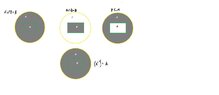
Another Venn diagram problem. just want to check if my answer is correct since i don't have a solutions manual of the book I'm using.

Use Venn diagrams to illustrate the following.

a. $\displaystyle A\cup B\,=\,A$ if and only if $\displaystyle B\subset A$
b. $\displaystyle A\cap B\,=\,B$ if and only if $\displaystyle B\subset A$
c. $\displaystyle B\subset A$ if and only if $\displaystyle A'\subset B'$
d. $\displaystyle \left(A'\right)'\,=\,A$

my answers
View attachment 1110
 

Attachments

  • vance 1.3.4.jpg
    vance 1.3.4.jpg
    19.7 KB · Views: 140
Physics news on Phys.org
bergausstein said:
Another Venn diagram problem. just want to check if my answer is correct since i don't have a solutions manual of the book I'm using.

Use Venn diagrams to illustrate the following.

a. $\displaystyle A\cup B\,=\,A$ if and only if $\displaystyle B\subset A$
b. $\displaystyle A\cap B\,=\,B$ if and only if $\displaystyle B\subset A$
c. $\displaystyle B\subset A$ if and only if $\displaystyle A'\subset B'$
d. $\displaystyle \left(A'\right)'\,=\,A$

my answers
View attachment 1110
I think you should have drawn the universal set too, especially while showing diagrams relating to complements.
 
caffeinemachine said:
I think you should have drawn the universal set too, especially while showing diagrams relating to complements.

i have drawn the universal set. w/c is set A. right?
 
bergausstein said:
i have drawn the universal set. w/c is set A. right?
What is 'w/c'??
 
caffeinemachine said:
What is 'w/c'??

i mean i have drawn the universal set. it's set A.
 
This is how I would draw them...I will leave the other cases for part c) for you to draw. :D

View attachment 1112

edit: caffeinemachine is correct, the universal set (the rectangles in my sketches) is needed for complementation.
 

Attachments

  • venn2.jpg
    venn2.jpg
    33.4 KB · Views: 123
MarkFL said:
This is how I would draw them...I will leave the other cases for part c) for you to draw. :D

View attachment 1111

edit: caffeinemachine is correct, the universal set (the rectangles in my sketches) is needed for complementation.

why $\displaystyle A\subset B$ ? shouldn't it be $\displaystyle B\subset A$ since B is inside A?
 
bergausstein said:
why $\displaystyle A\subset B$ ?

Darn it...after all that work, I manage to foul it up...of course those should read $B\subset A$. I amaze myself sometimes...(Tongueout) Thank you for catching this error! (Yes)

edit: I edited the drawing, and reattached it. :D
 

Attachments

  • Venn2.1.jpg
    Venn2.1.jpg
    7.3 KB · Views: 109
Last edited:
  • #10
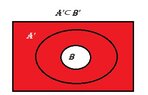
The other two cases involve $B$ and $A$ having partial intersection and no intersection. You have drawn the same case I drew.
 
  • #11
here's my second attempt for C.
View attachment 1116

i just want to ask why do we have to show different cases for each problems?
 

Attachments

  • Venn2.2.png
    Venn2.2.png
    2.1 KB · Views: 115
Last edited:
  • #12
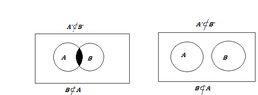
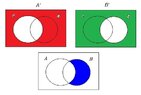
Demonstrating the truth for the given condition is not enough. You must also show it is false for the other cases to be thorough. This is how I would demonstrate the second case is not true for c):

View attachment 1117

The area in blue is within $A'$ but not in $B'$, hence $A'\not\subset B'$
 

Attachments

  • venn3.jpg
    venn3.jpg
    13.2 KB · Views: 118

Similar threads

  • · Replies 12 ·
Replies
12
Views
7K
  • · Replies 2 ·
Replies
2
Views
2K
  • · Replies 1 ·
Replies
1
Views
2K
Replies
9
Views
5K
  • · Replies 3 ·
Replies
3
Views
2K
  • · Replies 3 ·
Replies
3
Views
2K
Replies
1
Views
2K
  • · Replies 3 ·
Replies
3
Views
4K
  • · Replies 6 ·
Replies
6
Views
2K
  • · Replies 11 ·
Replies
11
Views
1K