MHB Verifying Solutions to Isomorphism Problem: Need Help!

  • Thread starter Thread starter Joe20
  • Start date Start date
  • Tags Tags
    Isomorphism
Click For Summary
The discussion focuses on verifying solutions to an isomorphism problem. The initial proof for part (a) is criticized for being circular, as it assumes the conclusion instead of proving it. For part (b), it is suggested to simplify the proof by demonstrating that the images of the function are distinct to establish injectivity, which leads to bijectivity due to the equal cardinality of the sets involved. The advice emphasizes clarity and logical progression in mathematical proofs. Overall, the feedback aims to enhance the rigor of the submitted solutions.
Joe20
Messages
53
Reaction score
1
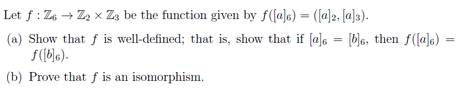
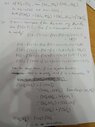
Hi, I have attached the question and the solutions to part a and b of this question. Would like someone to verify if I have done anything wrong. Greatly appreciate it! Thanks.

Would also like to check if there is a simpler method to prove f is an isomorphism? Thanks
 

Attachments

  • q4.png
    q4.png
    10.4 KB · Views: 117
  • Webp.net-resizeimage.jpg
    Webp.net-resizeimage.jpg
    107.6 KB · Views: 121
Physics news on Phys.org
Hi Alexis87,

Your proof for part (a) is somewhat circular — the goal was to prove $[a]_6 = _6$ implies $([a]_2,[a]_3) = (_2, _3)$, but you started with that claim. Remove it.

For part (b), remove the beginning part of your proof. To show that $f$ is bijective, you could show that the images $f(j)$, $j = 0,\ldots, 5$, are distinct, and so $f$ is injective. Since $f$ is an injective mapping between two sets of the same cardinality, it is also surjective. Hence, $f$ is bijective.
 
Thread 'How to define a vector field?'
Hello! In one book I saw that function ##V## of 3 variables ##V_x, V_y, V_z## (vector field in 3D) can be decomposed in a Taylor series without higher-order terms (partial derivative of second power and higher) at point ##(0,0,0)## such way: I think so: higher-order terms can be neglected because partial derivative of second power and higher are equal to 0. Is this true? And how to define vector field correctly for this case? (In the book I found nothing and my attempt was wrong...

Similar threads

  • · Replies 1 ·
Replies
1
Views
2K
  • · Replies 31 ·
2
Replies
31
Views
2K
  • · Replies 1 ·
Replies
1
Views
1K
Replies
6
Views
2K
  • · Replies 8 ·
Replies
8
Views
2K
  • · Replies 21 ·
Replies
21
Views
1K
Replies
3
Views
2K
  • · Replies 5 ·
Replies
5
Views
2K
  • · Replies 1 ·
Replies
1
Views
2K
  • · Replies 14 ·
Replies
14
Views
2K