Vibration Damping Help: CR3-100 Damper Cutoff Frequency

  • Thread starter Thread starter Shady99
  • Start date Start date
  • Tags Tags
    Damping Vibration
Join the discussion
Ask a follow-up here, or get your own question answered by working scientists, mathematicians and engineers — people, not an autocomplete.
Real named experts · corrections over time · the nuance an AI answer skips
11 replies · 2K views
Shady99
Messages
71
Reaction score
0
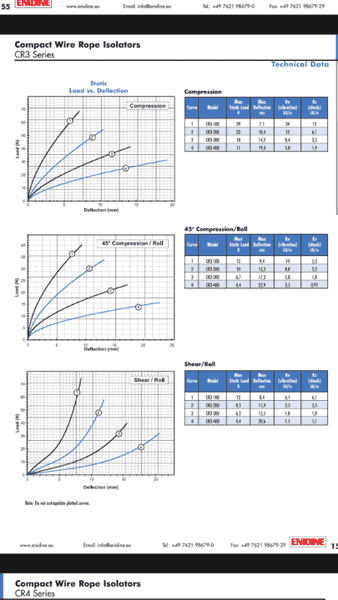
Hello i was looking at the damper CR3-100 as seen in the pic. Howver from the tech sheet given i cudnt make out what's the cutoff freq of this damper...i mean which is the frequency beyond which it doesn't let the frequency pass...what to make of this KN/m value?
1475173389238.png
 
on Phys.org
I googled it. There is an application guide in the catalogue.

Its a mass spring system. The cut off frequency will depend on the modal frequency of interest (ie what mass is on the spring). Isolation usually starts 1.4x the natural frequency.

So it really depends on how much attenuation of vibraion you want. The catalogue suggests a natural frequency 1/3 the excitation frequency for 80% attenuation.
 
  • Like
Likes   Reactions: Shady99
xxChrisxx said:
I googled it. There is an application guide in the catalogue.

Its a mass spring system. The cut off frequency will depend on the modal frequency of interest (ie what mass is on the spring). Isolation usually starts 1.4x the natural frequency.

So it really depends on how much attenuation of vibraion you want. The catalogue suggests a natural frequency 1/3 the excitation frequency for 80% attenuation.
The total mass of the system is 4 kgs resting on two dampers
 
All you need to do is work through page 38 of the catalogue. What aspect are you struggling with?
 
  • Like
Likes   Reactions: Shady99
xxChrisxx said:
All you need to do is work through page 38 of the catalogue. What aspect are you struggling with?
The system i have needs to be isolated from 30 hz freq...which means anything above 30 hz shud be damped...so how wud i know which freq this under discussion damper wud cut?
 
You know the mass value - 4kg. So you can use part 1 on page 38 to calculate the static load per isolator W.

You stated that it must attenuate above 30Hz. So this is your 'input excitation frequency'. You can use part 2 on page 38 to work out the required natural frequency of the system to provide 80% attenuation.

From that you can then calculate the maximum stiffness to allow this Kv.

Have a go at calculating these figures.
 
  • Like
Likes   Reactions: Shady99
xxChrisxx said:
You know the mass value - 4kg. So you can use part 1 on page 38 to calculate the static load per isolator W.

You stated that it must attenuate above 30Hz. So this is your 'input excitation frequency'. You can use part 2 on page 38 to work out the required natural frequency of the system to provide 80% attenuation.

From that you can then calculate the maximum stiffness to allow this Kv.

Have a go at calculating these figures.
1475225620237.jpg
 
xxChrisxx said:
You know the mass value - 4kg. So you can use part 1 on page 38 to calculate the static load per isolator W.

You stated that it must attenuate above 30Hz. So this is your 'input excitation frequency'. You can use part 2 on page 38 to work out the required natural frequency of the system to provide 80% attenuation.

From that you can then calculate the maximum stiffness to allow this Kv.

Have a go at calculating these figures.
By the way how the units in the last Kv equation are cancelling out??...i mean there is Newton and hertz^2 in the numerator and m/s^2 in the denominator
 
They look about right to me. So to provide the desired attentuation from 30Hz
W = 20N
Kv = 7.8 KN/m

From the catalogue it states that:
W < Static Max
Kv < Kv of isolator

So from the there are 4 tunes of isolator you posted in the OP. Which one works?
The reason why this works is that once you go past the natural frequency, the vibration is out of phase with the input. So you start to get attenuation. I suggest you read up on vibration transmissibility.
 
  • Like
Likes   Reactions: Shady99
xxChrisxx said:
They look about right to me. So to provide the desired attentuation from 30Hz
W = 20N
Kv = 7.8 KN/m

From the catalogue it states that:
W < Static Max
Kv < Kv of isolator

So from the there are 4 tunes of isolator you posted in the OP. Which one works?
The reason why this works is that once you go past the natural frequency, the vibration is out of phase with the input. So you start to get attenuation. I suggest you read up on vibration transmissibility.
The fourth one works...i still don't get how the units in Kv equation cancel out...Chris thankyou so much for the help...Appreciate it