Voltage and phase between two branches of ac circuit

Click For Summary
SUMMARY

The discussion focuses on analyzing a parallel AC circuit with two branches: one containing two equal resistors in series and the other containing a resistor in series with a variable inductor. The participants establish that the voltage magnitude between points A and B is given by the formula |VAB| = V/2, and the phase angle is determined by φ = tan-1(-2ωLR1 / (R12 - ω2L2)). The conversation emphasizes the importance of correctly applying the voltage divider formula and understanding the phase relationships between the components in the circuit.

PREREQUISITES
  • Understanding of AC circuit analysis
  • Familiarity with voltage divider and potential divider concepts
  • Knowledge of impedance for resistors and inductors
  • Proficiency in using LaTeX for mathematical expressions
NEXT STEPS
  • Study the application of the voltage divider formula in AC circuits
  • Learn about phasor analysis for AC circuit components
  • Explore the concept of impedance in RLC circuits
  • Review the use of MathJax for rendering LaTeX in online forums
USEFUL FOR

Electrical engineering students, circuit designers, and anyone involved in AC circuit analysis and design will benefit from this discussion.

Tom Moynihab
Messages
10
Reaction score
0
Mod Note: moved from technical forum, so homework template is missing

In a parallel circuit, one branch contains two equal resistors of resistance ##R_1## connected in series. The other branch contains a resistor of resistance ##R_1## in series with an inductor of variable inductance ##L##.
Show that the magnitude ##|V_{AB}|=\frac{V}{2}## and ##\phi=\tan^{-1}\big(-\frac{2\omega LR_1}{R_1^2-\omega^2L^2}\big)##https://gyazo.com/50cbf5ef913b0fc533ebcb0074b3b5a3 (Very sorry for the link, but the image uploader wasn't working for me)
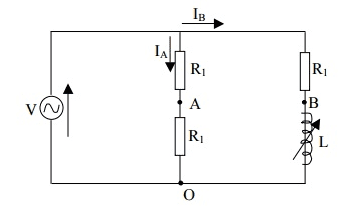
50cbf5ef913b0fc533ebcb0074b3b5a3.png
{image inserted by moderator}I have worked out that total impedance =##|Z|=\frac{2R_1(R_1+\omega L)}{3R_1+\omega L}## Which I'm not sure is correct.

I'm thinking that I have to work out what fraction of voltage ##R_1## gets in the ##B## branch, but I'm pretty confused.

Edit: I have managed to prove ##|V_{AB}|=\frac{V}{2}## and am now stuck on the second part, it's only two marks so it shouldn't be difficult, I just don't know what impedance I'm meant to be taking

Any help on this would be really appreciated :)
 
Last edited by a moderator:
Physics news on Phys.org
Hi Tom Moynihab.
smiley_sign_welcome.gif


You need to enclose your Latex inside double hash marks, not single dollars. You can use double dollars where you want it presented on a new line.
 
NascentOxygen said:
You need to enclose your Latex inside double hash marks, not single dollars.

oh sorry, which tex plugin is used?
 
MathJax does its work at the server and it is sent to you as javascript, I think.
 
NascentOxygen said:
MathJax does its work at the server and it is sent to you as javascript, I think.

oh hmm I'm not getting any tex, still all code. Also is this visible/what do i need to do to make it visible?
 
Tom Moynihab said:
oh hmm I'm not getting any tex, still all code. Also is this visible/what do i need to do to make it visible?
If you are using the PF app it displays the raw MathJax code. You'll need to use a browser to see your LaTex creation in its full glory.
 
NascentOxygen said:
If you are using the PF app it displays the raw MathJax code. You'll need to use a browser to see your LaTex creation in its full glory.

I am currently using chrome though. Edit: fixed it, had to turn off my previous plugin
 
NascentOxygen said:
If you are using the PF app it displays the raw MathJax code. You'll need to use a browser to see your LaTex creation in its full glory.

Sorry my post currently visible?
 
Tom Moynihab said:
Edit: I have managed to prove ##|V_{AB}|=\frac{V}{2}## and am now stuck on the second part, it's only two marks so it shouldn't be difficult, I just don't know what impedance I'm meant to be taking
For the phase angle, you've probably done most of the work already when proving that ##|V_{AB}|=\frac{V}{2}##. Can you show that work up to the point where you found the magnitude?
 
  • #10
gneill said:
For the phase angle, you've probably done most of the work already when proving that ##|V_{AB}|=\frac{V}{2}##. Can you show that work up to the point where you found the magnitude?

Well it might be a bit of a jump, but I said for A it was V/2 as the voltage simply splits 50/50. Then for B I said as the impedance between the resistor and the inductor is pi/2 out of phase, therefore voltage across the resistor varies between V and 0... and I just called it 0.
 
  • #11
Tom Moynihab said:
Well it might be a bit of a jump, but I said for A it was V/2 as the voltage simply splits 50/50. Then for B I said as the impedance between the resistor and the inductor is pi/2 out of phase, therefore voltage across the resistor varies between V and 0... and I just called it 0.
I'm afraid that doesn't hold water as a derivation. You'll need to return to that part and do the math.

The A branch is a simple voltage divider as you pointed out. But so is the B branch. The only difference is that one of the elements is an inductor rather than another resistor. You should be able write an expression for the potential at point B using the voltage divider formula.
 
  • #12
gneill said:
I'm afraid that doesn't hold water as a derivation. You'll need to return to that part and do the math.

The A branch is a simple voltage divider as you pointed out. But so is the B branch. The only difference is that one of the elements is an inductor rather than another resistor. You should be able write an expression for the potential at point B using the voltage divider formula.

The part which confused me was that the voltage from A is already V/2, therefore B has to be 0, which means surely the circuit wouldn't work?
 
  • #13
Tom Moynihab said:
The part which confused me was that the voltage from A is already V/2, therefore B has to be 0, which means surely the circuit wouldn't work?
That's not correct. Branch B contains an inductor. You need to consider the phase difference between voltages at A and B.
 
  • #14
Following on to what @cnh1995 said, if you do the algebra you'll find the answers to both the voltage magnitude and the phase angle questions.
 
  • #15
cnh1995 said:
That's not correct. Branch B contains an inductor. You need to consider the phase difference between voltages at A and B.

So as the impedance for a resistor is just R and the impedance for an inductor is [;j\omega L;] meaning they are [;\frac{\pi}{2};] out of phase with each other, meaning that when [;V_R=R*0;] and [;V_L=X_L*I_{max};] maybe? Am I at least on the right track? I am going to bed now as it is 3.30AM, but I will check tomorrow
 
  • #16
Do the math; it's just a bit of complex algebra. It'll automatically take care of the phase relationships without your having to make guesses. Certainly when the circuits get more complicated you won't be able to use handwavy arguments to analyze them.
 
  • #17
gneill said:
Following on to what @cnh1995 said, if you do the algebra you'll find the answers to both the voltage magnitude and the phase angle questions.
gneill said:
Do the math; it's just a bit of complex algebra. It'll automatically take care of the phase relationships without your having to make guesses. Certainly when the circuits get more complicated you won't be able to use handwavy arguments to analyze them.

I think my problem is setting up the correct math, it's confusing to me what to do, could you help with that please?
 
  • #18
Look up: "voltage divider" (or "potential divider").
 
  • #19
Tom Moynihab said:
I think my problem is setting up the correct math, it's confusing to me what to do, could you help with that please?
Tom Moynihab said:
I think my problem is setting up the correct math, it's confusing to me what to do, could you help with that please?
Would you be comfortable with the phasor approach?
 
  • #20
cnh1995 said:
Would you be comfortable with the phasor approach?

Yeah I am, many thanks
 
  • #21
Tom Moynihab said:
Yeah I am, many thanks
Ok.
Can you develop the phasor diagram?
Take the inductor voltage as reference phasor.
 
  • #22
cnh1995 said:
Ok.
Can you develop the phasor diagram?
Take the inductor voltage as reference phasor.
I think taking supply voltage as reference phasor would be the right approach.
 
  • #23
Tom Moynihab said:
So as the impedance for a resistor is just R and the impedance for an inductor is [;j\omega L;] meaning they are [;\frac{\pi}{2};] out of phase with each other, meaning that when [;V_R=R*0;] and
This is not valid for inline LaTex here. PF MathJax needs to be enclosed between double hash symbols, e.g. ##[/color]j\omega L##[/color]
 

Similar threads

  • · Replies 17 ·
Replies
17
Views
2K
  • · Replies 6 ·
Replies
6
Views
2K
Replies
0
Views
2K
Replies
19
Views
3K
  • · Replies 26 ·
Replies
26
Views
3K
  • · Replies 29 ·
Replies
29
Views
5K
  • · Replies 2 ·
Replies
2
Views
2K
  • · Replies 2 ·
Replies
2
Views
6K
  • · Replies 33 ·
2
Replies
33
Views
4K
  • · Replies 47 ·
2
Replies
47
Views
7K