Voltage offset differential amplifier

Click For Summary
SUMMARY

This discussion focuses on simulating a voltage offset differential amplifier using LTSpice. The user encounters a significant DC offset of approximately 12 volts at the drain output, despite using a basic NMOS model (.model M1 NMOS(Vto=0.7 Kp=100u L=1u W=32u)). Suggestions include using a dual matched pair of MOSFETs and ensuring proper grounding for resistors to minimize noise. The conversation highlights the importance of negative feedback in maintaining DC conditions and addresses potential discrepancies in simulation results compared to theoretical values from the Sedra-Smith textbook.

PREREQUISITES
  • Understanding of differential amplifier design principles
  • Familiarity with LTSpice simulation software
  • Knowledge of MOSFET and BJT transistor models
  • Basic electronics concepts, including biasing and feedback mechanisms
NEXT STEPS
  • Research the effects of channel length modulation in MOSFETs
  • Learn about negative feedback techniques in amplifier design
  • Explore advanced LTSpice modeling for accurate simulation results
  • Investigate dual matched pair MOSFET configurations for differential amplifiers
USEFUL FOR

Electronics engineers, students studying amplifier design, and anyone involved in circuit simulation and analysis using LTSpice.

Frank-95
Messages
51
Reaction score
1
Hi all!

I am trying to simulate a differential amplifier in LTSpice but I'm having some troubles.
First, I would like to know if you could suggest me some "basic", scholastic, MOSFET and BJT model, like the 1N4148 for diodes.

Secondly I designed this:
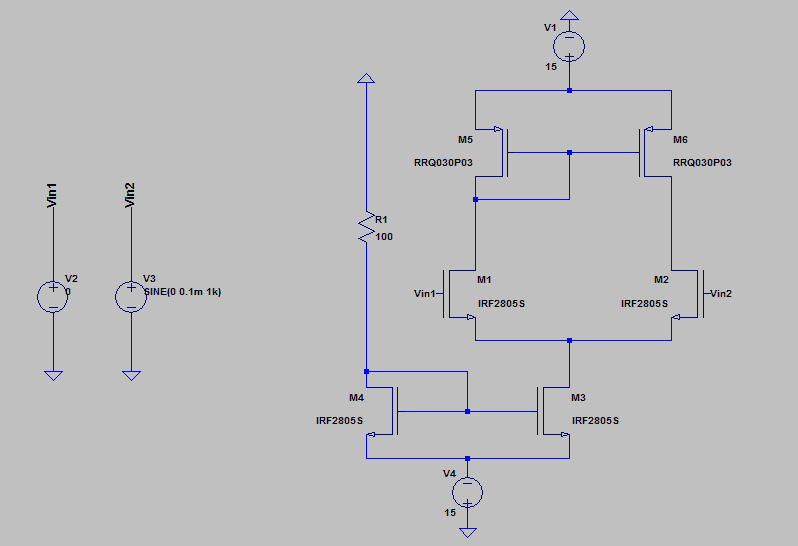
0j6aGh6.png


Practically when I get the drain output I have a big amplification but with a HUGE DC offset: 12 volts about!
Do you know why?Did I mistaken somehitng?

Moreover I don't remember a thing from my electronics studies: should R1 be linked to ground or to V1?

Thank you very much
 
Engineering news on Phys.org
Perhaps it's better this way
DifferentialM.PNG

― the drain of M1 ought to be kept at the same voltage as M2.

It's better to use a dual matched pair of MOSFET in one package as M1 and M2.
 
Last edited:
Your solution makes sense, I have some thoughts though:
First, I would like to use as less resistors as possible, like if it was an IC amplifier.
Secondly, I would like to know why my circuit offsets the voltage so much. This is basically the easiest form of differential amplifier, so there must be a problem I cannot recognize.

9s7y7ra.png


This is from the Sedra-Smith; as as you see I replaced the current source with the mirror, but the offset is still there.

What I think is that there is some problem either with transistors model, or ltspice itself. In fact I simulated an exercise from Sedra-Smith:

gC8bBlY.png


Which results are Rd=5k and Rs=3.25; and LTSpice gives different values for Id and Vd! The model I used is:

.model M1 NMOS(Vto=0.7 Kp=100u L=1u W=32u)

Is the model wrong?
 
It may well be the channel length modulation effect (neglected in the textbook but not in LTspice) to blame. In ICs, MOSFETs with very low channel modulation must be used, otherwise all the mirrors would work wrong. With your differential amplifier, I would first try to decrease the positive supply so as to make the drain potentials (left and right) equal when both the inputs are grounded.
 
Frank-95 said:
Practically when I get the drain output I have a big amplification but with a HUGE DC offset: 12 volts about!
Do you know why?Did I mistaken somehitng?
You are operating the amplifier in open loop. What are you measuring the huge DC offset voltage relative to.

Frank-95 said:
Moreover I don't remember a thing from my electronics studies: should R1 be linked to ground or to V1?
Ground will be quieter and heat the resistor half as much.
 
Your output voltage, (drains of M2 and M6 ?), is centred about +12 volt above ground because that is the voltage on the drain of M5, (and on the gates of the symmetrical p-channel mirror).
 
  • Like
Likes Frank-95
Baluncore said:
Your output voltage, (drains of M2 and M6 ?), is centred about +12 volt above ground because that is the voltage on the drain of M5, (and on the gates of the symmetrical p-channel mirror).

Oh right, my bad, that is the bias point; I've avoided that bypassing the output with a capacitor. But now an abvious questions arises: in real multistage opamp, where the output of one stage is the input of the next stage, is the dc component kept in each stage, it doesn't seem so to me, does it? Moreover, even if it does, is the output always bypassed with a capacitor in real cases?
 
As pointed out by Baluncore we never use this type of circuit without some sort of a negative feedback to "set" DC conditions.
Frank-95 said:
Which results are Rd=5k and Rs=3.25; and LTSpice gives different values for Id and Vd! The model I used is:

.model M1 NMOS(Vto=0.7 Kp=100u L=1u W=32u)

Is the model wrong?

No, your model is just fine. I for Rd = 5k and Rs = 3.25k get Id≈400μA in LTspice
You can also use this model
.model n VDMOS (Vto=0.7 Kp=3.2m)
 
Here is an output stage added to the differential front end.
Attached is an LTspice file diff-amp.asc. Remove the .txt extension to view or run it.
 

Attachments

Last edited:
  • #10
Jony130 said:
No, your model is just fine. I for Rd = 5k and Rs = 3.25k get Id≈400μA in LTspice
You can also use this model
.model n VDMOS (Vto=0.7 Kp=3.2m)

CbL4JyA.png


Oh I don't know, this circuit keeps on yielding 54 uA :/

Baluncore said:
Here is an output stage added to the differential front end.
Attached is an LTspice file diff-amp.asc. Remove the .txt extension to view or run it.

Thank you very much, I got your point :)
 
  • #11
Frank-95 said:
Oh I don't know, this circuit keeps on yielding 54 uA :/
Change NMOS name into M1 . Upper M1 is a transistor designation number not the sim MODEL.
 
  • Like
Likes Frank-95
  • #12
Thank you, got it!
 

Similar threads

Replies
2
Views
2K
  • · Replies 1 ·
Replies
1
Views
2K
  • · Replies 3 ·
Replies
3
Views
3K
  • · Replies 24 ·
Replies
24
Views
4K
  • · Replies 3 ·
Replies
3
Views
4K
  • · Replies 29 ·
Replies
29
Views
5K
Replies
20
Views
5K
  • · Replies 17 ·
Replies
17
Views
4K
  • · Replies 9 ·
Replies
9
Views
4K
  • · Replies 1 ·
Replies
1
Views
2K