Discussion Overview
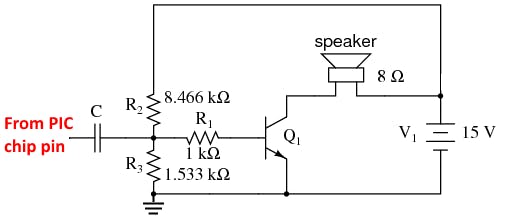
The discussion revolves around understanding common-emitter amplifiers, particularly in the context of building a simple amplifier circuit for homemade speakers. Participants explore the circuit's operation, component values, and implications of the ground symbol in the schematic.
Discussion Character
- Exploratory
- Technical explanation
- Debate/contested
- Mathematical reasoning
Main Points Raised
- One participant expresses confusion about how input and output voltages interact in a common-emitter amplifier and seeks clarification on the ground symbol in the schematic.
- Another participant questions the meaning of "crossing over" voltages and suggests that a common-emitter amplifier functions as a voltage inverter.
- A participant explains that the ground symbol indicates a reference point for voltage and discusses the implications of AC coupling in the input signal.
- Concerns are raised about DC biasing affecting loudspeaker performance, suggesting that loudspeakers should be AC-connected to avoid constant displacement of the diaphragm.
- Some participants discuss the limitations of the circuit design, including the inability of a single transistor to effectively drive the loudspeaker both high and low.
- There is a mention of using two output transistors to improve the circuit's performance, with a comparison to class A and class B amplifiers introduced.
- Clarifications are made regarding the definitions of amplifier classes, particularly the differences in idle current and their implications for circuit design.
- One participant notes that the original question may be too basic for the community, suggesting a need for further clarification from the original poster.
Areas of Agreement / Disagreement
Participants express differing views on the implications of the common-emitter amplifier design, particularly regarding DC biasing and the effectiveness of the circuit. There is no consensus on the best approach to resolve the issues raised.
Contextual Notes
Participants highlight various assumptions about component values, circuit behavior, and the nature of the input signal, which remain unresolved. The discussion includes technical details that may depend on specific circuit configurations and component characteristics.
Who May Find This Useful
Individuals interested in electronics, particularly those exploring amplifier design and circuit behavior in audio applications, may find this discussion relevant.