Voltage Regulator Circuit Calculations

Click For Summary
SUMMARY

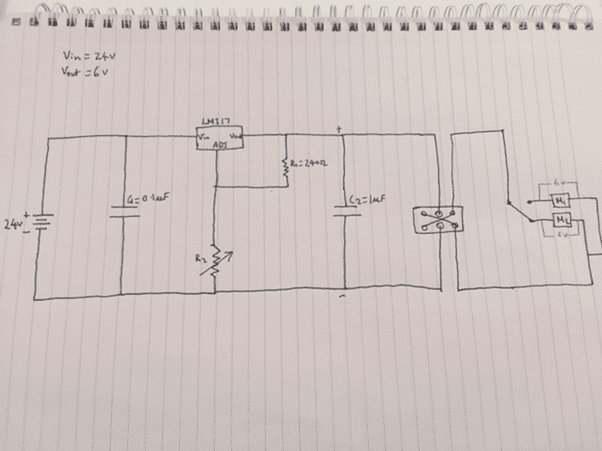
The discussion focuses on calculating output current in a voltage regulator circuit using an LM317 linear regulator, where the input voltage is 24V and the output voltage is reduced to 6V. Users emphasize the importance of measuring the current directly, as the current draw depends on the motor characteristics and mechanical load. The LM317 has a built-in current limit of approximately 1.5A, and users should be cautious of the Locked Rotor Amps (LRA) when switching motor directions, as this can exceed the regulator's capacity and lead to overheating without proper heat sinking.

PREREQUISITES
  • Understanding of LM317 linear voltage regulators
  • Basic knowledge of current measurement techniques using ammeters
  • Familiarity with motor specifications, including full load and locked rotor ratings
  • Knowledge of heat sinking requirements for voltage regulators
NEXT STEPS
  • Learn how to measure current accurately in a circuit with an ammeter
  • Research the specifications and datasheet of the LM317 voltage regulator
  • Investigate the characteristics of micro metal gear motors and their current ratings
  • Explore heat sink design and selection for linear voltage regulators
USEFUL FOR

Electronics enthusiasts, hobbyists working with motor control circuits, and engineers designing voltage regulation systems for motors will benefit from this discussion.
Alexander1
Messages
13
Reaction score
0
Hey Guys, so I'm just in need of some help in relation to finding the output current after the voltage has been dropped to 6V. The circuit has an input voltage of 24V and I've attached a photo of my circuit diagram. Hopefully I haven't made any errors in that, but I've tested the circuit and it does work effectively. The purpose of the circuit is to be able to flick between motors and also change their direction of rotation. The reason I need to know the output current is so I can find the power that each motor will require but I'm just a bit confused. Thanks.
upload_2017-5-7_14-30-46.png
 
Engineering news on Phys.org
You would have to measure the currents.

Unless the motor comes with information about how much current it draws when supplied with 6 volts and with different loads, the only way you can find out is to measure it.

You could put an ammeter in series with each motor, but this might cause the current to be reduced due to the resistance of the meter.

Or, you could put the meter directly after the 24 volt supply and measure the current there.

You could measure without the motors to work out how much is being used by the resistors and the regulator. Then subtract this from the figure you get with the motors running.
 
Last edited:
  • Like
Likes Alexander1
Thanks very much. The motors are micro metal gear motors so I'll have a look and see if they have that information.
 
Alexander1 said:
Hey Guys, so I'm just in need of some help in relation to finding the output current after the voltage has been dropped to 6V.

As VK6KRO has said, just measure it

Be aware that the LM317 like most other linear regulators have inbuilt current limiting --- check the specifics in the datasheet
it's somewhere around 1.5A
 
  • Like
Likes Alexander1
How much current is drawn depends on motor characteristics as VK6KRO and davenn have said, but also upon how much mechanical load is present at the motor shaft. The motors will have a full load current rating, and (possibly) a locked rotor rating.

Keep in mind that when flipping the direction switch the motor will pull LRA (Locked Rotor Amps) as it spins down before reversing itself. This can be quite a bit more than full load current, and may be enough to put the LM317 into overload limiting. If operating anywhere near the 1.5 amp rating bolt a fairly hefty heat sink to the regulator, or chances are good that it'll fry.
 
  • Like
Likes davenn and Alexander1
Most likely this can only be answered by an "old timer". I am making measurements on an uA709 op amp (metal can). I would like to calculate the frequency rolloff curves (I can measure them). I assume the compensation is via the miller effect. To do the calculations I would need to know the gain of the transistors and the effective resistance seen at the compensation terminals, not including the values I put there. Anyone know those values?

Similar threads

  • · Replies 6 ·
Replies
6
Views
2K
  • · Replies 38 ·
2
Replies
38
Views
5K
  • · Replies 16 ·
Replies
16
Views
2K
Replies
38
Views
6K
  • · Replies 14 ·
Replies
14
Views
2K
  • · Replies 16 ·
Replies
16
Views
4K
  • · Replies 7 ·
Replies
7
Views
4K
  • · Replies 34 ·
2
Replies
34
Views
10K
Replies
2
Views
3K
  • · Replies 14 ·
Replies
14
Views
2K