Need help with voltage regulator circuit that uses 7805

Click For Summary

Discussion Overview

The discussion revolves around troubleshooting issues with a voltage regulator circuit using a 7805 regulator in a microcontroller setup. Participants explore the circuit's performance, particularly the output voltage drop and overheating of the regulator, while considering alternative designs and components.

Discussion Character

  • Exploratory, Technical explanation, Debate/contested

Main Points Raised

  • One participant describes a circuit involving a PIC16F877A microcontroller, an LCD module, a keyboard, and an RTC module, all requiring a +5V supply, and reports issues with the 7805 regulator overheating and output voltage dropping significantly.
  • Another participant suggests the possibility of a miswire or short circuit in the power wiring, recommending testing the circuit with the ICs removed to isolate the issue.
  • Some participants speculate that the load from the components should not exceed 200 mA, indicating a potential fault or short circuit as the cause of the excessive current draw.
  • There is a request for clarification on the specific type of 7805 being used, noting that variations exist with different current ratings and pinouts.
  • A suggestion is made to test the 7805 with a known load (100 ohm resistor) to verify its output voltage under normal conditions, which could help identify if the problem lies with the PCB design.
  • Concerns are raised about potential oscillation in the circuit, which could lead to malfunctioning behavior, with a recommendation to check the output with an oscilloscope.
  • Some participants mention alternative regulators, such as the LM350, which can handle higher current, and switching buck regulators as potential solutions.

Areas of Agreement / Disagreement

Participants generally agree that the issues may stem from a short circuit or faulty component, but there is no consensus on the exact cause or solution. Multiple competing views on troubleshooting methods and alternative components are present.

Contextual Notes

Participants note the importance of verifying the specific type of 7805 used, as well as the need to check for shorts and oscillations, indicating that the discussion is highly dependent on the specifics of the circuit design and component selection.

thegreengineer
Messages
54
Reaction score
3
Well let me explain. I've finished a circuit that consists in a microcontroller unit (in this case a PIC16F877A) that is connected to a LCD module, a keyboard and a RTC module (via I2C protocol). As far as I know all of them require VCC (=+5V) for operating so I needed to create a +5V regulated source. At first I used the basic configuration of a +9V battery connected to a 7805 regulator with capacitors for smoothing. The circuit was kinda this (and I say kinda because I don't remember so well the capacitors' values)
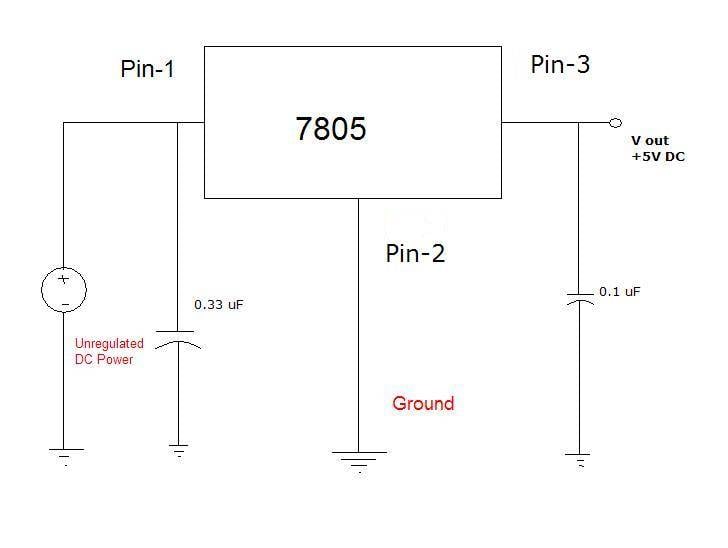
5v_power_supply_circuit_diagram1.jpg

When I wired it up I noticed two things, the output voltage from the 7805 dropped from +5 V (in fact it was +5.08 V) to a few millivolts after connecting it to the microcontroller circuit. The other thing I noticed was that the 7805 regulator was tremendously hot (so hot I couldn't even touch it with my bare hands and had to wait around 1 minute to cool down). I used a heat sinker, but still got hot.

This was not the first time this happens to my designs, so I went checking for alternatives that include a 7805 regulator that are capable of sourcing more current (since as far as I know the 7805 can only supply a maximum of 1.5 A) so I wanted to know what kind of circuit design could you recommend me in order to get 5 V output with more current. I appreciate your answers and comments.
 

Attachments

  • 5v_power_supply_circuit_diagram1.jpg
    5v_power_supply_circuit_diagram1.jpg
    15.4 KB · Views: 5,447
Engineering news on Phys.org
I'm assuming you are using a 7805 in the TO-220 package, the one with a plastic body, a metal mounting tab with a single mounting hole, and three leads coming out the side furthest from the mounting hole. If that is the case, it sure sounds like there is a miswire on one or more of your boards, that is to say a short circuit in the power wiring or power wired to the pins of an IC. If possible, try it with the ICs removed, and the keyboard. (They are in sockets aren't they?) Another possibility is there is an electrolytic capacitor that is wired backwards.

From the list of ICs you are using, I would expect way less than 1A load.

It sounds like you are getting an early taste of troubleshooting. That can be both the most fun and the most annoying part of a project, but you learn more from the mistakes than from the successes (darn it!).
 
  • Like
Likes   Reactions: jim hardy
Sounds like just a clock. Of the elements mentioned LCD requires the highest current, but if memory serves me well it is still well below 200 mA. Before switching to something capable of delivering more current I would check what consumes so much. I suspect either a faulty element or just a short circuit somewhere.

Edit: Tom.G was faster, but he confirms my intuition - there is nothing that could draw so much current.
 
It would be useful to know the exact type of that '7805'. As it is now, this chip can be purchased with output current from 100mA to 1.5A and the term '7805' is also used for DCDC converters with slightly similar pinout and 5V output voltage.
 
MarcusAu314 said:
I've finished a circuit that consists in a microcontroller unit (in this case a PIC16F877A) that is connected to a LCD module, a keyboard and a RTC module (via I2C protocol).
You can test the 7805 regulator by connecting a 100 ohm resistor as a load. That will draw a realistic 50 mA. If the output voltage remains over +4.75V then the power supply is probably OK and the problem is with the project PCB. Has the PCB been tested with another supply?

A 7805 will go into thermal shutdown to protect itself if you short circuit the output. My guess is that you have a short circuit between common=0V=ground and +5V=Vcc on the project PCB. Start by measuring the resistance between +5V and 0V input. Reverse the meter polarity and measure again. What do you get?

If it shows a short circuit, give the PCB a close visual inspection. I would look first for a solder bridge, then for a dead bypass capacitor, maybe a tantalum capacitor or a chip installed backwards. Whatever it is will be so simple that you have overlooked it.

If it still measures a power input short circuit, then you might try lifting some bypass components as you check for a change in the resistance. Consider cutting a Vcc power supply track to isolate the fault to one part of the PCB, keep doing that until your binary search identifies the cause of the short. Do it sensibly because you will have to stitch the tracks back together.

Can you give us a link to the project circuit diagram?
 
  • Like
Likes   Reactions: Tom.G and jim hardy
If you don't find any shorts or other problems with the target you may have oscillation occurring. This in turn can cause the target to malfunction to a latched-up state.

Do you have an oscilloscope handy? Does the voltage output do anything at startup? How much and what type of capacitance do you have in the target?

BoB
 
rbelli1 said:
Do you have an oscilloscope handy?
@MarcusAu314

Quick check internal Power limiter : How much voltage is on that 'unregulated' side ? How much power per 100 milliamps does that create inside yout 7805 ?

Quick check for oscillation: Set your DMM to AC and measure output.

LM350 is a 3 amp regulator , but like others here i think you have a short someplace.

And there are switching buck voltage regulators like this one @Baluncore recently pointed out in another thread
https://www.physicsforums.com/threads/lm317t-is-heating.928116/#post-5859837
all over Ebay
http://www.ebay.com.au/itm/Voltage-Regulator-LM2596-3A-Adjustable-DC-To-DC-Step-Down-Converter-Buck-Module/232274773224?
 

Similar threads

Replies
39
Views
6K
  • · Replies 38 ·
2
Replies
38
Views
5K
  • · Replies 4 ·
Replies
4
Views
2K
  • · Replies 10 ·
Replies
10
Views
2K
  • · Replies 16 ·
Replies
16
Views
4K
Replies
10
Views
2K
  • · Replies 18 ·
Replies
18
Views
3K
Replies
2
Views
2K
  • · Replies 5 ·
Replies
5
Views
2K
  • · Replies 34 ·
2
Replies
34
Views
10K