Voltage Regulator Project: Hysterisis, 9V, 15 Ohm Load

Click For Summary

Discussion Overview

The discussion centers around the design of a voltage regulator for a university project, specifically focusing on implementing hysteresis to achieve a 9V output from a 16Vrms AC power supply with a 15 ohm load. Participants explore various circuit design considerations, including overload protection and the choice of components.

Discussion Character

  • Technical explanation
  • Debate/contested
  • Homework-related

Main Points Raised

  • One participant suggests using a simple 9V DC regulator after a capacitor, questioning whether this approach aligns with the project requirements.
  • Another participant expresses concern that using a simple regulator might be considered "cheating" and implies that the assignment likely requires a switching regulator design instead.
  • A participant comments on the placement of the current sensing resistor, suggesting it should be positioned before the transistor to avoid complications with grounding in a non-isolated buck converter.
  • There is uncertainty regarding the use of a snubber on the flywheel diode, with one participant noting that it could lower efficiency and questioning its necessity.
  • Another participant raises a point about the use of a Darlington transistor for Q1, indicating that it could significantly impact efficiency.
  • Several participants emphasize the importance of incorporating hysteresis in the comparator circuit to ensure stability, expressing discomfort with designs lacking positive feedback hysteresis.

Areas of Agreement / Disagreement

Participants express differing opinions on the appropriateness of using a linear regulator versus a switching regulator, indicating a lack of consensus on the best approach for the project. There are also varying views on specific circuit design choices, such as component placement and the necessity of certain elements like snubbers.

Contextual Notes

Participants have not fully resolved the implications of using different types of regulators, nor have they reached a consensus on the optimal circuit design. Some assumptions about component behavior and circuit efficiency remain unaddressed.

Who May Find This Useful

Students and hobbyists interested in voltage regulation design, particularly those working on projects involving hysteresis and switching regulators.

LostEngKid
Messages
12
Reaction score
0
hey guys, I've got to make a voltage regulator for a uni project. it has to use hysterisis and produce 9v out from a 16Vrms AC powerpack over a 15 ohm load. It also needs overload protection, I've drawn up the attached circuit, i think it will work and filled in some of the values i know but I am stuck for the others, any help would be great.
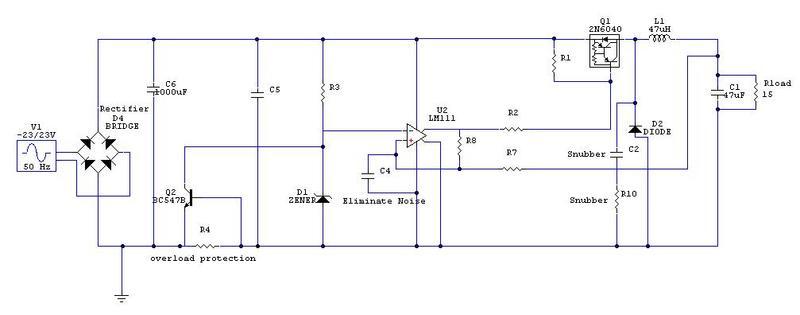
circuit.JPG
 
Physics news on Phys.org
I'm not qualified to analyze a circuit like that, but what about using a simple 9Vdc regulator after cap C6?
 
I think that's cheating!
 
LostEngKid said:
hey guys, I've got to make a voltage regulator for a uni project. it has to use hysterisis and produce 9v out from a 16Vrms AC powerpack over a 15 ohm load. It also needs overload protection, I've drawn up the attached circuit, i think it will work and filled in some of the values i know but I am stuck for the others, any help would be great.

View attachment 15072

Couple comments:

-- Usually I would put the current sensing resistor in the + feed, right before Q1. Having it in the negative return complicates the grounding of this non-isolated buck converter.

-- I'm not sure about the snubber on the flywheel diode. I've never used one, and generally haven't seen them used in bucks. It will lower your efficiency at least. Why do you have it there?

-- It seems like you should consider putting a bit of hysteresis in your comparator circuit. I'm not generally comfortable with comparator circuits without at least some postitive feedback hysteresis.
 
Redbelly98 said:
I'm not qualified to analyze a circuit like that, but what about using a simple 9Vdc regulator after cap C6?

I get the feeling that the assignment is to design a switching regulator, rather than a linear regulator.
 
berkeman said:
Couple comments:

-- Also, is there a reason that you are using a Darlington for Q1? That will impact your efficiency pretty significantly.


Quiz Question: Why?

.
 
Redbelly98 said:
... what about using a simple 9Vdc regulator after cap C6?

mgb_phys said:
I think that's cheating!

berkeman said:
I get the feeling that the assignment is to design a switching regulator, rather than a linear regulator.

Whoops, my bad!
 
berkeman said:
Couple comments:

-- It seems like you should consider putting a bit of hysteresis in your comparator circuit. I'm not generally comfortable with comparator circuits without at least some postitive feedback hysteresis.

Another Quiz Question for the original poster (OP) -- Why do I say this about comparator hysteresis?
 

Similar threads

  • · Replies 15 ·
Replies
15
Views
2K
  • · Replies 18 ·
Replies
18
Views
5K
  • · Replies 1 ·
Replies
1
Views
4K
  • · Replies 2 ·
Replies
2
Views
2K
  • · Replies 12 ·
Replies
12
Views
13K
  • · Replies 7 ·
Replies
7
Views
4K
Replies
18
Views
3K
Replies
6
Views
3K
  • · Replies 17 ·
Replies
17
Views
13K
  • · Replies 6 ·
Replies
6
Views
3K