Waveguide: get I and II M.eq. from III and IV M.eq.

Click For Summary

Discussion Overview

The discussion revolves around the derivation of Maxwell's equations in a waveguide context, specifically how to obtain certain equations (labeled B) from others (labeled A). The focus is on the validity of the equations and the nature of vector and scalar quantities within the framework of electromagnetism.

Discussion Character

  • Technical explanation
  • Debate/contested

Main Points Raised

  • One participant presents the waveguide equations and questions the utility of equations B, suggesting they can be derived from equations A.
  • Another participant questions the validity of the equations presented, noting that one should be a vector and the other a scalar.
  • A third participant asserts that the equations cannot be true, emphasizing that a vector cannot equal a scalar, and cites the divergence of E and B as zero under certain conditions.
  • The original poster later corrects their initial statement, clarifying that they intended to reference the divergence equations for E and B as zero when there are no sources.

Areas of Agreement / Disagreement

Participants express disagreement regarding the validity of the equations presented, with some asserting that the equations cannot be true due to the nature of vectors and scalars. The discussion remains unresolved as to how to derive equations B from A.

Contextual Notes

There are limitations in the clarity of the equations presented, particularly regarding the distinction between vector and scalar forms. The discussion also highlights the dependence on the assumption of no sources affecting the fields.

crick
Messages
39
Reaction score
4
Consider a waveguide with axis parallel to axis ##z##. Using cartesian coordinates the fields inside the waveguide can be written as

Immaginiie.png

Where ##\alpha## is the wavenumber and ##k=\frac{\omega}{c}## .

The maxwell equations ##\nabla \times E=-\frac{\partial B}{\partial t}## and ##\nabla \times B=\epsilon \mu \frac{\partial E}{\partial t}## are written in components as
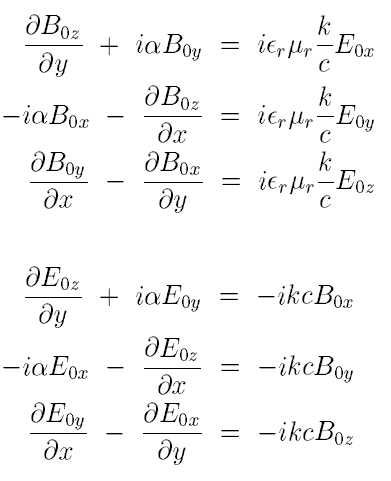
Immaginke.png
##\tag{(A)}##While the maxwell equations ##\nabla \cdot E=-\frac{\partial B}{\partial t}## and ##\nabla \cdot B=\epsilon \mu \frac{\partial E}{\partial t}## are written in components as
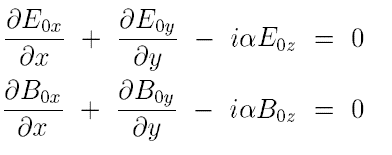
Immagikne.png

##\tag{(B)}##

On textboox it is claimed that equations ##B## are not useful, since they can obtained from equations ##A##. So how to obtain equations ##B## using equations ##A##?
 
Physics news on Phys.org
crick said:
∇×E=−∂B/∂t

crick said:
∇⋅E=−∂B/∂t
Are these both true? One should be a vector and one a scalar.
 
Of course, they are not true since
$$\vec{\nabla} \cdot \vec{E}=0, \quad \vec{\nabla} \cdot \vec{B}=0.$$
A vector can never ever be equal to a scalar!
 
mjc123 said:
Are these both true? One should be a vector and one a scalar.
vanhees71 said:
Of course, they are not true since
$$\vec{\nabla} \cdot \vec{E}=0, \quad \vec{\nabla} \cdot \vec{B}=0.$$
A vector can never ever be equal to a scalar!

EDIT OF THE QUESTION: I apologize, I made a mistake, I intended to write the first two maxwell equations, that are ##\nabla \cdot E=0## and ##\nabla \cdot B=0## (if there are no sources). ##E## and ##B## are intended to be vectors.
 
  • Like
Likes   Reactions: vanhees71

Similar threads

  • · Replies 1 ·
Replies
1
Views
979
  • · Replies 5 ·
Replies
5
Views
999
  • · Replies 3 ·
Replies
3
Views
1K
  • · Replies 5 ·
Replies
5
Views
1K
  • · Replies 10 ·
Replies
10
Views
1K
  • · Replies 6 ·
Replies
6
Views
2K
  • · Replies 3 ·
Replies
3
Views
1K
  • · Replies 7 ·
Replies
7
Views
2K
  • · Replies 29 ·
Replies
29
Views
2K
  • · Replies 1 ·
Replies
1
Views
2K