Waveguide standing wave pattern

Click For Summary

Discussion Overview

The discussion revolves around the measurement of standing wave patterns within a waveguide in the X band, specifically addressing unexpected results when using a slotted line with a short circuit termination. Participants explore the implications of different load conditions and potential sources of error in the measurements.

Discussion Character

  • Exploratory
  • Technical explanation
  • Debate/contested

Main Points Raised

  • One participant reports measuring a standing wave pattern and expects a rectified sine wave but observes different results, prompting a request for assistance.
  • Another participant suggests that the observed pattern may resemble phase variation rather than amplitude variation, questioning the interpretation of the results.
  • Several participants inquire about how the standing wave pattern changes with different load conditions, such as good match, fair match, and short circuit.
  • A participant notes that measurements in air yield better results compared to those with a short circuit, speculating that the propagation mode may influence the outcomes.
  • One participant, drawing from experience with UHF and coax feeders, suggests using a 3dB attenuator to improve the match and proposes that harmonics in the signal source could be contributing to the observed anomalies.

Areas of Agreement / Disagreement

Participants express varying interpretations of the results and the factors affecting the standing wave patterns, indicating that multiple competing views remain without a clear consensus on the underlying issues.

Contextual Notes

Participants mention potential limitations related to the measurement setup, including the influence of load conditions and the characteristics of the signal source, but do not resolve these uncertainties.

Who May Find This Useful

This discussion may be of interest to those involved in microwave engineering, waveguide design, and experimental physics, particularly in the context of standing wave measurements and signal integrity.

JuanCarlos
Messages
3
Reaction score
0
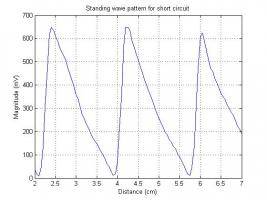
Hi everybody, that's my question, I have been measuring the standing wave pattern within a waveguide (X band) using a slotted line, I put a short circuit termination and the theory said that we expect a rectified sine, but I don't get that, my result is in the picture
thump_8136214swrpat.jpg


I can't explain my results and I have tried with two different microwave sources (10.5 GHz).

I appreciate your help.
 
Engineering news on Phys.org
JuanCarlos said:
Hi everybody, that's my question, I have been measuring the standing wave pattern within a waveguide (X band) using a slotted line, I put a short circuit termination and the theory said that we expect a rectified sine, but I don't get that, my result is in the picture

thump_8136214swrpat.jpg


I can't explain my results and I have tried with two different microwave sources (10.5 GHz).

I appreciate your help.

That looks more like the phase variation along a line than the amplitude variation. Is that possible?
 
How does that pattern change when you change the load on the end (good match / fair match / short circuit) ?
 
I have measured the standing wave pattern in the air using the same source and the results looks better, of course that's not a short circuit but the wave is not inclined.

thump_8136530swrair.jpg


I've been thinking if it is about the propagation mode.
 
sophiecentaur said:
How does that pattern change when you change the load on the end (good match / fair match / short circuit) ?

The picture is a short circuit, and when the load is changed, the swr and the phase changes, but the wave is still inclined.

thump_8136540swrarb.jpg


That's an arbitrary load pattern.
 
You need someone with more experience with waveguide, I think. My actual work was all on UHF and coax feeder.
If I were chasing strange things like that, I think I'd put a 3dB attenuator (resistive) in the source to improve that match and put a good terminating load at the end. If I couldn't get a flattish line then, I would be scratching my head. I could suggest that harmonics in the signal source could be setting up another standing wave which adds to the one you want? (Not relevant if you are using a 'proper' receiver but could be, if you are just using a simple detector.) Solution: filter the output of the signal source.
 

Similar threads

Replies
15
Views
3K
  • · Replies 50 ·
2
Replies
50
Views
6K
Replies
10
Views
2K
  • · Replies 5 ·
Replies
5
Views
3K
  • · Replies 5 ·
Replies
5
Views
1K
  • · Replies 13 ·
Replies
13
Views
4K
  • · Replies 2 ·
Replies
2
Views
2K
  • · Replies 10 ·
Replies
10
Views
2K
  • · Replies 21 ·
Replies
21
Views
3K
  • · Replies 41 ·
2
Replies
41
Views
17K