What are the coordinates of the upper cylinder? (and some algebra)

Click For Summary

Homework Help Overview

The discussion revolves around determining the coordinates of two cylinders in a geometric and algebraic context. The original poster presents the coordinates of the lower cylinder and seeks clarification on the coordinates of the upper cylinder, as well as how to combine two equations related to their motion.

Discussion Character

  • Mixed

Approaches and Questions Raised

  • The original poster attempts to understand the geometric reasoning behind the coordinates of the upper cylinder, specifically the y-coordinate expression.
  • Participants discuss the algebraic manipulation of two equations to eliminate a variable and derive a specific result.
  • Some participants question the assumptions regarding the motion of the cylinders and the application of small angle approximations.

Discussion Status

Participants are actively exploring the geometric and algebraic aspects of the problem. Some have offered hints and suggestions for approaching the algebraic issue, while others are still seeking clarity on the geometric reasoning. There is no explicit consensus on the geometric issue, and the algebraic problem has seen some progress.

Contextual Notes

There are indications that the problem may involve calculus and kinematics, with discussions about the rolling motion of the cylinders without slipping. The original poster is encouraged to provide more context for better assistance.

JD_PM
Messages
1,125
Reaction score
156
Homework Statement
1) Get the coordinates of both the lower and upper cylinders.

2) Combine the two given equations to get the given result.
Relevant Equations
1) ##( x_1 + 2R \sin \theta, 3R - 2(R-\cos \theta))##

2) Combine

$$\frac 1 2 M R^2 \Big( 3 \dot \theta_1^2 + 2 \dot \theta_1 \dot \theta(1 - 2 \cos \theta) + 6 \dot \theta^2 \Big) + 2MR(1 + \cos \theta)g = 4MRg \ \ \ \ (1)$$

$$MR^2 \Big(3 \dot \theta_1 + \dot \theta ( 1 - 2 \cos \theta) \Big)=0 \ \ \ \ (2)$$

To get

$$\dot \theta^2 \Big( 18 - (1 - 2 \cos \theta)^2 \Big) = \frac 12 R (1 -\cos \theta) g$$
I was solving a problem and got stuck in two aspects:

1) Geometric issue.
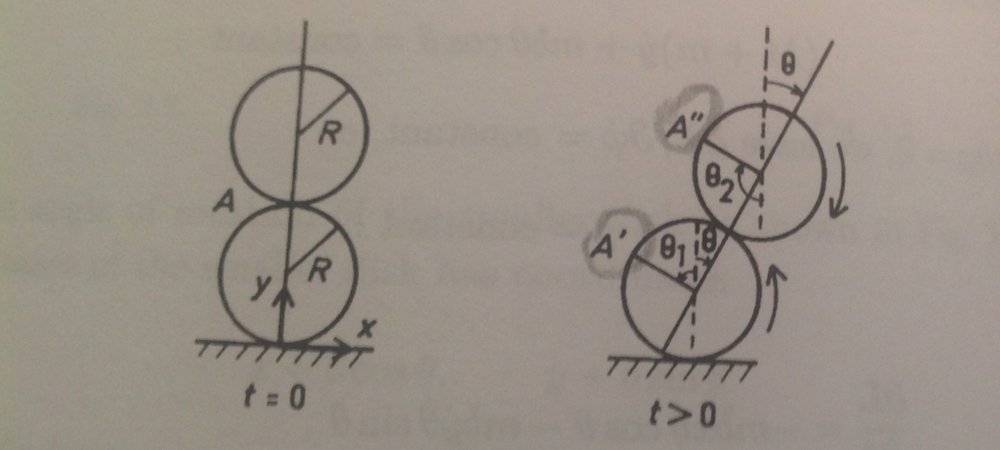
FullSizeRender (50).jpg


Alright, I understand that the coordinates of the lower cylinder are

$$( -R \theta_1, R)$$

The coordinates of the upper cylinder are:

$$( x_1 + 2R \sin \theta, 3R - 2(R-\cos \theta))$$

I get that the ##x## coordinate of the upper cylinder is ##x_2 = x_1 + 2R \sin \theta##

But I do not understand why ##y_2 = 3R - 2(R-\cos \theta)##.

2) Algebraic issue

I have the following two equations:

$$\frac 1 2 M R^2 \Big( 3 \dot \theta_1^2 + 2 \dot \theta_1 \dot \theta(1 - 2 \cos \theta) + 6 \dot \theta^2 \Big) + 2MR(1 + \cos \theta)g = 4MRg \ \ \ \ (1)$$

$$MR^2 \Big(3 \dot \theta_1 + \dot \theta ( 1 - 2 \cos \theta) \Big)=0 \ \ \ \ (2)$$

There has to be a way to combine them such that we eliminate ##\theta_1## to get:

$$\dot \theta^2 \Big( 18 - (1 - 2 \cos \theta)^2 \Big) = \frac 12 R (1 -\cos \theta) g$$

But I do not see it. What I have done is multiply the second equation by ##-\frac{\dot \theta_1}{2}## and then add both up. Like that I just get rid of the first terms of both equations.

Could you please give me some hints on 1) and 2) issues?

Thanks.
 
  • Like
Likes   Reactions: PhDeezNutz
Physics news on Phys.org
JD_PM said:
Homework Statement:: 1) Get the coordinates of both the lower and upper cylinders.

2) Combine the two given equations to get the given result.
Relevant Equations:: 1) ##( x_1 + 2R \sin \theta, 3R - 2(R-\cos \theta))##

2) Combine

$$\frac 1 2 M R^2 \Big( 3 \dot \theta_1^2 + 2 \dot \theta_1 \dot \theta(1 - 2 \cos \theta) + 6 \dot \theta^2 \Big) + 2MR(1 + \cos \theta)g = 4MRg \ \ \ \ (1)$$

$$MR^2 \Big(3 \dot \theta_1 + \dot \theta ( 1 - 2 \cos \theta) \Big)=0 \ \ \ \ (2)$$

To get

$$\dot \theta^2 \Big( 18 - (1 - 2 \cos \theta)^2 \Big) = \frac 12 R (1 -\cos \theta) g$$

I was solving a problem and got stuck in two aspects:

1) Geometric issue.

View attachment 256891

Alright, I understand that the coordinates of the lower cylinder are

$$( -R \theta_1, R)$$

The coordinates of the upper cylinder are:

$$( x_1 + 2R \sin \theta, 3R - 2(R-\cos \theta))$$

I get that the ##x## coordinate of the upper cylinder is ##x_2 = x_1 + 2R \sin \theta##

But I do not understand why ##y_2 = 3R - 2(R-\cos \theta)##.

2) Algebraic issue

I have the following two equations:

$$\frac 1 2 M R^2 \Big( 3 \dot \theta_1^2 + 2 \dot \theta_1 \dot \theta(1 - 2 \cos \theta) + 6 \dot \theta^2 \Big) + 2MR(1 + \cos \theta)g = 4MRg \ \ \ \ (1)$$

$$MR^2 \Big(3 \dot \theta_1 + \dot \theta ( 1 - 2 \cos \theta) \Big)=0 \ \ \ \ (2)$$

There has to be a way to combine them such that we eliminate ##\theta_1## to get:

$$\dot \theta^2 \Big( 18 - (1 - 2 \cos \theta)^2 \Big) = \frac 12 R (1 -\cos \theta) g$$

But I do not see it. What I have done is multiply the second equation by ##-\frac{\dot \theta_1}{2}## and then add both up. Like that I just get rid of the first terms of both equations.

Could you please give me some hints on 1) and 2) issues?

Thanks.
You really need to give more details and give the context for this problem.

It looks like it might be posted in the wrong forum. You have derivatives (Calculus) here, and perhaps kinematics relevant to a physics course.

As far as I can tell:
  1. You have two cylinders (each of radius, R) in contact.
  2. When you refer to the coordinates of a cylinder, you mean the coordinates of the center (axis).
  3. θ is the angle that the line joining the centers makes with the vertical (measured clockwise?). At time, t=0, θ=0.
  4. θ1 is amount of rotation (counter-clockwise) made by the lower cylinder.
  5. θ2 is amount of rotation (clockwise) made by the upper cylinder.
Does the lower cylinder slip with respect to the horizontal surface and/or the upper cylinder?

What are A' and A'' ?
.
 
  • Like
Likes   Reactions: JD_PM
SammyS said:
You really need to give more details and give the context for this problem.

Alright, the whole problem is:

Screenshot (1026).png

Screenshot (1027).png
SammyS said:
It looks like it might be posted in the wrong forum. You have derivatives (Calculus) here, and perhaps kinematics relevant to a physics course.

Is Calculus Forum the best option? I will report the question.

SammyS said:
Does the lower cylinder slip with respect to the horizontal surface and/or the upper cylinder?

Both cylinders roll without slipping.
SammyS said:
What are A' and A'' ?

##A## is the point of contact between the cylinders at ##t=0##. This point of contact moves to ##A'## on the lower cylinder and to ##A''## on the upper cylinder at ##t>0##.
 
  • Like
Likes   Reactions: PhDeezNutz
Your Geometrical issue has typing mistake. Instead of ##3R-2(R-cos\theta)##, it should be ##3R-2R(1-cos\theta)## as can be seen from geometry as well as dimensions.

For Algebraic issue:

Try using Eq 2 to substitute ##\theta_1## in Eq (1)
 
  • Like
Likes   Reactions: DEvens and JD_PM
JD_PM said:
Is Calculus Forum the best option? I will report the question.
This (Advanced Physics Homework Help) is where I would have suggested to post this thread. (Thank you Mentor.)
 
Let me tackle the algebraic issue first.

Abhishek11235 said:
For Algebraic issue:

Try using Eq 2 to substitute ##\theta_1## in Eq (1)

Alright you propose using substitution method.

By doing so I get

$$\dot \theta^2 \Big( 6 + (1 - 2 \cos \theta)^2 \Big) = \frac 4 R g(1- \cos\theta)$$

As we already know what we are looking for, I thought of multiplying both sides by ##3## to get:

$$\dot \theta^2 \Big( 18 + 3 (1 - 2 \cos \theta)^2 \Big) = \frac{12}{R} g(1- \cos\theta)$$

But the above equation is not the same that

$$\dot \theta^2 \Big( 18 - (1 - 2 \cos \theta)^2 \Big) = \frac{12}{R} (1 -\cos \theta) g$$

Because

$$3 (1 - 2 \cos \theta)^2 \neq - (1 - 2 \cos \theta)^2$$

Mmm what am I missing?
 
Try again. I got the result.
 
  • Like
Likes   Reactions: JD_PM
Let me show what method I am using to determine the coordinates of the lower and upper cylinder.

The ##(x,y)## coordinates are taken as follows (##x## horizontal and ##y## vertical):

Screenshot (1031).png


Coordinates for the lower cylinder

x coordinate
Screenshot (1030).png


By straightforward geometry we get:

$$\sin \theta_1 = -\frac{x_1}{R}$$

Applying the small angle approximation ##\sin \theta_1 \simeq \theta_1## and solving for ##x_1## we get the desired result:

$$x_1 = -R \theta_1$$

y coordinate

Screenshot (1032).png


The blue line is the radius ##R##. We get the desired result:

$$y_1 = R$$Coordinates for the upper cylinder

x coordinate

Screenshot (1034).png


OK. The method is to obtain an equation for the orange, blue and green pieces and then add them up to obtain an equation for the thin red line.

- Orange slab

We already know an equation for it; ##x_1 = -R \theta_1##

- Blue and green slabs.

Both have the same mathematical expression: ##\sin \theta = \frac{x'}{R} \rightarrow x' = R \sin \theta##

Thus the mathematical expression for both is ##2 R \sin \theta##

Adding the mathematical expressions of the orange, blue and green slabs lead to the desired result (as expected):

$$x_2 = x_1 + 2 R \sin \theta$$

(Note: in the provided solution the small angle approximation is not applied to ##\theta## but it is applied to ##\theta_1##; why?).y coordinate (the one I am stuck in)

Screenshot (1035).png


I wanted to use the latter method to get the desired result

$$y_2 = 3R-2R(1-cos\theta)$$

But it seems that it is not a good idea. For this method to work we would need the blue line not to cross the green slab. How can I proceed then? Should I switch method?

Any help is appreciated.

Thanks.
 
Last edited:
Abhishek11235 said:
Try again. I got the result.

I will try again
 
  • #10
Abhishek11235 said:
Try again. I got the result.

Abhishek11235 thank you! The algebraic issue has been solved.

Only the geometric one is still unsolved.
 
  • #11
JD_PM said:
Let me show what method I am using to determine the coordinates of the lower and upper cylinder.

The ##(x,y)## coordinates are taken as follows (##x## horizontal and ##y## vertical):

View attachment 256959

Coordinates for the lower cylinder

x coordinateView attachment 256958

By straightforward geometry we get:

$$\sin \theta_1 = -\frac{x_1}{R}$$

Applying the small angle approximation ##\sin \theta_1 \simeq \theta_1## and solving for ##x_1## we get the desired result:

$$x_1 = -R \theta_1$$

y coordinate

View attachment 256960

The blue line is the radius ##R##. We get the desired result:

$$y_1 = R$$

Coordinates for the upper cylinder
...


Any help is appreciated.

Thanks.
There is no need to use the small angle approximation.

If the lower cylinder rotates through angle θ1, then any point on the circumference moves a distance ##R \cdot \theta_1## along the circumference of the cylinder. The cylinder moves without slipping on the horizontal surface. Therefore, the cylinder moves a distance, ##R \cdot \theta_1## in the negative ##x## direction.
 
Last edited:
  • #12
JD_PM said:
Abhishek11235 thank you! The algebraic issue has been solved.

Only the geometric one is still unsolved.
As said, the given formula is wrong. The picture will be really helpful to you. Alternatively (which is how I actually got y-coordinate) , we have R distance from ground to centre of 1st sphere. Then there is 2Rcos##\theta## so that total distance is R+2Rcos##\theta##
 

Attachments

  • IMG_20200213_200727.jpg
    IMG_20200213_200727.jpg
    38.2 KB · Views: 259
  • Like
  • Informative
Likes   Reactions: JD_PM and SammyS
  • #13
Your picture was really helpful, thanks.
 

Similar threads

  • · Replies 4 ·
Replies
4
Views
2K
Replies
6
Views
2K
  • · Replies 8 ·
Replies
8
Views
1K
  • · Replies 9 ·
Replies
9
Views
4K
  • · Replies 21 ·
Replies
21
Views
5K
  • · Replies 2 ·
Replies
2
Views
2K
  • · Replies 1 ·
Replies
1
Views
2K
Replies
9
Views
4K
Replies
9
Views
3K