High School What are the different methods of factoring polynomials?

Click For Summary
SUMMARY

The discussion focuses on various methods of factoring polynomials, including the method of common factors, factorization by regrouping terms, and factorization using identities. Participants emphasize the importance of finding roots, particularly for quadratic polynomials, and suggest using iterative methods like Laguerre's method for practical applications. Additionally, the Rational Root Theorem is highlighted as a useful tool for splitting polynomials with integer coefficients. Resources for further learning include NCERT textbooks and other algebra materials, although some participants note a lack of cubic polynomial factorization examples in these resources.

PREREQUISITES
  • Understanding of polynomial expressions and their degrees
  • Familiarity with the Rational Root Theorem
  • Knowledge of iterative methods for finding roots, such as Laguerre's method
  • Basic algebraic identities for polynomial factorization
NEXT STEPS
  • Study the Rational Root Theorem in detail
  • Learn about Laguerre's method for root finding
  • Explore advanced factorization techniques for cubic polynomials
  • Practice polynomial factorization problems using resources like NCERT and algebra textbooks
USEFUL FOR

Students learning algebra, educators teaching polynomial factorization, and anyone seeking to improve their skills in solving polynomial equations.

awholenumber
Messages
200
Reaction score
10
Methods of factoring .

Method of common factors
Factorization by regrouping terms
Factorization using identities
Factors of the form ( x + a) ( x + b)
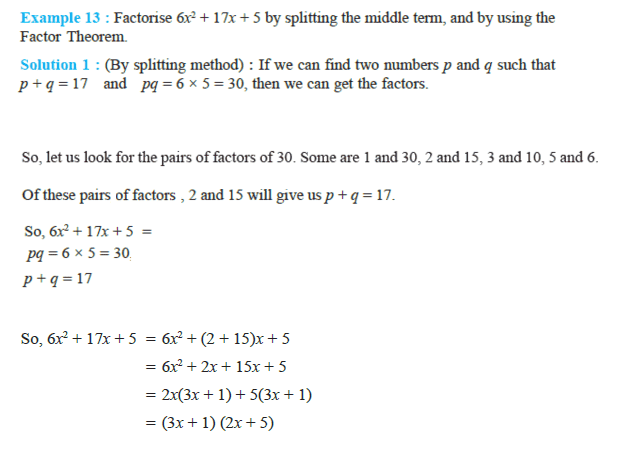
Factor by Splitting
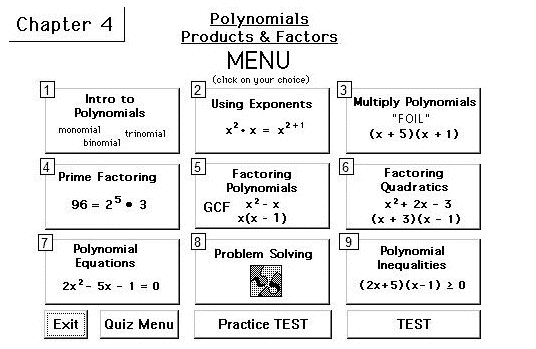
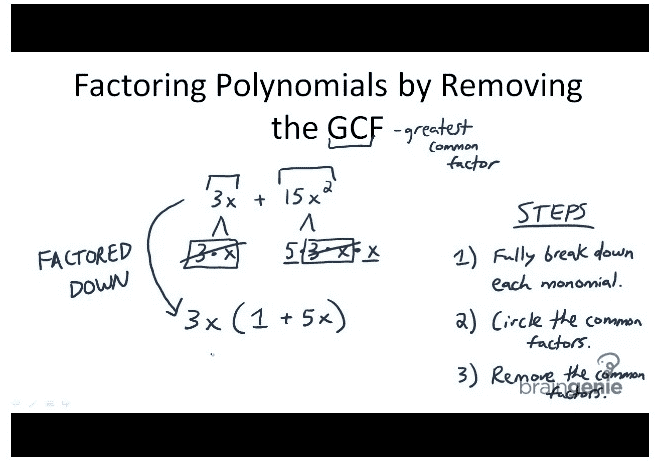
factoring_polynomials.png


factoing_polynomials_2.png

factoring_polynomials_3.png


Is this all the factoring methods out there ? Or are there more ?

I am also looking for a book with lots of practice problems of factoring polynomials .

Please help
 
Mathematics news on Phys.org
If you want to factorize school examples that are designed to have nice results, you can use whatever tricks come to your mind.
If you want to do it in practice, you find the roots first, either with a formula (probably only with quadratic polynomials) or using one of several iterative methods (I like Laguerre's method but there are dozens).
Once you have the roots, say a, b, c, d then the factorization is ##k(x-a)(x-b)(x-c)(x-d)##. Obviously the number of factors depends on the degree of the polynomial.

Edit: forgot to put in the constant multiplier ##k## that is the same as the coefficient of the highest degree, e.g. 5 in ##5x^3-2x+1##.
 
  • Like
Likes awholenumber
Thanks for the reply ,
One reason why i like this forum is that you always get a fast reply no matter how stupid your questions are .

:-)
 
  • Like
Likes Brian blake science
You may like the Rational root theorem.

If we can split a polynomial with integer coefficients, like ##3x^3 - 5x^2 + 5x - 2##, in the form ##a(x-b)(x^2+...)## where ##b## is an integer or a rational number, then ##b## has to be plus or minus a divider of ##2## divided by a divider of ##3##.
That is, b is one of ##\pm \frac 11, \pm\frac 21, \pm\frac 13, \pm \frac 23##.
And indeed, if we substitute ##x=\frac 23##, we find that it's a root.
So we can split it as ##3(x- \frac 23)(x^2 + ..)## or more cleanly as ##(3x- 2)(x^2 + ..)##.
 
  • Like
Likes Greg Bernhardt and awholenumber
Thanks for the reply ,
Currently i am only following the materials available from these resources .

http://ncert.nic.in/textbook/textbook.htm
https://2012books.lardbucket.org/books/beginning-algebra/
http://ins.sjtu.edu.cn/people/mtang/textbook.pdf

Most of those resources don't have factorization of Cubic polynomials in it , Don't know why though .
I guess those methods are more advanced than the usual methods .

I am only getting comfortable with explanations like these ,

A whole number has "pairs of factors" in it which when multiplied together gives you the whole number
I like that explanation because it says "pairs of factors" , you can then chose the "pairs of factors" that goes to the middle part of the polynomial when factoring it .

I am only trying to find more examples of "Factor by Splitting"

:-)
 
awholenumber said:
Most of those resources don't have factorization of Cubic polynomials in it
Because factoring a cubic polynomial is generally very complicated. There are a few cubics that have nice factorizations, such as ##(x^3 + a^3) = (x + a)(x^2 - ax + a^2)## and ##(x^3 - a^3) = (x - a)(x^2 + ax + a^2)##.
 
  • Like
Likes awholenumber
Thanks for the explanations :-)
 

Similar threads

  • · Replies 19 ·
Replies
19
Views
3K
  • · Replies 2 ·
Replies
2
Views
2K
  • · Replies 1 ·
Replies
1
Views
2K
  • · Replies 2 ·
Replies
2
Views
1K
  • · Replies 11 ·
Replies
11
Views
3K
  • · Replies 2 ·
Replies
2
Views
2K
  • · Replies 12 ·
Replies
12
Views
2K
  • · Replies 5 ·
Replies
5
Views
2K
  • · Replies 3 ·
Replies
3
Views
3K
  • · Replies 4 ·
Replies
4
Views
1K