What Do the Parameters in EveryCircuit's Diode Element Mean?

  • Context: High School 
  • Thread starter Thread starter Bruno Tolentino
  • Start date Start date
  • Tags Tags
    Parameters
Click For Summary
SUMMARY

The discussion focuses on the parameters of the diode element in EveryCircuit, highlighting their significance and variability based on diode make and model. Key parameters include saturation current, ohmic resistance, emission coefficient, and junction capacitance. Users typically do not need to modify these parameters unless modeling a specific diode not included in the library. Understanding these parameters is crucial for accurately simulating diode behavior in electronic circuits.

PREREQUISITES
  • Familiarity with diode characteristics and behavior
  • Basic understanding of circuit simulation tools, specifically EveryCircuit
  • Knowledge of semiconductor physics, particularly diode IV characteristics
  • Understanding of capacitance and its role in electronic components
NEXT STEPS
  • Research the concept of saturation current in semiconductor devices
  • Explore the role of ohmic resistance in diode performance
  • Learn about the emission coefficient and its impact on diode IV curves
  • Investigate junction capacitance and its applications in tuning circuits
USEFUL FOR

Electronics enthusiasts, circuit designers, and students studying semiconductor devices who seek to deepen their understanding of diode parameters and their implications in circuit simulations.

Bruno Tolentino
Messages
96
Reaction score
0
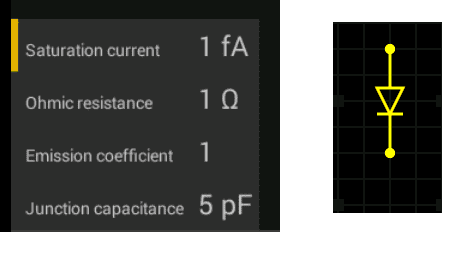
In the EveryCircuit, the element diode has all these parameters:
555555555555.png


And I don't know what each parameters means...

The program don't inform anything, so, what these parameters means?

I searched for a manual in the google and don't exist too... And now? Exist so much elements whose with so much functions that I don't know what means...
 
Physics news on Phys.org
I'm not familiar with EveryCircuit but..

These parameters will usually vary depending on the make/model of diode and are built into the library models provided with a simulator. You can usually leave them alone unless you are trying to model a particular diode that's not in the library and even then these parameters may not effect the operation of your circuit.

Saturation current..
https://en.wikipedia.org/wiki/Saturation_current

Ohmic Resistance see #4 here..
http://forum.allaboutcircuits.com/threads/diodes-internal-resistance.61107/

The emission coefficient (ideality factor) is a measure of how closely the IV curve matches that of an ideal diode..https://en.wikibooks.org/wiki/Semiconductor_Electronics/Diode/Diode_Maths

Junction Capacitance A diode has a depletion layer that prevents current flowing across the junction. There is a certain similarity between this region and the plates on a capacitor. Indeed at high frequencies this capacitance can allow some current to flow across the junction making the diode less "ideal". In some applications this capacitance can be useful. For example by varying the DC voltage you can change the width of the depletion layer and vary the capacitance. This effect is sometimes used in the tuning circuit of a radio - the diode is used as a variable capacitor controlled by a DC voltage.
 

Similar threads

  • · Replies 6 ·
Replies
6
Views
3K
  • · Replies 3 ·
Replies
3
Views
5K
  • · Replies 1 ·
Replies
1
Views
2K
Replies
1
Views
2K
  • · Replies 14 ·
Replies
14
Views
5K
  • · Replies 12 ·
Replies
12
Views
2K
  • · Replies 1 ·
Replies
1
Views
734
  • · Replies 9 ·
Replies
9
Views
3K
  • · Replies 11 ·
Replies
11
Views
2K
  • · Replies 1 ·
Replies
1
Views
2K