What factors affect the movement of a ball bearing attached to a spinning disc?

  • Context: Undergrad 
  • Thread starter Thread starter MrShoe
  • Start date Start date
  • Tags Tags
    Ball Bearing Inertia
Click For Summary

Discussion Overview

The discussion revolves around the factors affecting the movement of a ball bearing attached to a spinning disc, specifically exploring the dynamics of circular motion and the conditions under which the ball bearing might stop rolling and adhere to the disc's outer edge. The scope includes conceptual reasoning and technical explanations related to physics principles.

Discussion Character

  • Exploratory
  • Technical explanation
  • Conceptual clarification

Main Points Raised

  • One participant describes a scenario involving a spinning disc with a ball bearing in a tube, seeking to understand the RPM at which the bearing would stop moving.
  • Another participant explains that friction causes the ball to move forward relative to the ground while rolling backward relative to the disc.
  • A follow-up question is posed regarding the conditions under which the ball would stop rolling and stick to the outer edge, assuming smooth surfaces.
  • One participant compares the behavior of the ball bearing to that of a centrifuge, suggesting that the ball will continue to roll backward regardless of speed due to its constant distance from the outer wall.
  • Another participant notes that the ball will not stop rolling unless it becomes deformed, contrasting it with a cube that would behave differently under similar conditions.

Areas of Agreement / Disagreement

Participants express differing views on whether the ball bearing can stop rolling and adhere to the disc, with some arguing it will always roll while others explore the conditions that might lead to it sticking.

Contextual Notes

Assumptions regarding the smoothness of surfaces and the nature of forces acting on the ball bearing are discussed but not fully resolved. The discussion does not reach a consensus on the specific RPM at which the ball bearing might stop rolling.

MrShoe
Messages
3
Reaction score
0
Hello everyone,

Being new here, and not a "Physics Guy" I wasn't sure where this should go, but General Physics seemed like the best bet.

Recently I've been thinking about the effects of circular motion on external objects, and I've hit dead end with one of my trains of thought.

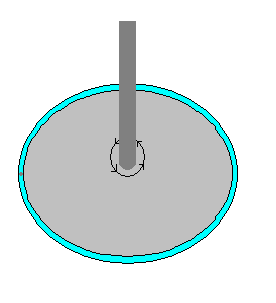
Excuse the crude drawing, but this is what I'm looking at:
BGsFZSS.png


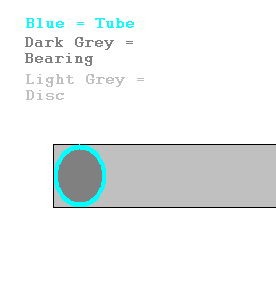
The above picture shows a round disc (meant to be perfectly round/balanced) attached to a drive shaft, with a blue ring on the outside containing a ball bearing. The ring would be a tube inside the outer perimeter of the disc (see below image):
eEjktHa.png


As the disc starts to spin, I imagine that the bearing would also move, probably spinning in the opposite direction, but moving in the same direction. What I'd like to figure out is at what RPM would the bearing stop moving completely, and the factors that can and will change this.

For simplicity, let's say the disc has a diameter of 4" and the ball bearing has a mass of 0.5g. The drive shaft can spin from 0-600 RPM.

I'm sorry if this is vague, I tried to word it the best way I could. If anymore information is needed please let me know.

Thank you!
 
Physics news on Phys.org
Hello MrShoe! Welcome to PF! :smile:

The friction is always forward, so the ball will always move forward relative to the ground, but will always move, and roll, backward relative to the disc. :wink:
 
  • Like
Likes   Reactions: 1 person
Ohh I see, thank you, but at what point will the ball stop rolling and stick to the outer edge? Or how would I go about finding that? Assuming that the bearing itself and the surface on the inside of the tube are both very smooth.
 
MrShoe said:
Ohh I see, thank you, but at what point will the ball stop rolling and stick to the outer edge?

oh i see … you mean, like a centrifuge, which if it spins fast enough, things will stick to its outer wall?

no, the ball will still roll (backwards) whatever the speed, because the center of mass of the ball will always be a constant distance from the outer wall, no matter what position the ball is

(this is unlike say a cube, which once the centrifuge reaches a certain speed will be unable to "roll" because that would mean being on edge at times, and the distance to the centre of mass is √2 more in that position, and the "centrifugal force" prevents the centre of mass "rising that high")

there is no reason for the ball to stop rolling, at least until the pressure makes it so deformed that it becomes a bit cube-like :wink:
 
  • Like
Likes   Reactions: 1 person
That makes a lot of sense, actually.

Thank you for the explanation!
 

Similar threads

  • · Replies 60 ·
3
Replies
60
Views
6K
  • · Replies 3 ·
Replies
3
Views
2K
Replies
3
Views
5K
  • · Replies 47 ·
2
Replies
47
Views
5K
  • · Replies 1 ·
Replies
1
Views
2K
  • · Replies 1 ·
Replies
1
Views
3K
Replies
2
Views
3K
  • · Replies 9 ·
Replies
9
Views
3K
  • · Replies 2 ·
Replies
2
Views
3K
  • · Replies 11 ·
Replies
11
Views
2K