What is the formula for the area of a sector of a circle?

  • Thread starter Thread starter Calcotron
  • Start date Start date
  • Tags Tags
    Area Circle
Click For Summary

Homework Help Overview

The discussion revolves around deriving the formula for the area of a sector of a circle, specifically A = 1/2 r²θ, where r is the radius and θ is the central angle. Participants explore various mathematical approaches and substitutions to arrive at this formula.

Discussion Character

  • Mixed

Approaches and Questions Raised

  • Participants discuss using trigonometric substitution and integration to find the area of the sector, with some attempting to break the area into two parts: a triangle and a second region. Others suggest using polar coordinates or relationships between arc lengths and areas.

Discussion Status

There are multiple approaches being explored, with participants questioning the limits of integration and the use of different variables. Some guidance has been offered regarding substitutions and integration techniques, but no consensus has been reached on a single method.

Contextual Notes

Participants note potential confusion regarding variable usage and limits of integration, indicating a need for clarity in the mathematical setup. There is an emphasis on ensuring that assumptions about angles and areas are consistent throughout the discussion.

Calcotron
Messages
17
Reaction score
0
Prove the formula [tex]A = \frac{1}{2}r^{2}\theta[/tex] for the area of a sector of a circle with radius r and central angle [tex]\theta[/tex]. (Hint: Assume 0 < [tex]\theta[/tex] < [tex]\frac{\pi}{2}[/tex] and place the center of the circle at the origin so it has the equation [tex]x^{2} + y^{2} = r^{2}[/tex] . Then A is the sum of the area of the triangle POQ and the area of the region PQR in the figure.)
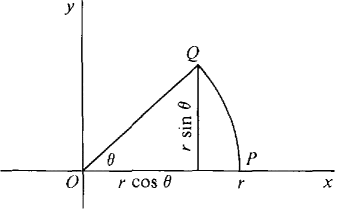
07_trigonometric_functions-516.gif


So the area of the triangle is 1/2bh which comes to [tex]\frac{1}{2}r^{2}cos\theta sin\theta[/tex]

Now, for the other region I used the integral [tex]\int\sqrt{r^{2} - x^{2}}dx[/tex]

I make x = r sin[tex]\theta[/tex]

I plug that in under the square root sign and get r cos[tex]\theta[/tex].

I changed the limits of integration from r cos[tex]\theta[/tex] to r, to pi/4 to pi/2.

Now since dx = r cos[tex]\theta[/tex]d[tex]\theta[/tex] the integral for the area of the second region is [tex]\int r^{2}cos^{2}\theta d\theta[/tex]. Now here is where the problem starts, I pull the r^2 out of the equation and use half angle theorem on the cos^2 theta. After his I end up with [tex]\frac{1}{2}r^{2}(\theta+\frac{1}{2}sin2\thetacos\theta)[/tex] with limits pi/4 to pi/2. Now I am assuming there should be a negative equivalent somewhere here to cross out the first area and leave me with just [tex]\frac{1}{2}r^{2}\theta[/tex]but I don't see how I can get it to work, especially after I finish integration and sub the limits in at which point I will lose the trig ratios. Can anyone help me finish this question up?
 

Attachments

  • 07_trigonometric_functions-516.gif
    07_trigonometric_functions-516.gif
    2.5 KB · Views: 2,478
Last edited:
Physics news on Phys.org
there's a better way:

Area of all / Area of sector = Total arc length / sector arc length

use r.theta = arc length
 
While I see that does work, I am more interested in solving the problem using trigonometric substitution.
 
why divide it into two areas
when you can use Polar co-ordinates?

Using Jacobi transformations
integrate from 0 to theta
 
I was preoccupied watching movie..

using your method
I got
0.5r^2.theta - 0.5 * int (0,theta) cos 2*t dt
for second area...

I think you took wrong limits

starting from very beginning:
second area:
int (0, theta) int (r. cos thata -- > r) [r] .dr.d(theta)

urs different

for
[tex] \int r^{2}cos^{2}\theta d\theta[/tex]

I have
[tex] \int r^{2}sin^{2}\theta d\theta[/tex]
 
Calcotron said:
Now, for the other region I used the integral [tex]\int\sqrt{r^{2} - x^{2}}dx[/tex]

I make x = r sin[tex]\theta[/tex]

I plug that in under the square root sign and get r cos[tex]\theta[/tex].

I changed the limits of integration from r cos[tex]\theta[/tex] to r, to pi/4 to pi/2.

Now since dx = r cos[tex]\theta[/tex]d[tex]\theta[/tex] the integral for the area of the second region is [tex]\int r^{2}cos^{2}\theta d\theta[/tex].

Hi Calcotron! :smile:

You've used θ to mean two different things.

First, it's a fixed value, then it's a variable of integration.

Don't be stingy … use another letter! :smile:

(and be careful about the limits of integration!)
 
Yeah, I always use theta for that part and I wasn't thinking here. Ok, so if I make the substitution x = r sin u the limits change to [tex]sin^{-1}cos\theta[/tex] to [tex]\frac{\pi}{2}[/tex]correct?

I end up with [tex]\frac{1}{2}r^{2}[\frac{\pi}{2} - (sin^{-1}cos\theta + \frac{1}{4}sin(2sin^{-1}(cos\theta))][/tex]

I assume the sin and arcsin cross out but I still cannot see how to get this into a form so that it will cancel out the area of the first triangle that I found. Can anyone see where I made a mistake?
 
Well, if I replace [tex]sin^{-1}cos\theta[/tex] with [tex]\frac{\pi}{2} - \theta[/tex] in both spots there and then an angle sum identity on the last term, and then the double angle sin identity I get the right answer. Can anyone confirm this is correct?
 
Last edited:
go for the obvious …

Hi Calcotron! :smile:
Calcotron said:
Now, for the other region I used the integral [tex]\int\sqrt{r^{2} - x^{2}}dx[/tex]
Calcotron said:
Ok, so if I make the substitution x = r sin u the limits change to [tex]sin^{-1}cos\theta[/tex] to [tex]\frac{\pi}{2}[/tex]correct?

uhh? :confused:

Why x = rsinu?

Why deliberately give yourself limits like arcsin(cos)??

Try again with (the far more obvious?) x = rcosu. :smile:
 
  • #10
that works too
 

Similar threads

  • · Replies 19 ·
Replies
19
Views
3K
  • · Replies 20 ·
Replies
20
Views
3K
  • · Replies 2 ·
Replies
2
Views
2K
  • · Replies 4 ·
Replies
4
Views
2K
  • · Replies 5 ·
Replies
5
Views
2K
Replies
3
Views
2K
  • · Replies 7 ·
Replies
7
Views
3K
Replies
14
Views
2K
  • · Replies 14 ·
Replies
14
Views
2K
Replies
9
Views
4K