What Is The Maximum Force The Locust Exerted on The Plate?

Join the discussion
Registration is free. Ask a follow-up in this thread, or start your own.
24 replies · 3K views
BurpHa
Messages
47
Reaction score
14
Homework Statement
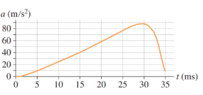
The jumping ability of the African desert locust was measured by placing the insect on a force plate, a platform that can
accurately measure the force that acts on it. When the locust
jumped straight up, its acceleration was measured to follow the
curve in Figure P4.71. What was the maximum force that this
0.50 g locust exerted on the force plate?
Relevant Equations
Newton's Second Law: F = ma.
At the beginning, I just looked for the highest point in the graph, which is approximately 90 \frac m s^2.
Then I plugged it in the formula F = ma and got the force equaled to 0.045 N.

However, when I looked back, the graph is about the change in acceleration. So really, I'm dealing with acceleration of acceleration. From what I understand, the acceleration increases when the locust jumps up until t is approximately about 27 ms, when it starts to decrease.

The answer I get from my book is 0.084 N. When I plug 0.084 N to the formula F = ma, the acceleration is 168 \frac m s^2

I don't understand how it got 168 \frac m s^2 so that it could get 0.084 N.

Thank you for your help.
 

Attachments
  • Untitled.png
    Untitled.png
    12.6 KB · Views: 170
Last edited:
Physics news on Phys.org
PeroK said:
The rate of change of acceleration is called jerk. But, that's not relevant here.

I'm not sure how the book got its answer, but you did forget something!
Do you mean the gravitational force?
 
BurpHa said:
Do you mean the gravitational force?
Yes, I've been trying to understand how the book (College Physics: A Strategic Approach 4th edition by knight, jones, and field) got its answer
 
BurpHa said:
Yes, I've been trying to understand how the book (College Physics: A Strategic Approach 4th edition by knight, jones, and field) got its answer
I can't help you there. I just googled for "speed of jumping locust" to corroborate their data. You couldn't do that when I was a student!
 
PeroK said:
I can't help you there. I just googled for "speed of jumping locust" to corroborate their data. You couldn't do that when I was a student!
I also googled, but the answer I got was the one I got, 0.045 N.
 
Reply
  • Like
Likes   Reactions: PeroK
PeroK said:
I can't help you there. I just googled for "speed of jumping locust" to corroborate their data. You couldn't do that when I was a student!
But the thing is that the acceleration changes when the locust in in its motion. According to the graph, it looks like the acceleration increases when the locust jumps up.
 
PeroK said:
For such a high acceleration, the extra force to overcome gravity is not as significant as it would normally be.
So you agree the answer is 0.045 N? I mean, we don't have a fixed acceleration as we do in other problems. This time, the acceleration changes as the locust progresses through its jump.
 
haruspex said:
Plus the force to overcome gravity, which adds about 10%.
Do you think 0.084 N is the correct answer?
 
haruspex said:
Does adding 10% to 0.045 give 0.084?
No. But my book gave 0.084 N as the answer. I did get your result when I tried the problem.
 
haruspex said:
Does adding 10% to 0.045 give 0.084?
There is a period when the acceleration increases, and that is what I don't understand. I mean, when you apply a force, the acceleration should be constant.
 
haruspex said:
only if the force is constant.
So you take a = 90 m / s ^ 2. But for the most part, the acceleration increases, so why you choose this acceleration? I did what you did until I realized the acceleration is not constant.
 
BurpHa said:
There is a period when the acceleration increases, and that is what I don't understand. I mean, when you apply a force, the acceleration should be constant.
The acceleration (increasing velocity) of any constant mass is a consequence of the magnitude of the net force that is applied to it.

In this case, the net force increases as time goes by, reaches a peak, and decreases again.
The reason is the mechanism of the legs and muscles of the insect, which provide a different amount of force as they extend.

On the other hand, the weight (force induced by gravity) of the insect remains constant during the process.

The net force mentioned above is the vectorial summation of leg's force and weight.

Please, see:
http://hyperphysics.phy-astr.gsu.edu/hbase/avari.html
 
Reply
  • Informative
Likes   Reactions: BurpHa
Lnewqban said:
The acceleration (increasing velocity) of any constant mass is a consequence of the magnitude of the net force that is applied to it.

In this case, the net force increases as time goes by, reaches a peak, and decreases again.
The reason is the mechanism of the legs and muscles of the insect, which provide a different amount of force as they extend.

On the other hand, the weight (force induced by gravity) of the insect remains constant during the process.

The net force mentioned above is the vectorial summation of leg's force and weight.

Please, see:
http://hyperphysics.phy-astr.gsu.edu/hbase/avari.html
Thanks, a bit of biology helps.
 
Reply
  • Like
Likes   Reactions: Lnewqban
haruspex said:
Because it asks for the maximum force.
I agree, but I don't know why my textbook gives the result as 0.084 N.
 
I searched for the question online. Got several hits, all the same graph, just small variations in locust mass.
All were on paywalled student help sites, though you could sign up for a free trial. The only one I looked further into was Brainly. The "expert verified" solution it showed quoted "Fnet=ma-mg". At that point I gave up.
 
Reply
  • Haha
Likes   Reactions: BurpHa
haruspex said:
I searched for the question online. Got several hits, all the same graph, just small variations in locust mass.
All were on paywalled student help sites, though you could sign up for a free trial. The only one I looked further into was Brainly. The "expert verified" solution it showed quoted "Fnet=ma-mg". At that point I gave up.
Brainly is not reliable, those "expert verified" thing is rubbish. Yeah, most of the other sites are paid, that is why I look at my textbook's solution to check ;))) By the way, thank you for your help!!
 
Reply
  • Like
Likes   Reactions: Lnewqban
BurpHa said:
Homework Statement:: The jumping ability of the African desert locust was measured by placing the insect on a force plate, a platform that can
accurately measure the force that acts on it. When the locust
jumped straight up, its acceleration was measured to follow the
curve in Figure P4.71. What was the maximum force that this
0.50 g locust exerted on the force plate?
Relevant Equations:: Newton's Second Law: F = ma.

At the beginning, I just looked for the highest point in the graph, which is approximately 90 \frac m s^2.
Then I plugged it in the formula F = ma and got the force equaled to 0.045 N.

However, when I looked back, the graph is about the change in acceleration. So really, I'm dealing with acceleration of acceleration. From what I understand, the acceleration increases when the locust jumps up until t is approximately about 27 ms, when it starts to decrease.

The answer I get from my book is 0.084 N. When I plug 0.084 N to the formula F = ma, the acceleration is 168 \frac m s^2

I don't understand how it got 168 \frac m s^2 so that it could get 0.084 N.

Thank you for your help.
I have received a great deal of help! All I want to say is thank you!
 
Reply
  • Like
Likes   Reactions: Lnewqban