What is the rate of water decreasing in a hemisphere bowl when the depth is 6cm?

  • Thread starter Thread starter Ose90
  • Start date Start date
  • Tags Tags
    Application
Click For Summary
SUMMARY

The discussion centers on calculating the rate at which water decreases in a hemisphere bowl with a radius of 12 cm, initially full of water. The water exits through a hole at a rate of 48π cm³/s. It is established that the depth of the water, denoted as x cm, decreases at a rate of 48/[x(24-x)] cm/s. Specifically, when the bowl is full, the depth decreases at 1 cm/s, and when the depth is 6 cm, the rate of decrease is 2/3 cm/s.

PREREQUISITES
  • Understanding of calculus, specifically related rates
  • Familiarity with the geometry of a hemisphere
  • Knowledge of volume formulas for solids of revolution
  • Ability to apply the chain rule in differentiation
NEXT STEPS
  • Study the application of related rates in calculus problems
  • Learn about the volume of a hemisphere and its derivatives
  • Explore the use of implicit differentiation in geometric contexts
  • Investigate real-world applications of fluid dynamics in containers
USEFUL FOR

Students and educators in calculus, engineers dealing with fluid dynamics, and anyone interested in mathematical modeling of physical systems.

Ose90
Messages
5
Reaction score
0
A hemisphere bowl of radius 12cm is initially full of water. Water runs out of a small hole at the bottom of the bowl at a rate of 48pi cm^3 s^-1. When the depth of the water is x cm , show that the depth is decreasing at a rate of 48/[x(24-x)] cm s^-1
Also, find the rate at which the depth is decreasing when

a) The bowl is full.
b)The depth is 6cm.

Another question is in this picture
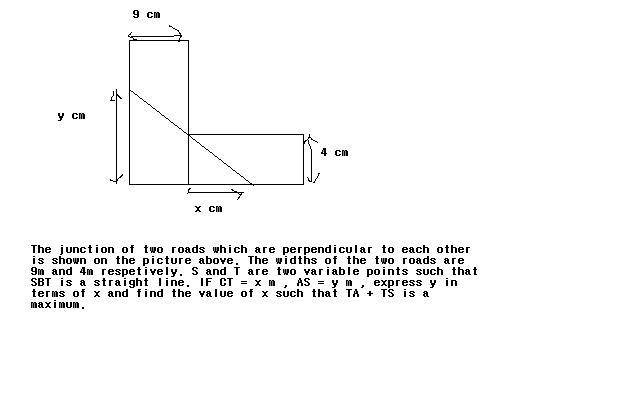
Math.jpg


Thanks in advance! Really urgent :)
 
Physics news on Phys.org
Hi Ose90! :smile:

Show us what you've tried, and where you're stuck, and then we'll know how to help. :smile:
 
tiny-tim said:
Hi Ose90! :smile:

Show us what you've tried, and where you're stuck, and then we'll know how to help. :smile:

Hi tiny-tim, thanks for replying.
Glad to tell you that I have solved it.

However, I will still write down my solution to see if it is correct.

For the first question, I imagine the right side of the semi-circle displaced vertically, I get the equation (x-0)^2 + (y - r)^2 = r^2
then, x^2 = r^2 - (y^2 + r^2 -2yr)
x^2 = r^2 - y^2 -r^2 +2yr
= 2yr - y^2
x = [y(2r - y)]^(1/2)

Hence, when h = x and r = 12 , dV/dx = pi(24x-x^2)

from the question , dv/dt =48 pi

dx/dt = dx/dv x dv/dt
= 48 pi
-----
pi(24x - x^2)

For the second question , I use similar triangle to solve it.

Thanks!
 

Similar threads

  • · Replies 7 ·
Replies
7
Views
3K
Replies
8
Views
7K
  • · Replies 6 ·
Replies
6
Views
3K
  • · Replies 4 ·
Replies
4
Views
2K
  • · Replies 2 ·
Replies
2
Views
3K
Replies
2
Views
4K
  • · Replies 4 ·
Replies
4
Views
2K
Replies
8
Views
4K
  • · Replies 1 ·
Replies
1
Views
3K
  • · Replies 2 ·
Replies
2
Views
2K