What is the role of i3 in superposition for electrical circuits?

Click For Summary

Discussion Overview

The discussion revolves around the application of the superposition theorem in electrical circuits, specifically focusing on the role of the current i3 and its components i3' and i3''. Participants explore the physical interpretation of superposition in terms of electron flow and electric fields, while also considering the validity of using traditional circuit analysis methods.

Discussion Character

  • Exploratory
  • Technical explanation
  • Conceptual clarification
  • Debate/contested

Main Points Raised

  • One participant proposes that i3 can be calculated using the superposition theorem, leading to expressions for i3' and i3'' based on different voltage sources.
  • The same participant questions whether i3' and i3'' represent actual currents or if only the net current i3 exists, seeking clarification on how superposition occurs in practice.
  • Another participant advises against focusing on electron flow for calculations, suggesting that potential difference and current are more relevant for circuit analysis.
  • This participant emphasizes the effectiveness of Kirchhoff's Laws in analyzing the circuit without needing to consider electric fields or electron behavior.
  • A later reply acknowledges the usefulness of Kirchhoff's Laws and the superposition theorem but expresses a desire to understand the physical processes behind the summation of currents.
  • Another participant suggests that simplified models of electron flow may not be adequate and hints at the need for more complex models to accurately represent the phenomena.
  • One participant requests examples of more complicated models, referencing a Wikipedia article on computational electromagnetics, although they admit to not fully understanding it.

Areas of Agreement / Disagreement

Participants generally agree on the utility of Kirchhoff's Laws and the superposition theorem for circuit analysis. However, there is disagreement regarding the interpretation of current flow and the relevance of electron behavior versus potential difference in understanding superposition.

Contextual Notes

Some participants express uncertainty about the physical processes involved in current summation and the adequacy of simplified models. There is also a recognition that ideal conditions may not hold in practical scenarios, which could complicate the analysis.

Who May Find This Useful

This discussion may be of interest to those studying electrical engineering, circuit analysis, or anyone curious about the underlying physical principles of electrical circuits and the application of theoretical concepts like superposition.

nik2011
Messages
11
Reaction score
0
Hello!

If we want to find i3, we can apply the superposition theorem to the circuit below.
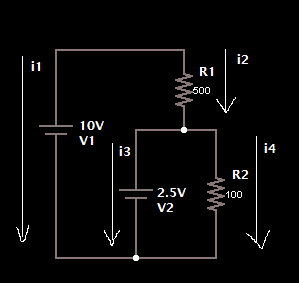
attachment.php?attachmentid=40097&stc=1&d=1318876665.png


It gives

For V2 set to 0: i3' = V1 / R1
For V1 set to 0: i3'' = V2 / (R1 || R2)
i3 = i3' - i3'' = V1/R1 - V2 / (R1 || R2)
i3 = 10 / 500 - 2.5 / 83.3 = -0.01A

My question is
Do the i3' and i3'' currents really exist. By exist I mean part of electrons flowing through V2 flow in one direction and the other part flow in the opposite direction? And when i3 is measured it is the net current of i3' and i3''.

Or only i3 exists so all electrons flow through V2 in the same direction. If so how does the superposition happens? E. g., do V1's electric field interact with V2's electric field "directly"?

Or it is this way, if we look at a single electron which flows through V2's branch the force applied by V1's field sums up with force applied by V2's field and the resulting force defines the electron's speed and direction? If so, how to calculate the values of the force applied by V1 and the force applied by V2?

So in general, what I want to know is how does superposition happens in electrical circuits?

Thank you!
 

Attachments

  • circuit_source1.png
    circuit_source1.png
    1.6 KB · Views: 751
Physics news on Phys.org


I should strongly advise you against trying to use electrons for ordinary electrical calculations. What's wrong with Current? All the equations use it and it avoids all those dodgy models involving electrons that people carry in their heads. Forget "electric field" here. What counts is Potential difference. The same current will flow whatever shape / length the resistors and wires happen to be so the field (volts per meter) is irrelevant.

Kirchoffs Laws etc. work perfectly for situations like this.
V2 is a voltage source and that defines the current I4 through R2.
The PD across R1 is also defined by the difference between the two Voltage sources V1 and V2. So the Current I2 is determined by that. The voltage source V2 will source or sink just the right amount of current (I3) so that I4 is what you calculated already.
The only problem you might consider having would be if the tow 'batteries' were not ideal - but that would be specified and would involve, effectively, some more simultaneous equations.


sophiecentaur,
Thanks for your answer.

I agree using Kirchoffs Laws or the Superposition theorem is the best approach to analyse this circuit.

What I'm trying to do is to imagine what physical processes actually happen when two currents sums up.
I would be pretty happy with a simplified model if what actually is going on is a very complicated process.
Just to have some "image" of this process in my head.
Or a reference to a book/site where I can read up about this process would be great.

Or a simplified explanation and a reference to the complex one would be just perfect :)


Fair enough but you need to start off in a valid direction. Electric fields can hardly help and neither can very simplified models of electron flow.
The 'next level' of complication needs to be much more complicated if it is to hold water.


sophiecentaur said:
The 'next level' of complication needs to be much more complicated if it is to hold water.

Could you name a couple of such model?
I found this Wikipedia's article http://en.wikipedia.org/wiki/Comput...ics#Finite-difference_time-domain_.28FDTD.29"
Though I don't understand a single word in it, to be honest. But just out of curiosity, do some of the things described in this article look like such models?
 
Last edited by a moderator:

Similar threads

  • · Replies 26 ·
Replies
26
Views
3K
Replies
9
Views
2K
  • · Replies 16 ·
Replies
16
Views
4K
  • · Replies 1 ·
Replies
1
Views
2K
  • · Replies 6 ·
Replies
6
Views
2K
  • · Replies 5 ·
Replies
5
Views
4K
  • · Replies 4 ·
Replies
4
Views
2K
  • · Replies 3 ·
Replies
3
Views
974
  • · Replies 12 ·
Replies
12
Views
2K
  • · Replies 3 ·
Replies
3
Views
2K