Discussion Overview
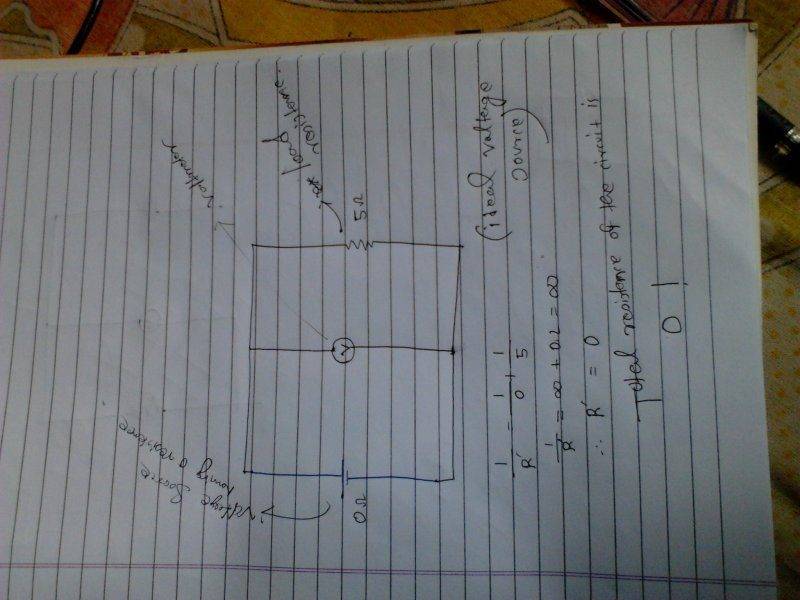
The discussion revolves around the total resistance of a circuit that includes an ideal voltage source and a resistor. Participants explore the implications of an ideal voltage source's characteristics on total resistance, considering both theoretical and practical aspects.
Discussion Character
- Debate/contested
- Technical explanation
- Conceptual clarification
Main Points Raised
- Some participants suggest that the total resistance of a circuit with an ideal voltage source and a resistor could be zero, questioning how a circuit can have a resistor yet exhibit zero total resistance.
- Others argue that the internal resistance of an ideal voltage source is zero, implying that the total resistance remains zero regardless of the load connected.
- A participant clarifies that the effective resistance of a circuit with an ideal voltage source in parallel with any load is zero ohms, but this raises questions about the definition of "total resistance."
- One participant introduces the concept of Thevenin equivalent circuits, explaining that the total resistance can be calculated differently depending on whether the circuit is analyzed for DC or AC conditions.
- Another participant emphasizes the need for clarity in the question posed, noting that the term "total resistance" must be defined and the configuration (series or parallel) specified for accurate measurement.
Areas of Agreement / Disagreement
Participants express differing views on the concept of total resistance in circuits involving ideal voltage sources, with no consensus reached on the definition or implications of total resistance in this context.
Contextual Notes
Limitations include the ambiguity in the term "total resistance" and the dependence on circuit configuration (series vs. parallel) when measuring resistance. The discussion also highlights the distinction between DC and AC analysis in circuit calculations.