Discussion Overview
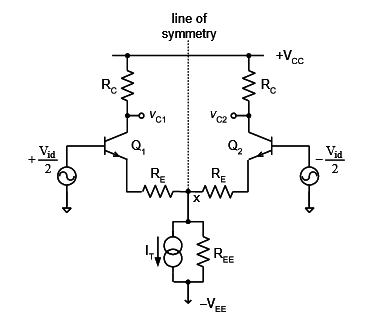
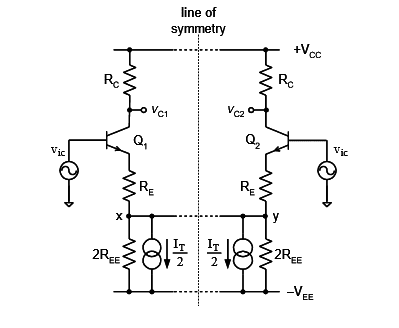
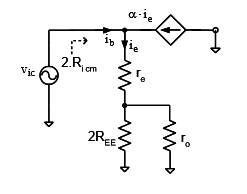
The discussion revolves around modifications to BJT amplifier circuits when dealing with common mode input signals. Participants explore the implications of these modifications on circuit behavior, particularly focusing on common mode input resistance and the analysis of small signal models. The conversation includes theoretical considerations and practical implications of circuit design.
Discussion Character
- Technical explanation
- Conceptual clarification
- Debate/contested
- Mathematical reasoning
Main Points Raised
- Some participants inquire about the reasons for modifying the amplifier circuit when common mode signals are applied, questioning the role of components like RE and ro in the analysis.
- There is a discussion about the behavior of transistors under common mode signals, with some arguing that both transistors will show similar increases in collector currents.
- One participant notes that neglecting REE in small signal analysis could lead to incorrect equations, prompting questions about the assumptions made regarding voltage at specific nodes.
- Another participant presents a formula for common mode input resistance, suggesting that simplifying assumptions are being made in the analysis.
- Concerns are raised about whether the voltage at a certain node can be assumed to be zero, with some attributing this to circuit symmetry.
- There are conflicting views on whether the increase in signal current in one BJT can be matched by a decrease in another under common mode conditions, with some asserting that this leads to a differential signal instead.
- Participants discuss the implications of excluding certain components in the calculation of common mode input resistance and the reasoning behind these exclusions.
Areas of Agreement / Disagreement
Participants express differing views on the assumptions made in the analysis of common mode signals and the resulting implications for circuit behavior. There is no consensus on the validity of certain assumptions, particularly regarding the voltage at specific nodes and the treatment of common mode versus differential signals.
Contextual Notes
Participants highlight limitations in their analyses, including assumptions about symmetry, the behavior of components under common mode signals, and the effects of neglecting certain resistances in calculations.
Who May Find This Useful
This discussion may be useful for students and professionals interested in BJT amplifier design, particularly those exploring the effects of common mode signals and input resistance calculations in circuit analysis.