Why can't pH of diprotic acids be calculated like that of amphiprotic?

  • Thread starter Thread starter krackers
  • Start date Start date
  • Tags Tags
    Acids Ph
Click For Summary

Discussion Overview

The discussion revolves around the calculation of pH for diprotic acids in comparison to amphiprotic substances, specifically using H2S as an example. Participants explore the reactions involved and question the assumptions made in pH calculations for these types of acids.

Discussion Character

  • Exploratory
  • Technical explanation
  • Debate/contested
  • Mathematical reasoning

Main Points Raised

  • Some participants question why the pH of diprotic acids like H2S cannot be calculated similarly to amphiprotic substances, suggesting that HS- could be treated as amphiprotic.
  • It is proposed that the calculation can be valid if the dissociation of HA- does not affect the first dissociation step, with sulfuric acid cited as an example where this assumption holds.
  • Concerns are raised about the validity of assuming that the concentration of H3AsO4 is greater than that of HAsO42- due to the differing equilibrium constants (Ka) for the relevant reactions.
  • Some participants emphasize that amphiprotic substances can react in both acidic and basic ways, but this does not necessarily indicate the relative strengths of those reactions.
  • There is a discussion about the accuracy of pH calculations based on assumptions made regarding the dominance of certain reactions and the need for sanity checks against known equilibria.

Areas of Agreement / Disagreement

Participants express differing views on the applicability of amphiprotic principles to diprotic acids, with no consensus reached on the validity of the assumptions made in the calculations. The discussion remains unresolved regarding the specific conditions under which these calculations can be reliably performed.

Contextual Notes

Participants highlight the importance of equilibrium constants and the assumptions made in calculations, noting that these can significantly influence the outcomes. There are references to stoichiometric relationships and the need for careful consideration of the reactions involved.

krackers
Messages
72
Reaction score
0
I was reading this website (http://www.chembuddy.com/?left=pH-calculation&right=pH-amphiprotic-salt) on calculating pH of amphiprotic salts.

My question is why can't you do something similar for diprotic acids? Take for example the diprotic acid H2S.

Because you have the following reactions:

H+ + HS- ⇔ H2S

HS- ⇔ H+ + S2-

can't you treat HS- like an amphiprotic substance and calculate the pH the same way you calculated pH for other amphiprotic substances?

—————————————————————

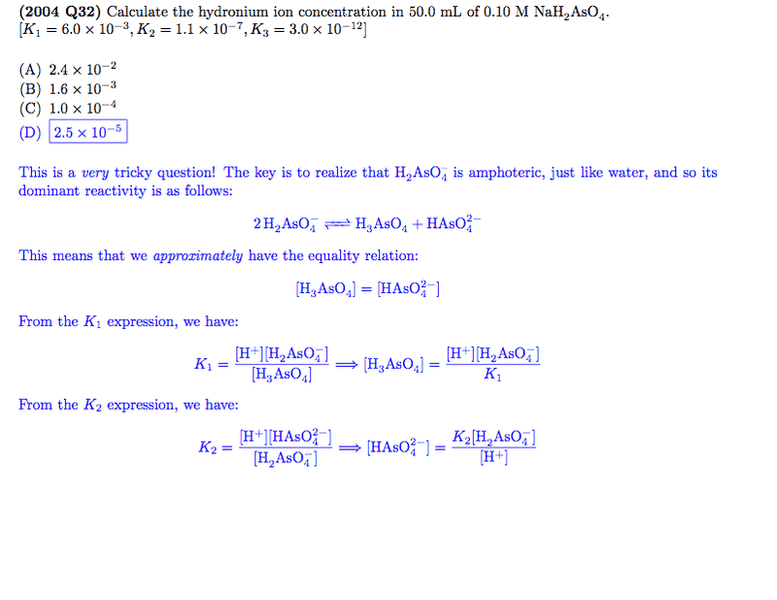
I also have another question relating to these topics. In this image,
Frfxa.png


I don't understand how they came to the conclusion that [H3AsO4-] ≈ [HAsO42-]. Further, why is H2AsO42- considered amphiprotic when the value of K-1, that is the equilibrium constant for H2AsO42- + H+ ⇔ H3AsO4, is much higher than that of the reaction where it acts an acid?
 
Chemistry news on Phys.org
krackers said:
I was reading this website (http://www.chembuddy.com/?left=pH-calculation&right=pH-amphiprotic-salt) on calculating pH of amphiprotic salts.

My question is why can't you do something similar for diprotic acids? Take for example the diprotic acid H2S.

Because you have the following reactions:

H+ + HS- ⇔ H2S

HS- ⇔ H+ + S2-

can't you treat HS- like an amphiprotic substance and calculate the pH the same way you calculated pH for other amphiprotic substances?

It can be done, but only if you can be sure HA- dissociation won't change first dissociation step. That can work for a sulfuric acid, where we can safely assume first step is always 100% dissociatied.

I don't understand how they came to the conclusion that [H3AsO4-] ≈ [HAsO42-].

Simple stoichiometry.

Further, why is H2AsO42- considered amphiprotic when the value of K-1, that is the equilibrium constant for H2AsO42- + H+ ⇔ H3AsO4, is much higher than that of the reaction where it acts an acid?

Amphiprotic means it can react both ways, it doesn't tell much about relative strengths of both reactions. And the difference of 4 orders of magnitude in such a case is not much.
 
Borek said:
It can be done, but only if you can be sure HA- dissociation won't change first dissociation step. That can work for a sulfuric acid, where we can safely assume first step is always 100% dissociatied.
How would you know whether this holds true for HS-?

The Ka values are as follows:

H+ + HS- ⇔ H2S (Ka = 107)

HS- ⇔ H+ + S2- (Ka = 10-19)

Borek said:
Simple stoichiometry.

The amphiprotic reactions are as follows:

H2AsO4 ⇔ HAsO42- + H+ (Ka = 1.1 *10-7)

H2AsO4- + H+ ⇔ H3AsO4 (Ka = 1.6 * 102)

Doesn't the acidic reaction have a much higher Ka and thus won't the concentration of H3AsO4 greater than that of HAsO42-?
 
krackers said:
How would you know whether this holds true for HS-?

Calculate pH using this approach, plug it into equilibrium equations and see if they still make sense.

H+ + HS- ⇔ H2S (Ka = 107)

More like 10-7.

Have you seen http://www.chembuddy.com/?left=pH-calculation&right=pH-polyprotic-simplified ?

Doesn't the acidic reaction have a much higher Ka and thus won't the concentration of H3AsO4 greater than that of HAsO42-?

They ASSUME system is dominated by the reaction they wrote and they use it to calculate pH. Assumption doesn't have to be correct - but once again, after calculating pH you can do the simple sanity check, seeing if the numbers fit all known equilibria and mass balances. Turns out they do.

It is discussed at the page you linked to - there are tables showing how accurate the results calculated using equivalent assumption are. Quotient [H2A]/[A2-] being close to 1 is equivalent to the idea that [HAsO42-]≈[H3AsO4] (these may look like completely unrelated, but try to understand the acid/base reaction happening and you will see they are the same).
 

Similar threads

  • · Replies 6 ·
Replies
6
Views
1K
  • · Replies 8 ·
Replies
8
Views
12K
  • · Replies 2 ·
Replies
2
Views
2K
  • · Replies 1 ·
Replies
1
Views
7K
  • · Replies 3 ·
Replies
3
Views
3K
  • · Replies 46 ·
2
Replies
46
Views
7K
  • · Replies 6 ·
Replies
6
Views
4K
Replies
4
Views
3K
  • · Replies 3 ·
Replies
3
Views
3K
  • · Replies 1 ·
Replies
1
Views
3K