OmCheeto
Gold Member
- 2,536
- 3,660
I was afraid you would ask that.sophiecentaur said:How about for larger angles?
Unfortunately, I didn't set up my original simulation for such a task, and it would have taken me another 3 hours to add larger angles, so I scratched my head, and came up with a faster solution: Google Earth Pro and their "grid" lines.
Looking west (latitude lines are parallel) from the height of the ISS:
It looks as though the Earth's curvature throws things off a bit more than I suspected, but not too much.
And from a geosynchronous orbit height:
The lines are "visually" quite linear.
"hard to visualize"? I'd say; "Impossible".I wasn't sure what your modelling was showing. This sort of geometry is hard to visualise. (Hence the Apollo misconceptions)
Though, I did find one video that shows it quite well:
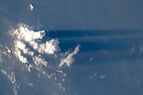
Wide angle lenses don't always give curved lines and some are terrible. The panels in the cloud shots are tapered, implying a fairly wide angle lens. But the taper goes the other way compared with the shadows so you can probably ignore my comment. (Situation normal.)
Along with finishing an on-line Linear Algebra course last week, I went back and studied lens/lense "stuff" yesterday. All I can say is; "Ehr mehr gerd! Maths is Hard!"
Attachments