Discussion Overview
The discussion centers around the phenomenon of resistive heating in wires due to current flow, exploring the underlying mechanisms and energy transformations involved. Participants examine the relationship between electron kinetic energy, electric fields, and thermal energy within conductors, touching on theoretical models and analogies.
Discussion Character
- Exploratory
- Technical explanation
- Conceptual clarification
- Debate/contested
Main Points Raised
- Some participants note that the kinetic energy from the drift velocity of electrons is insufficient to explain the heating, questioning the source of heat energy.
- Others argue that the energy carried by electric fields, as described by Poynting's Theorem, is a crucial factor in understanding resistive heating.
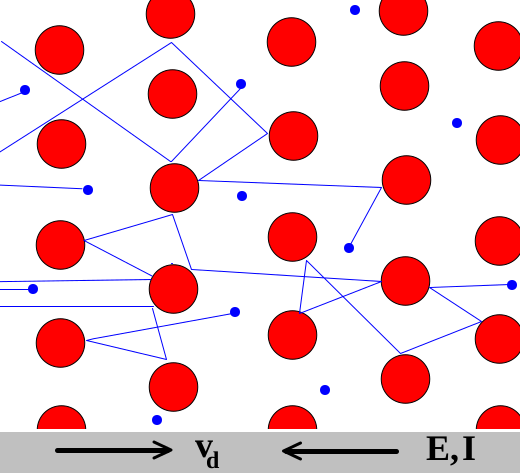
- A participant suggests that while electric energy is carried outside the conductor, resistive heating occurs within it due to collisions between electrons and atomic cores.
- One participant introduces the idea that a significant friction force must exist for the electron-gas to lose kinetic energy rapidly, contributing to heating.
- Another participant discusses the mechanical analogy of fluid dynamics to explain energy loss in electrical systems, emphasizing the role of resistance in opposing electron motion.
- Concerns are raised about the oversimplification of concepts in educational contexts, with a participant reflecting on their own learning experience and the inadequacy of high school explanations.
Areas of Agreement / Disagreement
Participants express a range of views on the mechanisms of resistive heating, with no consensus reached on the primary factors involved. Multiple competing explanations and analogies are presented, indicating an ongoing debate.
Contextual Notes
Some discussions highlight the limitations of high school physics education in conveying complex concepts related to electricity and resistance, suggesting a need for deeper exploration of the topic.
Who May Find This Useful
This discussion may be of interest to students and educators in physics, as well as individuals seeking a deeper understanding of electrical conduction and resistive heating mechanisms.