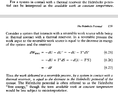
Why does Callen insist a process must be reversible here?

Click For Summary
SUMMARY

The discussion centers on the interpretation of the Helmholtz potential and its relationship to reversible processes as emphasized by Callen. Participants clarify that while quasistatic processes in thermal equilibrium with a reservoir are reversible, irreversibility arises from finite rate transport processes such as heat conduction and viscous dissipation. The maximum work obtainable from a system is defined as Wmax = -ΔF, occurring only when no irreversibilities are present. The conversation highlights the importance of distinguishing between quasistatic conditions and actual reversibility in thermodynamic processes.

PREREQUISITES
  • Understanding of the first and second laws of thermodynamics
  • Familiarity with Helmholtz potential and free energy concepts
  • Knowledge of quasistatic processes and thermal reservoirs
  • Awareness of entropy generation and its implications in irreversible processes
NEXT STEPS
  • Study the derivation of the Helmholtz potential and its applications in thermodynamics
  • Learn about the distinctions between reversible and irreversible processes in thermodynamic systems
  • Examine the role of entropy generation in real-world thermodynamic cycles
  • Read "Fundamentals of Engineering Thermodynamics" by Moran et al., focusing on Chapter 6 for deeper insights
USEFUL FOR

Students and professionals in thermodynamics, mechanical engineers, and anyone interested in the principles of energy transfer and efficiency in thermal systems.

EE18
Messages
112
Reaction score
13
In a discussion about the (change in the) Helmholtz potential being interpretable as the maximum available amount of work for a system in contact with a thermal reservoir (i.e. the free energy), Callen seems to insist this fact is true only for reversible processes. Why should this be? I understand that any quasistatic process performed in contact/equilibrium with a thermal reservoir (as is the case here) will necessarily be reversible (since heat exchange proceeds at the same temperature), but to my reading Callen's emphasis on reversible seems to suggest there's something extra here I am perhaps missing? After all, as far as I can tell we must have ##dW_{RWS} = -dU - dU^r## by pure energy conservation for any process.
 

Attachments

  • Screen Shot 2023-07-01 at 7.08.12 PM.png
    Screen Shot 2023-07-01 at 7.08.12 PM.png
    48.6 KB · Views: 114
Science news on Phys.org
My understanding of how this works is as follows: The first law of thermodynamics tells us that $$\Delta U=Q-W$$. For a system that can only exchange heat with an reservoir at temperature T, and for which the initial and final equilibrium states of the system are also at temperature T, the 2nd law of thermodynamics tells us that $$\Delta S=\frac{Q}{T}+\sigma$$where ##\sigma## is the amount of entropy generated (positive) due to irreversibility within the system. If we combine these two equations, we get $$\Delta F=\Delta U-T\Delta S=-W-T\sigma$$or$$W=-\Delta F-T\sigma$$So the maximum work in going from the initial state to the final state is ##W_{max}=-\Delta F##, and occurs when there are no irreversibilities.
 
Chestermiller said:
My understanding of how this works is as follows: The first law of thermodynamics tells us that $$\Delta U=Q-W$$. For a system that can only exchange heat with an reservoir at temperature T, and for which the initial and final equilibrium states of the system are also at temperature T, the 2nd law of thermodynamics tells us that $$\Delta S=\frac{Q}{T}+\sigma$$where ##\sigma## is the amount of entropy generated (positive) due to irreversibility within the system. If we combine these two equations, we get $$\Delta F=\Delta U-T\Delta S=-W-T\sigma$$or$$W=-\Delta F-T\sigma$$So the maximum work in going from the initial state to the final state is ##W_{max}=-\Delta F##, and occurs when there are no irreversibilities.
I think I see; if it's OK, I just want to follow-up since Callen has not (yet) introduced explicit notion like ##\sigma## quantifying the extent of the irreversibility. Is it possible Callen is arguing as I have? That because the heat transfer is assumed quasistatic (by writing ##dS + dS^r = 0## in the first place), that then implies the reversibility (since heat transfer is at the same temperature)?
 
Last edited:
  • Like
Likes   Reactions: TonyStewart
EE18 said:
I think I see; if it's OK, I just want to follow-up since Callen has not (yet) introduced explicit notion like ##\sigma## quantifying the extent of the irreversibility. Is it possible Callen is arguing as I have? That because the heat transfer is assumed quasistatic (by writing ##dS + dS^r = 0## in the first place), that then implies the reversibility (since heat transfer is at the same temperature)?
No. Irreversibility within a system is caused by transport processes within a system proceeding at finite rates:
1. Heat conduction occurring at finite temperature gradients
2. Viscous dissipation occurring at finite velocity gradients
3. Molecular diffusion occurring at finite concentration gradients
In addition, irreversibility within a system is caused by chemical reactions occurring at finite reaction rates.

I cannot relate to what is in Callen because I am strongly opposed ti using differentials for describing irreversible processes. In my judgment, it is bad practice to do this, and only leads to confusion.
 
Chestermiller said:
No. Irreversibility within a system is caused by transport processes within a system proceeding at finite rates:
1. Heat conduction occurring at finite temperature gradients
2. Viscous dissipation occurring at finite velocity gradients
3. Molecular diffusion occurring at finite concentration gradients
In addition, irreversibility within a system is caused by chemical reactions occurring at finite reaction rates.

I cannot relate to what is in Callen because I am strongly opposed ti using differentials for describing irreversible processes. In my judgment, it is bad practice to do this, and only leads to confusion.
But as far as I can tell there is no finite temperature gradient (since the primarhy system is held at the reservoir temperature ##T^r##); that is, all of the processes you have outline there are not quasistatic, right? I'm not sure they then apply as counterexamples?

I will abstain from using differentials to your point, but I think the question still stands, no? How come quasistatic does not imply reversible here (when heat transfer is at the same temperature).
 
In the irreversible case, even though the part of the system in contact with the reservoir is at the reservoir temperature (which is the same as the initial and final temperatures of the system), the temperature within the system can vary with spatial position during the process, and there can be finite temperature gradients within the system. If the process takes place rapidly, this will happen with compression heating or expansion cooling. The interior will be at a higher or lower average temperature than the boundary. For the process to be reversible, it must be carried out very slowly in order for the interior temperatures to equilibrate with the boundary.
 
EE18 said:
I understand that any quasistatic process performed in contact/equilibrium with a thermal reservoir (as is the case here) will necessarily be reversible (since heat exchange proceeds at the same temperature), but to my reading Callen's emphasis on reversible seems to suggest there's something extra here I am perhaps missing? After all, as far as I can tell we must have ##dW_{RWS}=−dU−dU^r## by pure energy conservation for any process.
I think all he means is that you're not losing work to dissipative processes, like friction sapping some of the available work. In other words, even if the heat exchange is done reversibly and the system evolves quasi-statically, the entire process would still be irreversible if some work is lost to friction.
 
vela said:
I think all he means is that you're not losing work to dissipative processes, like friction sapping some of the available work. In other words, even if the heat exchange is done reversibly and the system evolves quasi-statically, the entire process would still be irreversible if some work is lost to friction.
Frictional work will typically affect the amount of heat transferred.
 
I strongly recommend you see Moran, et al, Fundamentals of Engineering Thermodynamics, I believe available online. See Chapter 6 in particular. They show that there are only 2 ways that the entropy of a closed system can change:

1. By heat flow from the surrounding to the system Q at the temperature of the interface between the system and surroundings through which the heat flows. This mechanism occurs in both reversible and irreversible processes.

2. By entropy generation within the system by the mechanisms I mentioned in an earlier post. This occurs only in irreversible processes.
 

Similar threads

  • · Replies 7 ·
Replies
7
Views
2K
  • · Replies 2 ·
Replies
2
Views
448
  • · Replies 12 ·
Replies
12
Views
3K
  • · Replies 3 ·
Replies
3
Views
2K
  • · Replies 13 ·
Replies
13
Views
4K
  • · Replies 11 ·
Replies
11
Views
3K
Replies
10
Views
3K
  • · Replies 22 ·
Replies
22
Views
6K
  • · Replies 2 ·
Replies
2
Views
2K
  • · Replies 26 ·
Replies
26
Views
6K