Why Does Stoke's Stream Function Represent Fluid Flow?

  • Thread starter Thread starter chriswong
  • Start date Start date
  • Tags Tags
    Function Stream
Click For Summary
SUMMARY

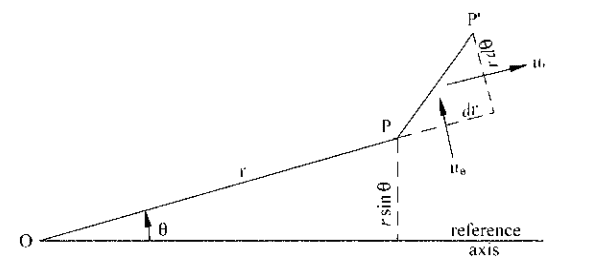
The discussion centers on the Stoke's stream function, specifically its application in fluid dynamics to quantify fluid flow across surfaces of revolution. It establishes that the quantity of fluid crossing the surface formed by the vector OP is represented as 2πc when the position vector is rotated around a reference axis. The analysis further explains that for two closely positioned points P and P', the flow rate across a unit area is quantified as 2πdΨ per unit time, emphasizing the mathematical relationship between the stream function and fluid flow rates.

PREREQUISITES
  • Understanding of fluid dynamics principles
  • Familiarity with vector calculus
  • Knowledge of Stoke's theorem
  • Basic concepts of surface integrals
NEXT STEPS
  • Study the mathematical derivation of Stoke's stream function
  • Explore applications of Stoke's theorem in fluid mechanics
  • Learn about surface integrals in vector calculus
  • Investigate the implications of fluid flow across surfaces of revolution
USEFUL FOR

Students and professionals in fluid dynamics, mechanical engineers, and researchers focusing on mathematical modeling of fluid flow.

chriswong
Messages
2
Reaction score
0
Summary:: Stoke stream function

[Mentor Note -- Thread moved from the technical forums, so no Homework Template is shown]

1622692859148.png

Why the quantity of fluid that crosses the surface of revolution formed by the vector OP is
1622692955444.png
?
 
Last edited by a moderator:
Physics news on Phys.org
What vector? There appears to be several here (or else the picture without context is just confusing to me). Have you tried to work this out on your own, and if so, what did you try so far?
 
Sorry about that. Here are more information.
"Let a function Ψ be defined such that if the position vector OP is rotated around the reference axis, that is, if the coordinate ω is varied through 2π while r and θ are held fixed, the quantity of fluid that crosses the surface of revolution formed by the vector OP will be 2pc. Now apply this definition to two points P and P' that are close together, as shown in the Figure. Then if the line element PP' is rotated about the reference axis, the resulting surface will have a quantity of fluid 2πdΨ crossing it per unit time. "

I am wondering why the flow rate across a unit area of the surface is
1622698976684.png
 

Similar threads

  • · Replies 7 ·
Replies
7
Views
1K
  • · Replies 7 ·
Replies
7
Views
2K
  • · Replies 7 ·
Replies
7
Views
2K
Replies
31
Views
4K
  • · Replies 5 ·
Replies
5
Views
3K
Replies
1
Views
2K
  • · Replies 12 ·
Replies
12
Views
2K
Replies
2
Views
2K
  • · Replies 9 ·
Replies
9
Views
4K
  • · Replies 3 ·
Replies
3
Views
4K