Why doesn't centripetal force change the magnitude of speed

Click For Summary

Discussion Overview

The discussion centers around the concept of centripetal force and its relationship to the speed and direction of an object's motion, particularly in the context of projectile motion versus circular motion. Participants explore how forces affect velocity and the conditions under which speed remains constant while direction changes.

Discussion Character

  • Exploratory
  • Technical explanation
  • Debate/contested
  • Conceptual clarification

Main Points Raised

  • One participant questions how centripetal force can maintain a constant resultant velocity when considering vector addition of plane and wind velocities.
  • Another participant asserts that for a force to change direction without altering speed, it must be perpendicular to the velocity, which is not the case when wind affects the plane's motion.
  • Participants discuss the example of a ball on a string to illustrate how centripetal force acts perpendicular to the velocity, allowing for constant speed while changing direction.
  • There is confusion regarding the speed of a ball in projectile motion, with one participant stating that the speed is not constant due to gravitational effects, while another seeks clarification on how centripetal force applies in this context.
  • Some participants emphasize that the scenario being discussed is a projectile motion problem, which does not involve centripetal force.
  • There are repeated requests for clarification on variable labeling and the relevance of diagrams presented in the discussion.
  • One participant expresses uncertainty about how to calculate resultant velocity when considering both horizontal and vertical components in a projectile motion context.

Areas of Agreement / Disagreement

Participants generally disagree on the application of centripetal force to the problem at hand, with some asserting that it is irrelevant to projectile motion, while others attempt to reconcile the concepts. The discussion remains unresolved regarding the relationship between centripetal force and the scenarios being analyzed.

Contextual Notes

Participants highlight that the gravitational force acts differently than centripetal force, and there is confusion regarding the conditions under which speed remains constant while direction changes. The discussion also reflects varying interpretations of the diagrams and examples used.

sameeralord
Messages
659
Reaction score
3
Hello guys,

It is hard for me to explain my question so I'll use a diagram
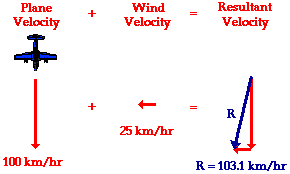
u3l1f4.gif


Consider plane velocity - As centripetal force
Wind velocity- As the velocity of object at the start
R- As the resultant velocity

So in the centripetal force objects this resultant velocity seems constant? How can this be when I add the vectors and use maths as in this question?

Thank you so much :smile:
 
Science news on Phys.org
In order for a force to change an object's direction of motion, but not its speed, that force must be always perpendicular to the object's velocity. That's not the case in your example. As soon as the wind acts, it changes the plane's velocity so that it is no longer perpendicular to the force.
 
Doc Al said:
In order for a force to change an object's direction of motion, but not its speed, that force must be always perpendicular to the object's velocity. That's not the case in your example. As soon as the wind acts, it changes the plane's velocity so that it is no longer perpendicular to the force.

Thank you so much for taking your time to help me Doc Al :smile: However I'm still confused, I'm rereading your response to grasp this. Have I labelled the variables wrong. Could you please tell me how you would label the variables? Thank you :smile:

u3l2c1.gif


In this example if the question says what is the speed of the ball at second circle, I have to add horizonatl and vertical components so how is the speed of the ball constant?
 
Last edited:
sameeralord said:
Thank you so much for taking your time to help me Doc Al :smile: However I'm still confused, I'm rereading your response to grasp this. Have I labelled the variables wrong. Could you please tell me how you would label the variables? Thank you :smile:
The issue has nothing to do with labels. For the wind to change the plane's direction but not its speed, the wind would have to shift so that it's always hitting the plane sideways to its direction of motion. That's not the case here. This is not an example of centripetal force.

Here's an example that illustrates what you're looking for, I think. Attach a ball on the end of a string and twirl it in a horizontal circle. The horizontal component of the string tension provides the centripetal force. That force is always perpendicular to the ball's velocity, which is tangent to the circle. As the ball moves around in a circle, the force changes direction to stay perpendicular to the ball's velocity vector.
 
sameeralord said:
u3l2c1.gif


In this example if the question says what is the speed of the ball at second circle, I have to add horizonatl and vertical components so how is the speed of the ball constant?
The speed of the ball is not constant. It's falling!

Only the horizontal component of the velocity is constant, since gravity only acts vertically.
 
sameeralord said:
Thank you so much for taking your time to help me Doc Al :smile: However I'm still confused, I'm rereading your response to grasp this. Have I labelled the variables wrong. Could you please tell me how you would label the variables? Thank you :smile:

u3l2c1.gif


In this example if the question says what is the speed of the ball at second circle, I have to add horizonatl and vertical components so how is the speed of the ball constant?

The gravitational force is normal to the velocity vector only at the instant the cannonball comes out of the cannon. This is similar to the situation Doc Al described in post #2. Paraphrasing his response, "As soon as gravity acts, it changes the cannonball's velocity so that it is no longer perpendicular to the gravitational force."
 
Thanks Doc Al and DH for your help :smile:

If the force is acting perpendicular to the velocity all the time how can it change the direction? Why doesn't centripetal force change the direction of the ball velocity so it is not perpendicular to the centripetal force?

Is this projectile motion completely irrevelant to centripetal force. Can I understand the answer to my question from the diagram I posted?

Sorry I know I have made a mess of this.
 
sameeralord said:
If the force is acting perpendicular to the velocity all the time how can it change the direction?
It pushes it sideways. In the example with the ball on a string, the ball is constantly changing direction.
Why doesn't centripetal force change the direction of the ball velocity so it is not perpendicular to the centripetal force?
The ball's velocity and the centripetal force change direction together at just the right rate so that they stay perpendicular.

Is this projectile motion completely irrevelant to centripetal force.
Yes. (Unless the projectile is moving so fast that it goes into orbit!)
Can I understand the answer to my question from the diagram I posted?
Which question? The problem with the cannon ball speed? Sure.
 
Doc Al said:
It pushes it sideways. In the example with the ball on a string, the ball is constantly changing direction.

Thanks again Doc Al :smile:

Now this is my misunderstanding. If you look at the second circle in my cannon diagram this is what I'm thinking. The ball velocity is 20m/s and the speed from centripetal force is 9.8 m/s, and the resultant velocity is the vector sum of that? Could you please help using this example.Thank you :smile:
 
  • #10
sameeralord said:
The ball velocity is 20m/s and the speed from centripetal force is 9.8 m/s, and the resultant velocity is the vector sum of that?
Yes, but there's no 'centripetal force' in this problem, just gravity acting down. Vx = 20 m/s and at the end of 1 second Vy = -9.8 m/s. What's the resultant velocity?
 
  • #11
Doc Al said:
Yes, but there's no 'centripetal force' in this problem, just gravity acting down. Vx = 20 m/s and at the end of 1 second Vy = -9.8 m/s. What's the resultant velocity?

Ok but the resultant velocity is not going to be 20m/s so how is centripetal force changing direction without magnitude? Thanks a lot for helping so far :smile:
 
  • #12
Doc Al said:
Yes, but there's no 'centripetal force' in this problem, just gravity acting down. Vx = 20 m/s and at the end of 1 second Vy = -9.8 m/s. What's the resultant velocity?

Ok but the resultant velocity is not going to be 20m/s so how is centripetal force changing direction without magnitude? Thanks a lot for helping so far :smile:

481px-Centripetal-force-fi.svg.png


I'm considering the blue line as 20 m/s and the green line as 9.8 m/s.
 
  • #13
sameeralord said:
Ok but the resultant velocity is not going to be 20m/s so how is centripetal force changing direction without magnitude?
Listen carefully: This is a projectile motion problem. Centripetal force has nothing to do with it! This is not an example of circular motion and centripetal force.
 
  • #14
sameeralord said:
Ok but the resultant velocity is not going to be 20m/s so how is centripetal force changing direction without magnitude? Thanks a lot for helping so far :smile:

481px-Centripetal-force-fi.svg.png


I'm considering the blue line as 20 m/s and the green line as 9.8 m/s.
This diagram is not relevant to this problem. There's no circular motion or centripetal force here. It's a projectile motion problem!
 
  • #15
Doc Al said:
Listen carefully: This is a projectile motion problem. Centripetal force has nothing to do with it! This is not an example of circular motion and centripetal force.

I think I just edited my post while you were replying. Could you please help me with the new diagram? Thank you :smile:
 
  • #16
See my comments above regarding the new diagram.
 

Similar threads

  • · Replies 7 ·
Replies
7
Views
5K
  • · Replies 8 ·
Replies
8
Views
3K
  • · Replies 15 ·
Replies
15
Views
4K
  • · Replies 10 ·
Replies
10
Views
2K
  • · Replies 24 ·
Replies
24
Views
4K
  • · Replies 23 ·
Replies
23
Views
4K
  • · Replies 47 ·
2
Replies
47
Views
5K
  • · Replies 21 ·
Replies
21
Views
3K
Replies
55
Views
3K
  • · Replies 3 ·
Replies
3
Views
2K