Why Don't Equal Forces in Newton's Third Law Always Feel the Same?

  • Context: Undergrad 
  • Thread starter Thread starter N's 3rd law ftw
  • Start date Start date
  • Tags Tags
    Doubt Law
Click For Summary

Discussion Overview

The discussion revolves around the nuances of Newton's Third Law of Motion, particularly focusing on the perception of forces when interacting with different objects, such as paper versus heavier items like furniture. Participants explore the implications of equal and opposite forces in various contexts, including the effects of punching different materials and the application of these principles in a vacuum, such as with rocket propulsion.

Discussion Character

  • Exploratory
  • Technical explanation
  • Debate/contested

Main Points Raised

  • One participant expresses confusion about why the force felt from punching a piece of paper differs from that of a heavier object, questioning the application of Newton's laws in these scenarios.
  • Another participant suggests that the forces in Newton's Third Law act on different objects, explaining that the reaction force from the block or object is equal and opposite to the force exerted by the person.
  • It is noted that less force is required to accelerate a piece of paper compared to a sofa, implying that the reaction force from the paper is also less.
  • A participant clarifies that the force of a punch depends on what it is hitting, with different materials providing varying levels of resistance and thus different forces in response.
  • Discussion arises about the application of Newton's Third Law in a vacuum, with participants questioning how it applies to rockets without a medium, leading to explanations about exhaust forces and rocket propulsion.
  • One participant states that the exhaust from a rocket engine continues to move in a vacuum, indicating the persistence of forces in space.

Areas of Agreement / Disagreement

Participants express differing views on the perception of forces when interacting with various objects, with some emphasizing the role of mass and acceleration, while others focus on the mechanics of force interactions in different environments, such as a vacuum. The discussion remains unresolved regarding the nuances of these interactions and their implications.

Contextual Notes

There are limitations in the discussion regarding assumptions about force perception, the definitions of forces involved, and the specific conditions under which Newton's laws apply, particularly in non-standard environments like space.

N's 3rd law ftw
Messages
1
Reaction score
0
I understand that if for an instance one object pushes another with a determinate force, the other object acelerates with that force, and the pushing object acelerates in oposite direction with the oposite force as well.

However if I punch a piece of paper I don't feel the same oposite force from my punch than with a heavier object like a furniture, shouldn´t it be the same?

I've google this and I saw this response:
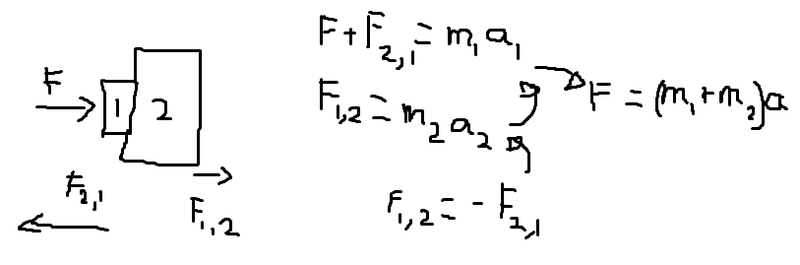
49580ef61041d9175d63b26c87fe7cde.png


It considers a1=a2

According to Newton's law F2,1=-F, right? then the block 1 wouldn´t move at all (f-f=0) and the object 2 would accelerate with an F force. I'm so confused.. Where does this F1,2 , F2,1 and F come in the first place, shouldn't F transform into F2,1 and F1,2? How come are they added in F=ma if they don't coexist.

thanks in advance
 
Physics news on Phys.org
Try googling for "horse cart problem Newton's third law" and you'll find a number of good explanations.

The key here is that the two forces that make up a third-law equal-and-opposite pair are acting on different objects. When you push on the block you are applying a force to the block and accelerating. The block is exerting an equal and opposite force on you. You would slide backwards if you were standing on a slippery floor; more often the friction between the soles of your shoes and the floor acts against the force the block exerts on you so the net force on you is zero and you stay put.
 
N's 3rd law ftw said:
However if I punch a piece of paper I don't feel the same oposite force from my punch than with a heavier object like a furniture, shouldn´t it be the same?
You can easily punch a heavy object with more force than you can punch a piece of paper. But either way, whatever force you exert on the object (whether paper or furniture) will be equal and opposite to the force that that object exerts back on you.

N's 3rd law ftw said:
According to Newton's law F2,1=-F, right?
No, not right. F is an applied force. The correct third law pair here is F2,1 & F1,2: They are equal and opposite.
 
N's 3rd law ftw said:
However if I punch a piece of paper I don't feel the same oposite force from my punch than with a heavier object like a furniture, shouldn´t it be the same?

It takes less force to give the same acceleration to a piece of paper than to a sofa. Therefore the reaction force from the piece of paper is also less.
 
N's 3rd law ftw said:
...

According to Newton's law F2,1=-F, right?
The force of a punch depends on what it is hitting. If you punch the air, you don't apply much force to the air and the air does not apply much force to your fist. But if you punch a cement wall, the wall will apply a very large force to your fist. Your fist will stop in a very short time so its momentum change per unit of time (F = dp/dt) is very large. The air will just slow your fist down by a very small amount in a very long time, so the force = dp/dt is very small.

AM
 
One think is there

Newtons 3rd law needed particular medium(ex.air)to be apply

so in vaccume( Space) How it apply to rocket,as there is no medium
 
Sanky123 said:
How it apply to rocket,as there is no medium
The force upon the motor is opposite to the force that the exhaust experiences in its escape from the motor.
 
Sanky123 said:
One think is there

Newtons 3rd law needed particular medium(ex.air)to be apply

so in vaccume( Space) How it apply to rocket,as there is no medium

The rocket engine pushes against the fuel exhaust to accelerate it out of the nozzle. Therefor there is also a force pushing back against the rocket engine, which is what accelerates the rocket.
 
Drakkith said:
The rocket engine pushes against the fuel exhaust to accelerate it out of the nozzle. Therefor there is also a force pushing back against the rocket engine, which is what accelerates the rocket.
Ok thanks..

one more thing , what happened to that exhausts from rocket engine in vaccume ( Space )
 
  • #10
Sanky123 said:
Ok thanks..

one more thing , what happened to that exhausts from rocket engine in vaccume ( Space )

It just keeps going.
 
  • #11
Ok
 

Similar threads

  • · Replies 19 ·
Replies
19
Views
2K
  • · Replies 40 ·
2
Replies
40
Views
4K
  • · Replies 4 ·
Replies
4
Views
2K
  • · Replies 41 ·
2
Replies
41
Views
8K
  • · Replies 7 ·
Replies
7
Views
2K
  • · Replies 8 ·
Replies
8
Views
2K
Replies
7
Views
2K
  • · Replies 61 ·
3
Replies
61
Views
5K
  • · Replies 14 ·
Replies
14
Views
2K
  • · Replies 29 ·
Replies
29
Views
3K