altruan23
- 22
- 5
- Homework Statement
- So i was learning about the subtractor op amp circuit and saw that everyone is saying that a subtractor is the same as a differential op amp.
- Relevant Equations
- superposition, voltage divider , op amp
So after using superposition and setting the ratio R2/R1 = R4/R3 the same or R2=R4 and R1=R3,i come to the eq. for output voltage Vout= R2/R1 * (V2-V1) or R4/R3(V2-V1). And in the book foundations of analog and digital electronics by agarwal and lang, they are saying that this circuit is a subtractor.
but isn't that just an differential amplifier, as it amplifies with the ratio R2/R1 the difference (V2-V1)? Schouldnt a subtractor be Vout= V2-V1 so that means i need to have R1=R2=R3=R4. why is everyone saying that a differential amp. is the same as subtracter?? i simulated both circuits and as i tought, all resistors must be the same to really have a subtractor.
The first picture is R2/R1 = R4/R3 as in the book.
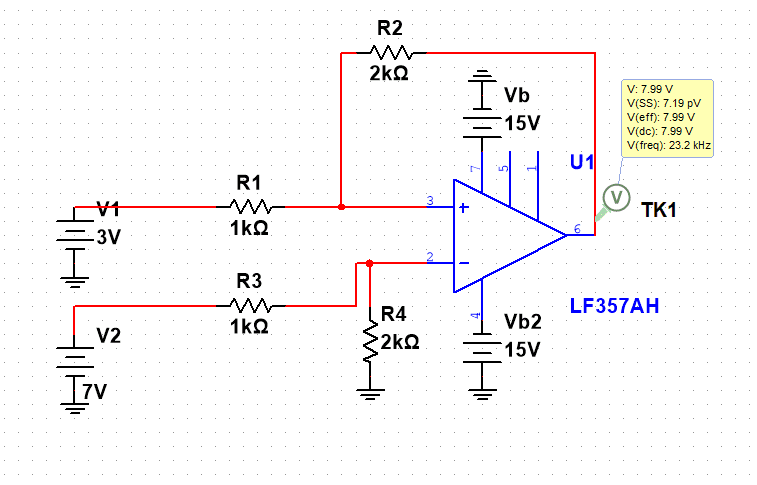
So as you can see, 7V-3V schould be 4 according to a real subtractor, but because the ratio R2/R1 or R4/R3 is 2, Uout is 2*4=8.
And if i set all the resistors the same i truly get a real subtractor.
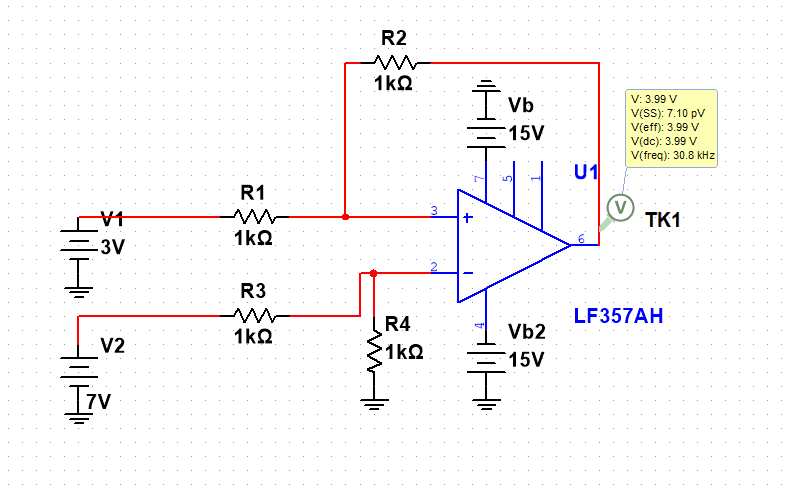
So why is everyone saying that a differential amp is the same as subctractor?? i mean a subtractor is a differential amp with gain 1, but a differential amp with some other gain isn't a subtractor.
the book is here: https://neurophysics.ucsd.edu/courses/physics_120/Agarwal and Lang (2005) Foundations of Analog and Digital.pdf
online book page 883
but isn't that just an differential amplifier, as it amplifies with the ratio R2/R1 the difference (V2-V1)? Schouldnt a subtractor be Vout= V2-V1 so that means i need to have R1=R2=R3=R4. why is everyone saying that a differential amp. is the same as subtracter?? i simulated both circuits and as i tought, all resistors must be the same to really have a subtractor.
The first picture is R2/R1 = R4/R3 as in the book.
So as you can see, 7V-3V schould be 4 according to a real subtractor, but because the ratio R2/R1 or R4/R3 is 2, Uout is 2*4=8.
And if i set all the resistors the same i truly get a real subtractor.
So why is everyone saying that a differential amp is the same as subctractor?? i mean a subtractor is a differential amp with gain 1, but a differential amp with some other gain isn't a subtractor.
the book is here: https://neurophysics.ucsd.edu/courses/physics_120/Agarwal and Lang (2005) Foundations of Analog and Digital.pdf
online book page 883