Why is the Electric Field outside this wire not zero?

Join the discussion
Ask a follow-up here, or get your own question answered by working scientists, mathematicians and engineers — people, not an autocomplete.
Real named experts · corrections over time · the nuance an AI answer skips
6 replies · 2K views
bryanso
Messages
28
Reaction score
7
Homework Statement
Not a homework. Just want to understand a (should be simple) example.
Relevant Equations
Why is E not zero?
Not a homework. Just self-studying electromagnetism.

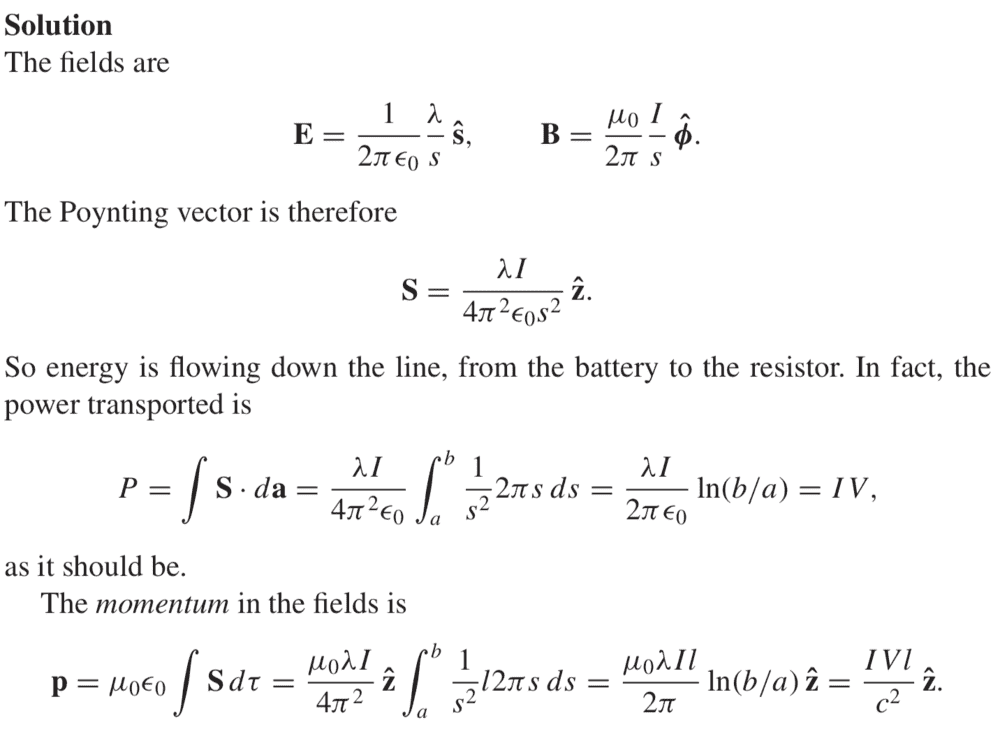
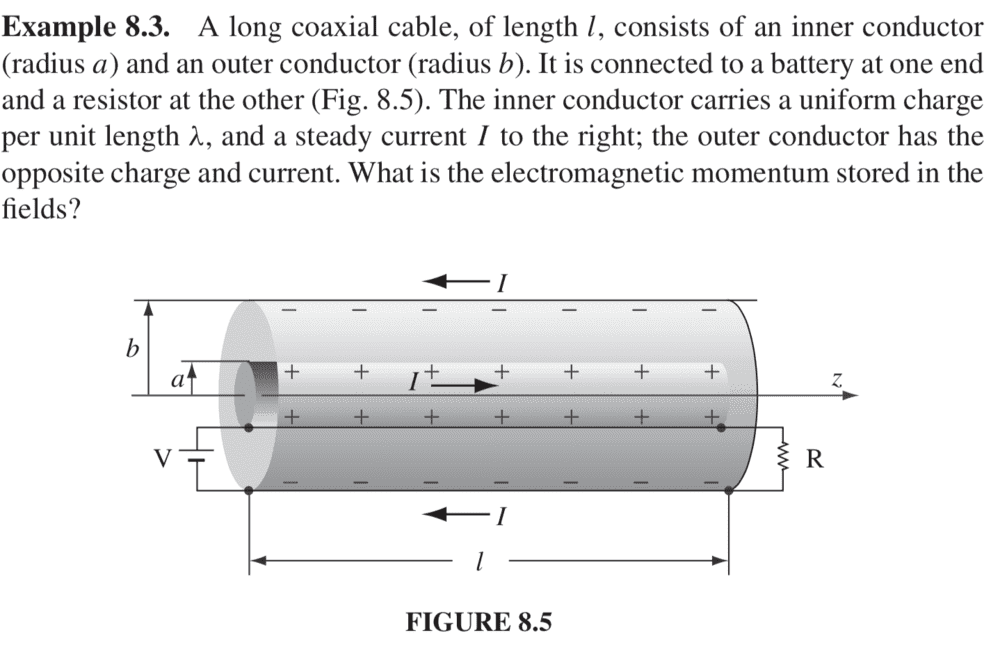
I am stuck at understanding the very beginning of the solution steps in this example:

The E as given in the solution is the field away from a long straight line with charge Lambda. That's clearly not the current configuration.

E should be zero by Gauss law, shouldn't it? ... Net charge is 0.

David Griffiths Electrodynamics 4th Edition, p. 368
Griffiths001.png
Griffiths002.png
 
Last edited by a moderator:
Physics news on Phys.org
bryanso said:
E should be zero by Gauss law, shouldn't it? ... Net charge is 0.
Ask yourself: The field where?
 
> Ask yourself: The field where?

Outside is 0 from Gauss Law.

Inside conductor is 0 (after equilibrium).

So there are two fields, one on the outer surface and one on the inside contacting surface?

Am I in the right direction?
 
The fields are only at the surface?? Please be a little more complete in your description. Electric field lines start on a positive charge and end on a negative charge.
 
  • Like
Likes   Reactions: bryanso
bryanso said:
> Ask yourself: The field where?

Outside is 0 from Gauss Law.

Inside conductor is 0 (after equilibrium).

So there are two fields, one on the outer surface and one on the inside contacting surface?

Am I in the right direction?
What about E field between a and b? By Gauss' law?
 
  • Like
Likes   Reactions: bryanso
Thank you all. Got it. I knew I missed something very simple. I got misled by the general rule of thumb that there is no E inside a conductor. But this is not a homogenous conductor here. I can proceed now.

Thanks
 
bryanso said:
Thank you all. Got it. I knew I missed something very simple. I got misled by the general rule of thumb that there is no E inside a conductor. But this is not a homogenous conductor here. I can proceed now.

Thanks
Right. There can be no E field inside a conductor.
In fact, unless it's a perfect NON-conductor there can be no E field in the steady-state.

UNLESS there is current flow, in which case you have E = ρι where ρ is resistivity and ι is current density.
(Vector equation.)