annamal
- 393
- 33
If we put a positive charge outside of a conductor, there is an induced charge, but if we put a positive and negative charge inside a conductor, there is no induced charge?
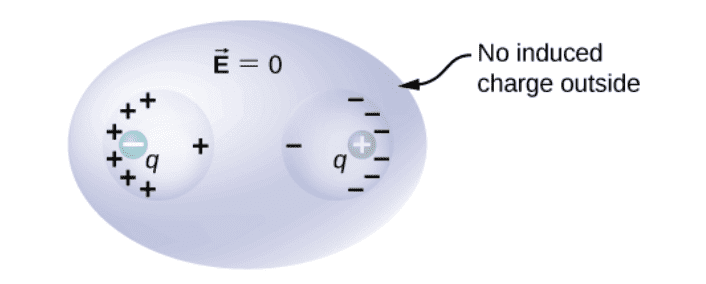
The discussion centers on the behavior of induced charges in conductors, specifically addressing the conditions under which induced charges appear on the surface of a conductor. When a positive charge is placed outside a conductor, it induces a charge on the conductor's surface. However, when both positive and negative charges are placed inside the conductor, no induced charge appears on the outer surface due to the cancellation of electric fields. This phenomenon is explained through the principles of electrostatics and the Faraday cage effect, which states that the electric field inside a conductor in electrostatic equilibrium is zero.
PREREQUISITESStudents of physics, electrical engineers, and anyone interested in understanding the principles of electrostatics and charge behavior in conductors.
I don't get it. A faraday cage creates charge on the outside of the conductor and blocks charge going in...Ibix said:Look up "Faraday cage".
...or charges on the inside to block electric fields going out. The diagram, I think, shows an ellipsoidal body with two spherical hollows, each containing a charge. There is an induced charge on the surface of the hollows (the inside surface of the conductor) but nothing on the outside surface because there's no net charge inside and the electron distribution on the inside surface cancels out the dipole field.annamal said:I don't get it. A faraday cage creates charge on the outside of the conductor and blocks charge going in...
If we had one cavity of charge, that would induce a charge on the surface.Ibix said:...or charges on the inside to block electric fields going out. The diagram, I think, shows an ellipsoidal body with two spherical hollows, each containing a charge. There is an induced charge on the surface of the hollows (the inside surface of the conductor) but nothing on the outside surface because there's no net charge inside and the electron distribution on the inside surface cancels out the dipole field.
The charge does not appear inside the conductor, so the charge cannot simply be placed inside the conductor, so a more accurate expression is as shown in the figure below. There must be an insulating layer, the charge will accumulate at the interface of the conductor and the insulating layer, so here is the electric field in the insulating layer.annamal said:If we put a positive charge outside of a conductor, there is an induced charge, but if we put a positive and negative charge inside a conductor, there is no induced charge?
You drew induced charges on the surface of the conductor. There are no induced charges.alan123hk said:The charge does not appear inside the conductor, so the charge cannot simply be placed inside the conductor, so a more accurate expression is as shown in the figure below. There must be an insulating layer, the charge will accumulate at the interface of the conductor and the insulating layer, so here is the electric field in the insulating layer.
annamal said:You drew induced charges on the surface of the conductor. There are no induced charges.
The beginning of the thread I posted a picture from my textbook and it says no induced charge outside.alan123hk said:I believe you mean that there will be no induced charges on the outermost surface of the conductor, but why are you so confident or so sure?
annamal said:The beginning of the thread I posted a picture from my textbook and it says no induced charge outside.