Undergrad Why is this volume/surface integration unaffected by a singularity?

Click For Summary
The discussion focuses on the application of the Gauss divergence theorem to a vector field that becomes singular at a specific point. It highlights that while the vector field ##\dfrac{\mathbf{M'}}{\left| \mathbf{r}-\mathbf{r'} \right|}## is discontinuous at ##\mathbf{r'}=\mathbf{r}##, both volume and surface integrals can still be computed despite this singularity. By utilizing vector identities and transforming the equations, it demonstrates that the integrands in the relevant equations remain defined except at the singular point. This allows for the evaluation of the integrals without being affected by the singularity. The discussion ultimately seeks to clarify the conditions under which the divergence theorem can still be applied in this context.
Mike400
Messages
59
Reaction score
6
##\mathbf{M'}## is a vector field in volume ##V'## and ##P## be any point on the surface of ##V'## with position vector ##\mathbf {r}##
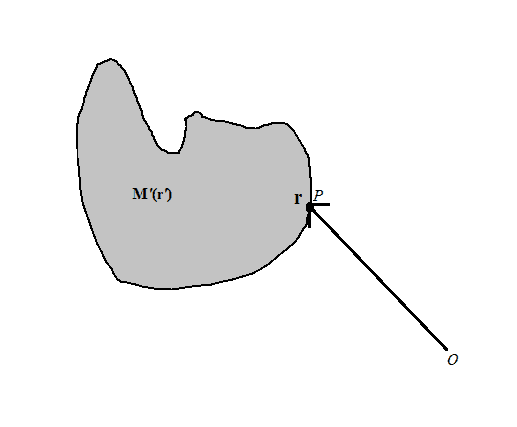
stack exchange 3-10-19.png

Now by Gauss divergence theorem:

\begin{align}
\iiint_{V'} \left[ \nabla' . \left( \dfrac{\mathbf{M'}}{\left| \mathbf{r}-\mathbf{r'} \right|} \right) \right] dV'
&=\unicode{x222F}_{S'} \left[ \left( \dfrac{\mathbf{M'}}{\left| \mathbf{r}-\mathbf{r'} \right|} \right) . \hat{n} \right] dS' \tag{1}\\
\end{align}

Both of these expressions, ##LHS## and ##RHS## of equation ##(1)##, have their respective integrands singular at ##\mathbf{r'}=\mathbf{r}##. Now how shall we show that both the volume and surface integration is unaffected by this singularity at ##\mathbf{r'}=\mathbf{r}##?
 

Attachments

  • stack exchange 3-10-19.png
    stack exchange 3-10-19.png
    2 KB · Views: 878
Physics news on Phys.org
The expression above is not valid, because the divergence theorem is only applicable to continuously differentiable vector fields, and the vector field
$$
\dfrac{\mathbf{M'}}{\left| \mathbf{r}-\mathbf{r'} \right|}$$
is discontinuous at ##\mathbf r##.
 
Using the vector identity ##\nabla.(\psi \mathbf{A})=\mathbf{A}.(\nabla \psi)+\psi (\nabla.\mathbf{A})##, ##LHS## of equation ##1## can be written as:

\begin{align}
\iiint_{V'} \left[ \nabla' . \left( \dfrac{\mathbf{M'}}{\left| \mathbf{r}-\mathbf{r'} \right|} \right) \right] dV'
&=\iiint_{V'} \mathbf{M'}.\nabla' \left( \dfrac{1}{\left| \mathbf{r}-\mathbf{r'} \right|} \right) dV'
+
\iiint_{V'} \dfrac{\nabla' . \mathbf{M'}}{\left| \mathbf{r}-\mathbf{r'} \right|} dV'
\tag{2}
\end{align}

Now for simplicity, let's take the origin of our coordinate system at ##P## (see the diagram). Thus equation ##(2)## becomes:

\begin{align}
\iiint_{V'} \left[ \nabla' . \left( \dfrac{\mathbf{M'}}{r'} \right) \right] dV'
&=\iiint_{V'} \mathbf{M'}.\nabla' \left( \dfrac{1}{r'} \right) dV' \tag{3}
&+\iiint_{V'} \dfrac{\nabla' . \mathbf{M'}}{r'} dV'\\
\end{align}

Now by writing ##dV'## as spherical volume element, equation ##(3)## becomes:

##\displaystyle \iiint_{V'} \left[ \nabla' . \left( \dfrac{\mathbf{M'}}{r'} \right) \right] {r'}^2\ \sin\theta\ d\theta\ d\phi\ dr'
=\iiint_{V'} \mathbf{M'}.\nabla' \left( \dfrac{1}{r'} \right) {r'}^2\ \sin\theta\ d\theta\ d\phi\ dr'
+\iiint_{V'} \dfrac{\nabla' . \mathbf{M'}}{r'} {r'}^2\ \sin\theta\ d\theta\ d\phi\ dr'\\
\displaystyle =\iiint_{V'} (\mathbf{M'}. \hat{r'}) \sin\theta\ d\theta\ d\phi\ dr'
+\iiint_{V'} (\nabla' . \mathbf{M'})\ r'\ \sin\theta\ d\theta\ d\phi\ dr'\\
\tag{4}##

In equation ##(4)##, the integrands are defined everywhere except at ##P## where ##r'=0## where the integrand is ##\frac{0}{0}##. Thus we can directly compute the volume integrals in equation ##(4)##. Can we now do something to apply the Gauss divergence theorem to the ##LHS## of equation ##(4)##?
 
Last edited:

Similar threads

  • · Replies 4 ·
Replies
4
Views
2K
  • · Replies 3 ·
Replies
3
Views
2K
  • · Replies 7 ·
Replies
7
Views
2K
  • · Replies 4 ·
Replies
4
Views
2K
  • · Replies 5 ·
Replies
5
Views
2K
  • · Replies 2 ·
Replies
2
Views
2K
Replies
2
Views
1K
Replies
4
Views
4K
  • · Replies 21 ·
Replies
21
Views
2K
  • · Replies 14 ·
Replies
14
Views
2K