Why isn't this circuit behaving like a low pass filter?

Click For Summary
SUMMARY

The discussion centers on troubleshooting a low pass filter circuit designed using the LT1001 opamp. The circuit is intended to have a DC gain of 1/16, but users report complete attenuation at low frequencies. Key issues identified include incorrect battery connections to the opamp and the need to plot frequency response down to 10 Hz to observe proper low pass behavior. The presence of a peak above 100 KHz is attributed to the capacitor C3, which should be removed to eliminate this peak.

PREREQUISITES
  • Understanding of low pass filter design principles
  • Familiarity with opamp configurations, specifically the LT1001
  • Knowledge of Bode plots and frequency response analysis
  • Experience with circuit simulation tools like PSPICE
NEXT STEPS
  • Review the transfer function for low pass filters in "Intro to Electric Circuits, 7e, Dorf and Svoboda"
  • Learn how to properly configure opamp power supply connections
  • Explore the effects of component values on filter performance
  • Investigate the use of VAC input sources in PSPICE for frequency sweeps
USEFUL FOR

Electronics engineers, circuit designers, and students studying filter design who are troubleshooting low pass filter circuits and analyzing frequency response.

chebyshevF
Messages
29
Reaction score
0
I'm trying to design a low pass filter from a transfer function (with one pole and one zero), and according to my textbook, the circuit which represents such a transfer function is of the following kind:
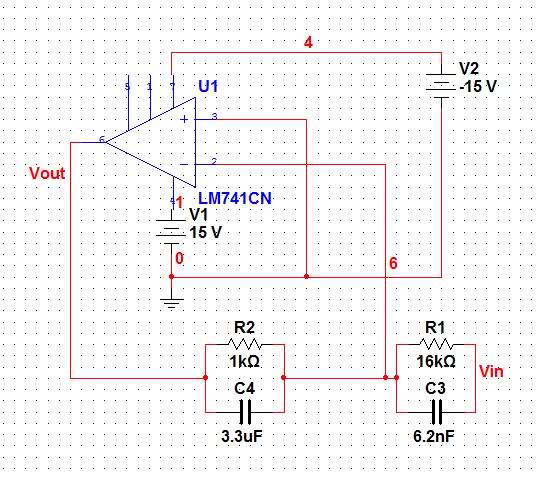
2howlkm.jpg

DC gain is 16.
Yet I get complete attenuation for low frequencies? Could my component values be wrong?
 
Engineering news on Phys.org
Looks like you swapped the V+ and V- supply pins on the opamp.
 
The DC gain should be 1/16 ie R2 / R1.

Below 50 KHz it does function as a low pass filter. Did you plot down to 10 Hz?

The gain rises sharply above 100 KHz.
 
I got this frequency response with the LT1001 opamp. Would you mind posting the transfer function from your book? Thanks.

-24.1 dB = 20 log10(1/16)

eajl6.png
 
I'm not sure what simulation program you're using, but if it's like PSPICE, you need to use VAC as the input source to sweep frequency from low to high.
 
vk6kro said:
The DC gain should be 1/16 ie R2 / R1.

Below 50 KHz it does function as a low pass filter. Did you plot down to 10 Hz?

The gain rises sharply above 100 KHz.
Yep you're right about the DC gain being 1/16, that was my mistake typing it there. And I plotted from 20Hz.

gnurf said:
I got this frequency response with the LT1001 opamp. Would you mind posting the transfer function from your book? Thanks.

-24.1 dB = 20 log10(1/16)

http://imgur.com/eajl6.png
Actually this is my issue. I get the same Magnitude Bode Plot, yet what I don't understand is: why is my input amplitude being attenuated so much? I've set the amplitude at 20Vp, and according to the oscilliscope I include in the circuit, the output is in the mV range?! Isn't it supposed to be that with Low Pass Filter circuits, low frequency input signals are easily passed through as opposed to high frequency signals?

I was expecting the plot to start off at around just -0.3~ dB, but then again doesn't this depend on my DC gain? So I'm guessing I'd need a lower DC gain then?

As for the transfer function and corressponding circuit (taken from Intro to Electric Circuits, 7e, Dorf and Svoboda):
icl6id.jpg


Where I set R2=1000 Ohms. (And then calculate for the other components).
 
Last edited:
If you plot this below 10 Hz you will get a classic low pass filter. The gain below 10 Hz is about 1/16.

Above 1000 Hz roughly, the output is much lower than 1/16 vin. This is what you would expect.

The huge peak above 100 KHz is due to C3. If you remove this, you don't get this peak.

It helps to plot the vertical scale as linear rather than logarithmic.

[PLAIN]http://dl.dropbox.com/u/4222062/LP%20filter2.PNG

This is with an input signal of 1 volt.
 
Last edited by a moderator:
I was about to point out that R1 C3 constitute a high pass filter at the input when I read the above.
 
chebyshevF said:
I'm trying to design a low pass filter from a transfer function (with one pole and one zero), and according to my textbook, the circuit which represents such a transfer function is of the following kind:
2howlkm.jpg

DC gain is 16.
Yet I get complete attenuation for low frequencies? Could my component values be wrong?

well your battery connections are incorrect for a start the cct will not work in the current configuration ... you have + voltage from each battery going to the 2 supply terminals of the Op-amp. Reverse the battery connections on Pin 4 of the opamp so that - of that battery goes to pin 4 and the + of that battery to the GND rail (Negative rail of the other battery)

Dave
 
  • #10
Isn't that just a matter of sloppy drawing. (Let him that is without sin cast the first stone).He still has the 15V and -15V labels to show his supplies are right. Anyway, if they weren't, the sircuit wouldn't do anything.
 

Similar threads

  • · Replies 5 ·
Replies
5
Views
2K
  • · Replies 6 ·
Replies
6
Views
3K
  • · Replies 1 ·
Replies
1
Views
3K
  • · Replies 7 ·
Replies
7
Views
4K
Replies
6
Views
3K
  • · Replies 6 ·
Replies
6
Views
3K
  • · Replies 16 ·
Replies
16
Views
2K
  • · Replies 10 ·
Replies
10
Views
2K
  • · Replies 23 ·
Replies
23
Views
6K
  • · Replies 20 ·
Replies
20
Views
2K