Why isn't this largest voltage source given as negative?

Click For Summary
The discussion centers on the interpretation of voltage sources in a circuit example, specifically why a 32V source is labeled positive despite current flowing against its gradient. It highlights that the positive designation indicates a voltage rise, while the -8V source represents a voltage drop due to current flowing with its gradient. The conversation clarifies that resistors, being passive elements, do not have inherent polarity; their voltage signs depend on current direction. The exercise aims to teach sign conventions, emphasizing that the + and - markings determine voltage differences rather than absolute values. Overall, the example serves to illustrate the complexities of voltage interpretation in circuit analysis.
kostoglotov
Messages
231
Reaction score
6
This isn't actually a homework problem, but it is an example in a my textbook that I have a question about...
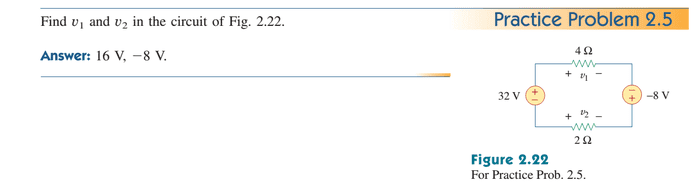
2OglMH4.png


imgur link: http://i.imgur.com/2OglMH4.png

Ok, I wanted to clarify some things. I understand that current flowing from a positive terminal to a negative terminal represents a positive voltage drop. I can see why the second voltage source (-8V) is a negative, since current is flowing against that voltage gradient within the component.

Two things

(1) the current is also flowing against the voltage gradient inside the 32V source, but the voltage is given as positive...is this because it is the dominant voltage source...so it represents not a voltage drop but a voltage rise, and as such, it is equivalent to a negative voltage drop...so a negative times a negative...?

(2) the resistors are passive elements, surely their polarities should be determined after we've figured out which way the current is flowing, no? Because the polarity of the bottom resistor should be reversed shouldn't it?
 
Physics news on Phys.org
Hi,

The book exercise is trying to mislead you (it mislead me in first instance). The exercise is in fact trying to teach us a lesson in sign conventions: If it says -8V next to a circle with a + and a - sign, the idea is that the + voltage is 8 V lower than the - voltage. That is not meant to be a conclusion but is meant as a given !

That way you get a total voltage of 24 V over the two resistors and hence a current of 4 A.
In the top resistor the current is from left to right, so the side marked + is at a higher voltage than the side marked - and therefore v1 is positive.
In the bottom resistor the current is from right to left to, so the side marked - is at a higher voltage than the side marked + and therefore v2 is negative.

kostoglotov said:
(1) the current is also flowing against the voltage gradient inside the 32V source, but the voltage is given as positive...is this because it is the dominant voltage source...so it represents not a voltage drop but a voltage rise, and as such, it is equivalent to a negative voltage drop...so a negative times a negative...?

(2) the resistors are passive elements, surely their polarities should be determined after we've figured out which way the current is flowing, no? Because the polarity of the bottom resistor should be reversed shouldn't it?
(1) It (going from - side to + side) always represents a voltage rise if the value for v (32 V here) is positive (so also if it is not the dominant voltage source).
(2) resistors have no polarity, but -- as you say correctly -- when you found out the direction of the current, there is a side that is a a higher voltage than the other side.

The + and the - marks simply dictate a sign for v2. So if you connect a voltmeter (+ on left, - on right) then it shows ##-##8 V.

The example isn't trivial, but someone who doesn't understand it does not benefit and only getst more confused. So it's good you check!

A double check would be to repeat the exercise with -44 V on the right instead of - 8 V :smile: !
 
  • Like
Likes kostoglotov

Similar threads

  • · Replies 7 ·
Replies
7
Views
2K
  • · Replies 1 ·
Replies
1
Views
2K
  • · Replies 19 ·
Replies
19
Views
5K
  • · Replies 3 ·
Replies
3
Views
2K
Replies
9
Views
1K
  • · Replies 10 ·
Replies
10
Views
6K
  • · Replies 36 ·
2
Replies
36
Views
5K
  • · Replies 10 ·
Replies
10
Views
8K
Replies
15
Views
2K
Replies
8
Views
3K