Window Comparator: Understanding the Output Behavior and Common Errors

Click For Summary
The discussion centers on the confusion surrounding the output behavior of a window comparator, particularly when the input voltage is between the specified reference values. The user expected a positive output with a 3V input between 1V and 5V but observed negative outputs instead, leading to questions about potential errors in the reference book. Participants suggest simulating the circuit using software like LTSpice to clarify the output behavior. There is speculation about whether the book contains inaccuracies regarding the expected output when the input is within the reference range. The conversation emphasizes the importance of understanding operational amplifiers and their configurations in practical applications.
Alex Hughes
Messages
54
Reaction score
13
So I've been reading an intro book to electronics and I got to a section about operational amplifiers. It talks about different uses of them and how they can be used as comparators. It then talks about a specific comparator called a window comparator which will output a positive voltage if the input voltage is in between the high and low reference values. Here is the diagram they give:
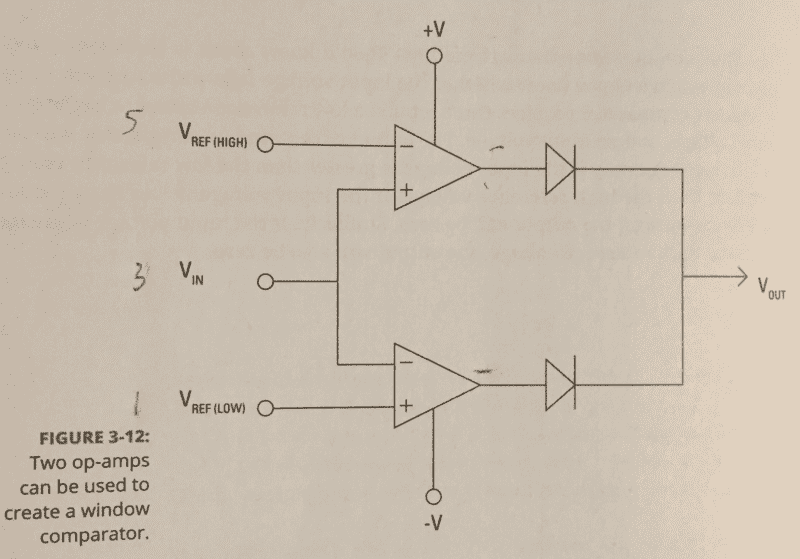
upload_2018-3-24_13-41-16.png


I understand the theory, but according to this diagram I don't seem to get the values they say I should get. For example, I put the Vref(high) at 5v and the low at 1V with a 3V input. According to the book I should get a positive voltage for Vout. However in the top comparator, The noninverting input (+ side) is at a lower value than the inverting input. According to the book, this means the output should be negative, right? In the bottom comparator, the noninverting input is also lower than the inverting input, once again resulting in a negative output. Since there are two diodes on both sides, this wouldn't allow any of the signal to get through and Vout would be 0. Can somebody explain to me why they say you should get a positive output if the input voltage lies between the two reference values then? Thanks.
 

Attachments

  • upload_2018-3-24_13-39-39.png
    upload_2018-3-24_13-39-39.png
    77.2 KB · Views: 694
  • upload_2018-3-24_13-41-1.png
    upload_2018-3-24_13-41-1.png
    77.2 KB · Views: 728
  • upload_2018-3-24_13-41-16.png
    upload_2018-3-24_13-41-16.png
    66.2 KB · Views: 1,050
Engineering news on Phys.org
Alex Hughes said:
For example, I put the Vref(high) at 5v and the low at 1V with a 3V input.

Have you implemented this either on a breadboard (or something) or using electronics simulator software and in what way i.e. what components you are using and what are the voltages you apply (##V_{cc}, V_{REF}, V_{in}##)?
 
Is there a requirement what the logic output is? In other words is there a reason that the output needs to be high when the input is within the window? I can't see what your book says. Your circuit will output a high when outside the window and a low when within the window.
 
  • Like
Likes berkeman
They explicitly said in the book that if the input voltage lies within both reference values, the output will be positive. You can read it here. Figure 3-12 is the diagram I attached above.
upload_2018-3-24_17-41-45.png


I've caught errors in this book before, is this another one of those errors?
 

Attachments

  • upload_2018-3-24_17-41-45.png
    upload_2018-3-24_17-41-45.png
    64 KB · Views: 1,111
Alex Hughes said:
They explicitly said in the book that if the input voltage lies within both reference values, the output will be positive. You can read it here. Figure 3-12 is the diagram I attached above.
View attachment 222679

I've caught errors in this book before, is this another one of those errors?
I would say.
 
  • Like
Likes berkeman
Alex Hughes said:
Can somebody explain to me why they say you should get a positive output if the input voltage lies between the two reference values then? Thanks.
Looks to me also that the output is active low...
Alex Hughes said:
I've caught errors in this book before, is this another one of those errors?
There's a free version of LTSpice that is especially helpful for students. I'd guess that if you simulated this circuit in LTSpice to confirm the hint from @Averagesupernova you would get extra credit... :smile:
 
  • Like
Likes dlgoff
I am trying to understand how transferring electric from the powerplant to my house is more effective using high voltage. The suggested explanation that the current is equal to the power supply divided by the voltage, and hence higher voltage leads to lower current and as a result to a lower power loss on the conductives is very confusing me. I know that the current is determined by the voltage and the resistance, and not by a power capability - which defines a limit to the allowable...

Similar threads

  • · Replies 20 ·
Replies
20
Views
5K
Replies
26
Views
6K
  • · Replies 15 ·
Replies
15
Views
3K
  • · Replies 2 ·
Replies
2
Views
2K
  • · Replies 11 ·
Replies
11
Views
3K
Replies
15
Views
2K
Replies
34
Views
4K
  • · Replies 21 ·
Replies
21
Views
3K
  • · Replies 4 ·
Replies
4
Views
3K
  • · Replies 1 ·
Replies
1
Views
2K