Work Done by Incline Plane & Gravity on Block?

Click For Summary
In a discussion about a block sliding down a frictionless inclined plane, it was clarified that the work done by the incline on the block is zero, as the normal force acts perpendicular to the block's movement. Conversely, the work done by gravity is considered positive since gravity is the force that propels the block downward along the incline. The relationship between gravitational potential energy and kinetic energy was also highlighted, emphasizing that as the block descends, it loses potential energy while gaining kinetic energy. The equations for kinetic energy (KE = 1/2 mv²) and potential energy (PE = mgh) were referenced to support these points. Overall, the discussion confirmed the initial assumptions regarding work done by both the incline and gravity.
TheNotoriousWM
Messages
2
Reaction score
0
Say we have a friction-less inclined plane in the shape of a right triangle, sloping downward to the right. The angle above the horizontal axis is inconsequential for these specific purposes aside from the fact that we know it is inclined above said axis.

We then have a block sliding down (to the right) the plane. My question is about the work done on the block by the incline plane and gravity.

Is the work done by the inclined place on the block considered to be positive, negative, or zero? I think it is zero as what would be considered the normal force has a direction perpendicular to the movement of the block.

I am also hung up on the same question regarding the work done by gravity. It would make sense to think the work by gravity would be positive as that is what moves the block down the inclined plane without outside forces having acted upon it. I just wanted to verify these if anyone could possibly clear things up a bit.

Thanks in advance.
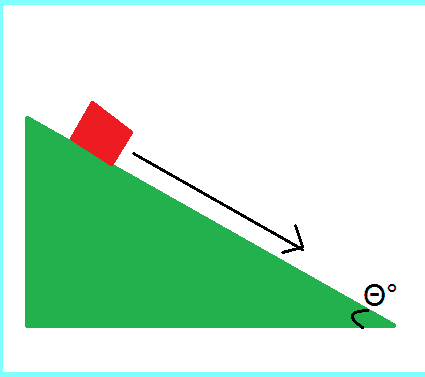
12540n8.jpg
 
Physics news on Phys.org
If you lift an object, you are giving it gravitational potential energy.

So, to put it at the top of that incline, it will have gained potential energy.

When it is released, it is losing potential energy, but gaining gravitational kinetic energy.

KE = PE

==================

When it's frictionless, it's best to think of these problems with the equations

KE = \frac{1}{2}mv^{2}

PE = mgh
 
TheNotoriousWM said:
Say we have a friction-less inclined plane in the shape of a right triangle, sloping downward to the right. The angle above the horizontal axis is inconsequential for these specific purposes aside from the fact that we know it is inclined above said axis.

We then have a block sliding down (to the right) the plane. My question is about the work done on the block by the incline plane and gravity.

Is the work done by the inclined place on the block considered to be positive, negative, or zero? I think it is zero as what would be considered the normal force has a direction perpendicular to the movement of the block.

I am also hung up on the same question regarding the work done by gravity. It would make sense to think the work by gravity would be positive as that is what moves the block down the inclined plane without outside forces having acted upon it. I just wanted to verify these if anyone could possibly clear things up a bit.

Thanks in advance.

12540n8.jpg
Hello TheNotoriousWM. Welcome to PF !

You are correct on both accounts.
 
Thanks for the help all, never hurts to check.
 
The book claims the answer is that all the magnitudes are the same because "the gravitational force on the penguin is the same". I'm having trouble understanding this. I thought the buoyant force was equal to the weight of the fluid displaced. Weight depends on mass which depends on density. Therefore, due to the differing densities the buoyant force will be different in each case? Is this incorrect?

Similar threads

  • · Replies 4 ·
Replies
4
Views
3K
  • · Replies 12 ·
Replies
12
Views
2K
  • · Replies 2 ·
Replies
2
Views
3K
  • · Replies 7 ·
Replies
7
Views
8K
Replies
2
Views
1K
Replies
2
Views
2K
  • · Replies 33 ·
2
Replies
33
Views
4K
Replies
30
Views
3K
Replies
3
Views
3K