Working with Electric Field E, not Vector Potential A

Join the discussion
Ask a follow-up here, or get your own question answered by working scientists, mathematicians and engineers — people, not an autocomplete.
Real named experts · corrections over time · the nuance an AI answer skips
2 replies · 2K views
WeiJie
Messages
1
Reaction score
0
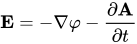
We commonly have E and B defined as:
e99910141286a0c46ef245c0ffb0a07d0a830817

06e479269ae003ed92c057eecdcf35f2b060cf70


But how can I work in electric field E, instead of vector potential A?
 
Physics news on Phys.org
WeiJie said:
We commonly have E and B defined as:
e99910141286a0c46ef245c0ffb0a07d0a830817

06e479269ae003ed92c057eecdcf35f2b060cf70


But how can I work in electric field E, instead of vector potential A?

That's not Maxwell's Equations. That is the relationship between the potentials and ##\mathbf E## and ##\mathbf B##.

Maxwell's Equations are commonly written in terms of ##\mathbf E## and ##\mathbf B##:
$$\nabla \cdot \mathbf E = \frac \rho {\varepsilon_0} \\
\nabla \cdot \mathbf B = 0 \\
\nabla \times \mathbf E = - \frac {\partial \mathbf B} {\partial t} \\
\nabla \times \mathbf B = \mu_0 \mathbf J + \mu_0 \varepsilon_0 \frac {\partial \mathbf E} {\partial t}$$

Those can of course be rewritten in terms of the potentials by substitution. But the usual thing you find when you search for "Maxwell's Equations" is in terms of the fields.
 
  • Like
Likes   Reactions: vanhees71