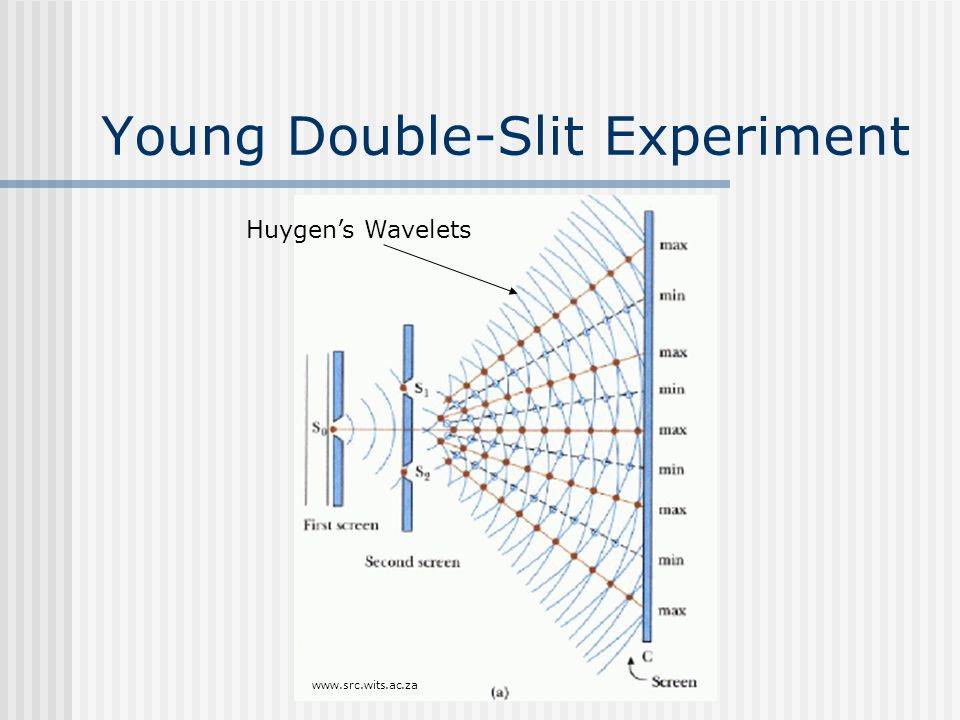
Young's double slit experiment -- Question about this wavefront diagram

Click For Summary
SUMMARY

The discussion centers on Young's double slit experiment and the interpretation of wavefront diagrams, specifically regarding the blue waves from sources S1 and S2. These waves are identified as wavefronts resulting from the interference of wavelets, as explained by Huygens' Principle. The conversation clarifies that while the diagram does not explicitly show wavelets, it represents the wavefronts of each slit, with each slit acting as a single source. The analysis emphasizes the importance of considering the finite width of slits in predicting the actual interference pattern.

PREREQUISITES
  • Understanding of Huygens' Principle in wave theory
  • Familiarity with Young's double slit experiment
  • Basic knowledge of wavefronts and interference patterns
  • Concept of diffraction and its mathematical representation
NEXT STEPS
  • Study Huygens' Principle in detail for wavefront analysis
  • Explore the mathematical modeling of interference patterns in Young's experiment
  • Investigate the effects of slit width on diffraction and interference
  • Learn about the integration techniques used in wave theory calculations
USEFUL FOR

Students of physics, educators teaching wave optics, and researchers interested in wave interference and diffraction phenomena.
Sebas4
Messages
13
Reaction score
2
TL;DR
Wavelets or resulting waves?
Hello, I have a question about the blue waves coming from sources S1 and S2 in de next picture.

zvFp8.jpg


The blue waves from sources S1 and S2, are those two resulting waves (interference of all wavelets, Huygens Principle) or are those blue waves two wavelets?
 
Last edited by a moderator:
Science news on Phys.org
I'm not sure what your question is. What's not clear from the diagram?
 
If this is high school (or elementary college ) physics...

The waves S1 and S2 are treated as two wavelets or two sources.

We use Huygens theory to explain why we get interference from a single source or single slit.

However, if fact, if you look closely at the double slit pattern, you will see that in fact, it's a double slit pattern superimposed on a single slit pattern, so in fact the two effects are present - each slit acting as a single slit according to Huygens, but then with interference between the two slits on top of that.
2iqI6bVKfLTvls8dG9Kf9dWE4bUZIGEqRNEEREHTKMbxki2Mwk.png
 
  • Like
Likes   Reactions: Leo Liu
The blue lines on the diagram are just the wavefronts of the waves from each slit. Sure, you can think of every point between the edges of the slit as an emitter of wavelets (as you can every point on an existing wavefront), and each wavefront results from the overlap of lots of individual wavelets. That's how Huygens explained diffraction anyway.

But no, that diagram doesn't show any wavelets explicitly. You don't need them to do any analysis :wink:
 
Last edited by a moderator:
  • Like
Likes   Reactions: Leo Liu
Huygens principle says that you can represent any wave front by an infinite number of secondary wavelets, placed along the front. That's the fundamental principle behind Diffraction theory; the wavelets are not 'real', they're just an aid to calculation - just like all calculations which involve integration. The basic Young's Interference from two slits treats each slit as just one wavelet. This is ok for predicting the positions of the peaks and troughs of the interference pattern near the boresight. But a slit of finite width will not have the isotropic pattern of a single wavelet so, if you want to predict the actual pattern, you need to take the pattern of a finite width slit. When the slits (or a number off slits) are identical, the overall pattern is the pattern of one slit multiplied by the interference pattern of the idealised point sources. See those images further up. Very wide slits send most of the light in the forward direction which swamps the visibility of the side peaks.

In practice, there's a compromise between having slits that are wide enough to get a bright pattern but not so wide that the brightness of the side fringes drops off so that you lose the pattern.
 
  • Like
Likes   Reactions: vanhees71 and etotheipi

Similar threads

  • · Replies 34 ·
2
Replies
34
Views
4K
  • · Replies 23 ·
Replies
23
Views
2K
  • · Replies 30 ·
2
Replies
30
Views
6K
  • · Replies 8 ·
Replies
8
Views
14K
  • · Replies 33 ·
2
Replies
33
Views
4K
  • · Replies 17 ·
Replies
17
Views
3K
  • · Replies 25 ·
Replies
25
Views
4K
  • · Replies 5 ·
Replies
5
Views
3K
  • · Replies 4 ·
Replies
4
Views
2K
  • · Replies 20 ·
Replies
20
Views
7K